
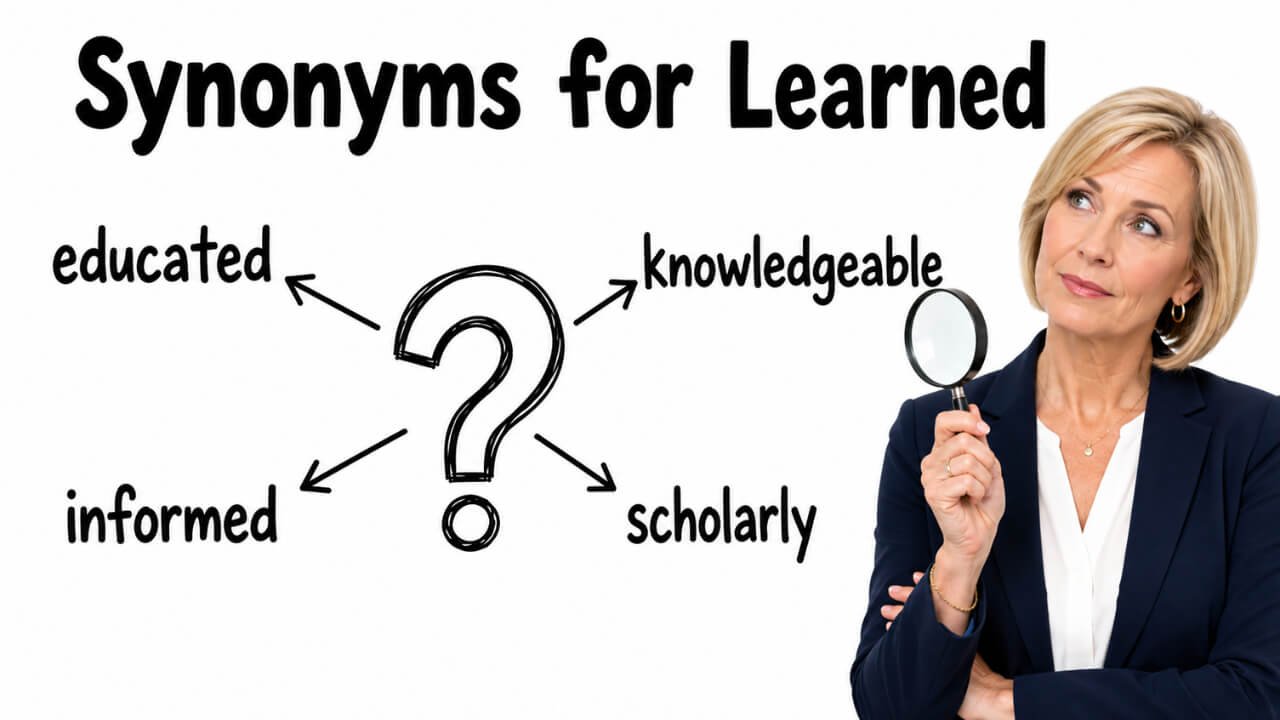
Quick Answer: Synonyms for learned include educated, knowledgeable, scholarly, informed, skilled, trained, experienced, erudite, cultured, and well read. The best synonym depends on context. Use educated for general knowledge, scholarly for academic writing, knowledgeable for practical understanding, skilled for ability gained through practice, trained for formal instruction, and erudite for a highly formal or intellectual tone.
Pronunciation and Word Details
Word: Learned
Pronunciation: ˈlɜːr nɪd or lɜːrnd
Part of Speech: Adjective and past tense verb
Meaning: Learned means having knowledge gained through study, experience, or instruction.
US Pronunciation:
UK Pronunciation:
What Does “Learned” Mean?
Learned means having gained knowledge, skill, or understanding through study, teaching, reading, or experience. It can work as an adjective or as the past tense of the verb learn.
As an adjective, learned often describes a person who is educated, scholarly, or highly knowledgeable. For example, a learned professor is someone with deep academic knowledge. As a verb form, learned means discovered, understood, or became aware of something. For example, “She learned the answer yesterday.”
The word can appear in formal writing, academic discussion, professional descriptions, and everyday speech.
Meaning, Tone, and Context of “Learned”
Learned is usually neutral to formal in tone. When pronounced as two syllables, it often sounds academic or literary, especially when describing a person, book, article, or discussion.
Formal Use: Learned is common in essays, research, legal writing, and professional descriptions.
Academic Use: It can describe scholars, experts, arguments, journals, and lectures.
Everyday Use: As the past tense of learn, it is common in normal speech, such as “I learned a new word.”
Positive Tone: Learned usually suggests intelligence, education, wisdom, or useful knowledge.
Context Note: Learned can mean educated, but it can also mean something was discovered or acquired.
When and How to Use “Learned”
For Education: Use learned when describing someone with strong knowledge or study experience.
Example: She is a learned historian with deep knowledge of ancient cultures.
For Discovery: Use learned when someone finds out new information.
Example: I learned that the meeting was moved to Friday.
For Skill Growth: Use learned when someone gains an ability through practice.
Example: He learned how to write clearer reports.
For Experience: Use learned when knowledge comes from real life.
Example: They learned many lessons from running a small business.
For Academic Tone: Use learned when you want a formal or scholarly feeling.
Example: The learned article explained the theory in detail.
Best Synonyms for Learned
Educated: Having received formal instruction or schooling.
Example: She is an educated speaker who explains ideas clearly.
Knowledgeable: Having much information or understanding about a subject.
Example: He is knowledgeable about grammar and vocabulary.
Scholarly: Related to serious study, research, or academic knowledge.
Example: Her scholarly work helped explain the old text.
Informed: Having useful or current knowledge about something.
Example: The manager made an informed decision after reading the report.
Skilled: Having ability gained through practice or training.
Example: He is skilled at solving technical problems.
Trained: Taught to do something through instruction or practice.
Example: The trained assistant handled the task efficiently.
Experienced: Having knowledge gained from doing something over time.
Example: An experienced writer understands tone and structure.
Erudite: Having deep, impressive, and formal knowledge.
Example: The erudite speaker discussed literature with confidence.
Cultured: Having refined knowledge of art, literature, manners, or society.
Example: She has a cultured understanding of music and history.
Well Read: Having gained much knowledge through reading.
Example: He is well read in philosophy and classic novels.
50 Synonyms for Learned with Short Meanings
- Educated: Having formal knowledge or schooling.
- Knowledgeable: Knowing a lot about a subject.
- Scholarly: Connected with serious study or research.
- Informed: Having useful facts or understanding.
- Skilled: Able because of practice or training.
- Trained: Taught for a task or role.
- Experienced: Knowledgeable through real practice.
- Erudite: Deeply and impressively knowledgeable.
- Cultured: Refined through education and exposure.
- Well Read: Knowledgeable because of much reading.
- Wise: Showing sound judgment and understanding.
- Intellectual: Related to serious thinking and knowledge.
- Academic: Connected with study or education.
- Studious: Serious about learning and study.
- Literate: Able to read and write well.
- Enlightened: Having advanced understanding or awareness.
- Accomplished: Highly skilled or successful.
- Qualified: Having the required knowledge or training.
- Professional: Trained and capable in a field.
- Expert: Having advanced knowledge or skill.
- Masterful: Showing great skill and control.
- Proficient: Competent and skilled at something.
- Competent: Able to do something well.
- Capable: Having the ability to perform well.
- Talented: Naturally or strongly skilled.
- Practiced: Improved through repeated use.
- Seasoned: Experienced and reliable over time.
- Veteran: Long experienced in a field.
- Adept: Highly skilled or quick in ability.
- Versed: Familiar with a subject or field.
- Conversant: Familiar enough to discuss something.
- Familiar: Knowing something through contact or study.
- Aware: Knowing that something exists or is true.
- Conscious: Mentally aware or informed.
- Taught: Given knowledge or instruction.
- Instructed: Educated or directed in a subject.
- Coached: Guided or trained by someone.
- Tutored: Taught privately or individually.
- Schooled: Educated or trained in a subject.
- Disciplined: Trained through practice and control.
- Polished: Refined in skill, manners, or style.
- Refined: Improved through learning or culture.
- Sophisticated: Showing advanced understanding or taste.
- Highbrow: Intellectual or culturally serious.
- Bookish: Interested in reading and study.
- Lettered: Educated, especially in literature.
- Sapient: Wise or showing deep understanding.
- Well Informed: Having strong and accurate knowledge.
- Well Educated: Having a strong educational background.
- Self Taught: Educated through personal effort.
Read Also:
Synonyms for Slow
Synonyms for Learned by Context
When Learned Means Educated
Use these synonyms when learned describes someone with formal education, schooling, or academic knowledge.
Educated: She is an educated leader with strong communication skills.
Scholarly: His scholarly approach made the lecture more useful.
Academic: The article uses an academic tone.
Well Educated: The candidate is well educated and professionally prepared.
When Learned Means Knowledgeable
Use these words when learned means someone knows a lot about a topic.
Knowledgeable: He is knowledgeable about word meanings.
Informed: She gave an informed opinion on the issue.
Well Informed: A well informed reader can understand the difference.
Versed: He is versed in grammar rules.
When Learned Means Skilled
Use these synonyms when learned means someone gained ability through practice.
Skilled: She is skilled in editing long articles.
Trained: The trained worker completed the task safely.
Proficient: He is proficient in academic writing.
Adept: She is adept at explaining difficult ideas.
When Learned Means Experienced
Use these words when learned knowledge comes from real life or repeated action.
Experienced: An experienced teacher understands student needs.
Seasoned: The seasoned editor noticed every small error.
Practiced: His practiced style made the speech smooth.
Veteran: A veteran journalist knows how to ask strong questions.
When Learned Means Discovered
Use these alternatives when learned is the past tense of learn and means found out.
Discovered: I discovered a better way to solve the problem.
Found Out: She found out the answer after reading the notes.
Realized: He realized the mistake after checking the sentence.
Understood: They understood the rule after seeing examples.
Another Word for Learned
Another word for learned is knowledgeable. It is one of the best general replacements because it works in formal, professional, and everyday writing. However, the best alternative depends on context. Use educated for schooling, skilled for ability, trained for instruction, and discovered when learned means found out.
Original: She is a learned teacher.
Better Option: She is a knowledgeable teacher.
Original: He learned the method quickly.
Better Option: He mastered the method quickly.
Original: I learned the news this morning.
Better Option: I discovered the news this morning.
Original: The learned scholar explained the text.
Better Option: The erudite scholar explained the text.
When Not to Use “Learned”
Do not use learned when a clearer synonym gives a more specific meaning. Learned can sound too formal when describing a person in casual speech. It can also be unclear because it may mean educated, discovered, trained, or became aware.
Weak: He is learned in computers.
Better: He is skilled in computer repair.
Weak: I learned the report yesterday.
Better: I read the report yesterday.
Weak: She is very learned about cooking.
Better: She is knowledgeable about cooking.
Weak: The worker learned for the machine.
Better: The worker was trained to use the machine.
Words Commonly Confused With Learned
Learned vs Educated: Learned can mean deeply knowledgeable, while educated usually means someone received formal schooling.
Learned vs Knowledgeable: Learned often sounds more formal or academic. Knowledgeable is more common and natural in everyday writing.
Learned vs Skilled: Learned refers to knowledge, while skilled refers to ability or performance.
Learned vs Trained: Learned can happen through study, reading, or experience. Trained usually means someone received guided instruction.
Learned vs Informed: Learned suggests broad knowledge or study. Informed means having useful facts about a specific matter.
Learned vs Erudite: Learned is formal, but erudite is even stronger and suggests impressive intellectual depth.
Learned vs Experienced: Learned may come from study, while experienced comes from doing something repeatedly.
Which Synonym Should You Choose?
Choose educated when writing about formal schooling, qualifications, or general learning.
Choose knowledgeable when describing someone who understands a topic well.
Choose scholarly when writing about research, essays, academic work, or serious study.
Choose informed when talking about decisions, opinions, reports, or awareness.
Choose skilled when the focus is practical ability.
Choose trained when someone learned through instruction, coaching, or a program.
Choose experienced when knowledge comes from real work or life situations.
Choose erudite when you want a formal, intellectual, and impressive tone.
Choose discovered when learned means found out new information.
Choose mastered when someone learned something completely and can use it well.
Real Life Examples of “Learned” in Sentences
Original: She is a learned writer.
Better Option: She is a knowledgeable writer.
Original: He learned the software in two weeks.
Better Option: He mastered the software in two weeks.
Original: I learned the truth after the meeting.
Better Option: I discovered the truth after the meeting.
Original: The learned professor answered every question.
Better Option: The erudite professor answered every question.
Original: They learned useful lessons from the project.
Better Option: They gained useful lessons from the project.
Original: She learned how to manage difficult clients.
Better Option: She became skilled at managing difficult clients.
Original: We learned about the new policy today.
Better Option: We were informed about the new policy today.
Original: He is learned in history.
Better Option: He is well read in history.
Original: The team learned better methods over time.
Better Option: The team developed better methods over time.
Original: I learned that the deadline changed.
Better Option: I found out that the deadline changed.
Synonym Groups and Usage Differences
Education Group
This group includes educated, schooled, academic, literate, and well educated. Use these words when learning is connected to formal education or study.
Example: She is a well educated professional with strong writing skills.
Knowledge Group
This group includes knowledgeable, informed, well informed, aware, and versed. Use these words when someone has useful understanding of a subject.
Example: He is well informed about grammar rules and word choice.
Skill Group
This group includes skilled, trained, proficient, adept, and capable. Use these when learning becomes practical ability.
Example: She is proficient in editing and proofreading.
Experience Group
This group includes experienced, seasoned, practiced, and veteran. Use these when knowledge comes from repeated work or life situations.
Example: A seasoned manager knows how to handle pressure.
Intellectual Group
This group includes scholarly, erudite, intellectual, cultured, and lettered. Use these for formal, academic, or refined knowledge.
Example: The erudite speaker explained the complex topic clearly.
Antonyms of Learned
Uneducated: Lacking formal education or schooling.
Ignorant: Lacking knowledge or awareness about something.
Uninformed: Not having the necessary facts or information.
Untrained: Not taught or prepared for a task.
Inexperienced: Lacking practice or real life knowledge.
Unskilled: Lacking practical ability.
Illiterate: Unable to read or write well.
Unaware: Not knowing something.
Naive: Lacking experience or practical understanding.
Untaught: Not instructed or educated.
Comparison: Learned vs Related Words
Learned vs Educated
Learned can suggest deep knowledge gained through study, reading, or experience. Educated usually focuses on formal schooling.
Example With Learned: The learned judge understood the legal history.
Example With Educated: The educated applicant had a strong academic background.
Learned vs Knowledgeable
Learned sounds more formal and academic. Knowledgeable is more flexible and common.
Example With Learned: A learned scholar reviewed the manuscript.
Example With Knowledgeable: A knowledgeable guide explained the city’s history.
Learned vs Scholarly
Learned describes a knowledgeable person. Scholarly describes work, tone, behavior, or study related to academics.
Example With Learned: She is a learned researcher.
Example With Scholarly: She wrote a scholarly article.
Learned vs Skilled
Learned focuses on knowledge. Skilled focuses on ability.
Example With Learned: He is learned in language theory.
Example With Skilled: He is skilled at teaching grammar.
Learned vs Trained
Learned can happen naturally, privately, or formally. Trained suggests instruction from a teacher, coach, or program.
Example With Learned: She learned the rule by reading examples.
Example With Trained: She was trained to use the editing software.
Learned vs Experienced
Learned can come from study or instruction. Experienced comes from doing something many times.
Example With Learned: The learned author explained the concept.
Example With Experienced: The experienced author knew how to engage readers.
Common Phrases and Expressions With Learned
Learned Person: A person with deep knowledge or education.
Learned Scholar: An academic expert with serious knowledge.
Learned Opinion: A view based on study, knowledge, or expertise.
Learned Behavior: Behavior gained through experience or teaching.
Learned Skill: An ability developed through practice.
Lessons Learned: Knowledge gained from experience or mistakes.
Newly Learned: Recently understood or acquired.
Learned Response: A reaction developed through experience.
Learned Habit: A habit formed through repetition.
Well Learned: Fully understood or mastered.
Common Mistakes to Avoid
One common mistake is using learned when a more specific word would be clearer. If you mean someone has formal education, educated may be better. If you mean ability, use skilled or trained. If you mean someone found out information, use discovered, realized, or found out.
Another mistake is overusing learned in the same paragraph. Repetition can make writing sound dull. Also, avoid using learned in a way that sounds unnatural, such as “learned in cooking” when “knowledgeable about cooking” or “skilled at cooking” would be smoother.
Conclusion
Understanding synonyms for learned helps you choose clearer and more natural words for different situations. Use educated for schooling, knowledgeable for subject understanding, scholarly for academic writing, skilled for ability, trained for instruction, experienced for practice, and erudite for a formal intellectual tone. When learned means found out, words like discovered, realized, and understood may work better. The best synonym always depends on whether you are describing knowledge, education, skill, experience, or discovery.
FAQs About Synonyms for Learned
What are the best synonyms for learned?
The best synonyms for learned are educated, knowledgeable, scholarly, informed, skilled, trained, experienced, erudite, cultured, and well read.
What is another word for learned person?
Another word for a learned person is scholar. You can also use knowledgeable person, educated person, expert, intellectual, or erudite person.
Is learned a formal word?
Learned can be formal, especially when it describes a person with deep knowledge. As the past tense of learn, it is common in everyday speech.
What is the difference between learned and educated?
Learned suggests knowledge gained through study, reading, or experience. Educated usually means someone has received formal schooling or instruction.
Can skilled be a synonym for learned?
Yes, skilled can be a synonym when learned means able to do something through practice. For knowledge alone, knowledgeable or educated is usually better.
What is a simple synonym for learned?
A simple synonym for learned is knowledgeable. It is natural, clear, and useful in many contexts.
What is the opposite of learned?
The opposite of learned can be uneducated, ignorant, uninformed, untrained, inexperienced, or unskilled, depending on the meaning.
