
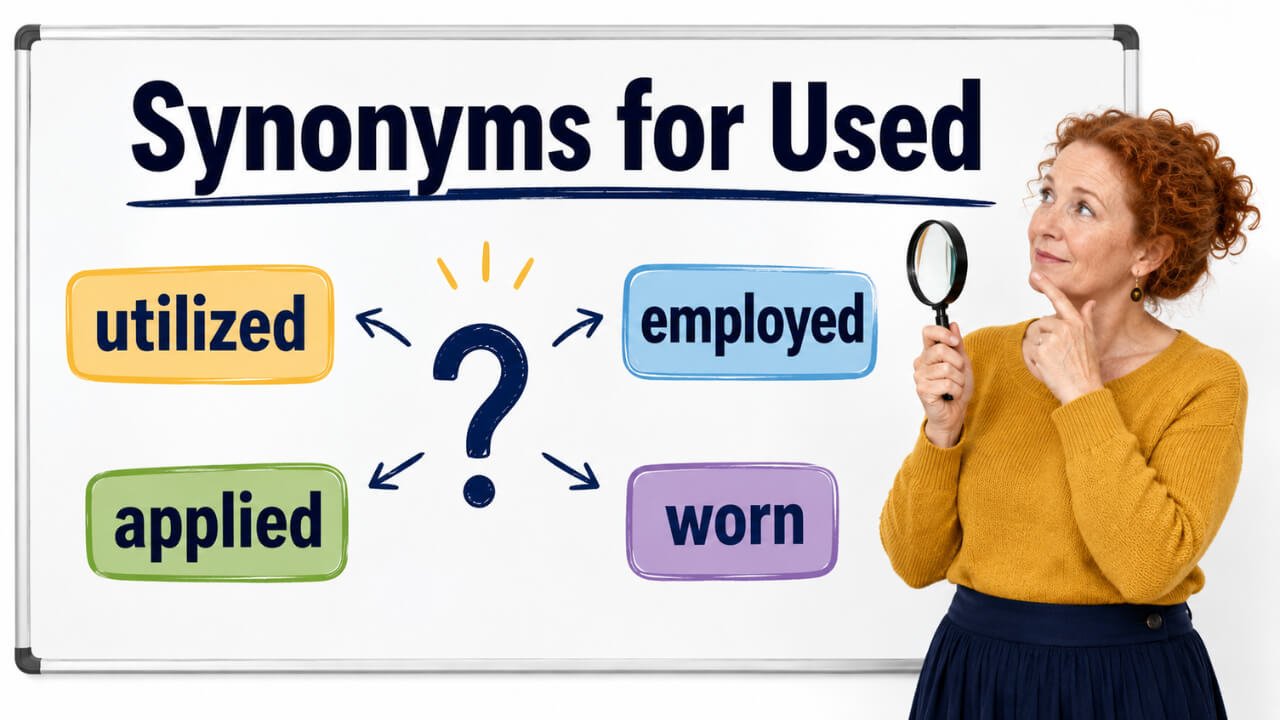
Quick Answer: Synonyms for used include employed, utilized, applied, operated, handled, consumed, spent, secondhand, worn, and accustomed. Use utilized for formal writing, employed for professional or academic style, applied for rules or methods, operated for machines, consumed for resources, secondhand for items, and accustomed when used means familiar with something.
Pronunciation and Word Details
Word: Used
Pronunciation: /juːzd/
Part of Speech: Adjective and verb
Meaning: Used means already applied, taken, consumed, owned before, or familiar through experience.
US Pronunciation:
UK Pronunciation:
What Does “Used” Mean?
Used means something has been taken, applied, operated, consumed, or owned before. It can also mean familiar with something because of repeated experience.
As a verb form, used shows that someone made something serve a purpose. For example, “She used a pen” means she wrote or worked with a pen. As an adjective, used describes something that is not new, such as a used car, used book, or used phone. In the phrase “used to,” it can describe habit or familiarity, as in “I am used to early mornings.”
Meaning, Tone, and Context of “Used”
Used is a common and neutral word. It works well in everyday conversation, school writing, workplace writing, product descriptions, grammar explanations, and general communication. It is simple, clear, and easy to understand.
The tone changes with context. In “used tools,” it is neutral. In “used his skills,” it sounds practical. In “used furniture,” it means previously owned. In “felt used,” it becomes negative and emotional because it suggests exploitation. In formal writing, words like utilized, employed, and applied can sound more precise, but they should not replace used when simple wording is better.
When and How to Use “Used”
For Practical Action: Use used when someone takes something and makes it serve a purpose.
Example: She used a notebook to plan her ideas.
For Methods and Skills: Use used when describing a method, rule, skill, or technique in action.
Example: The teacher used examples to explain the lesson.
For Machines and Tools: Use used when someone works with a tool, device, machine, or system.
Example: He used the printer to make copies.
For Resources: Use used when time, money, energy, fuel, or material is taken for a purpose.
Example: The project used most of the budget.
For Items Not New: Use used when describing something previously owned or handled.
Example: They bought a used table for the kitchen.
For Familiarity: Use used in “used to” when someone is familiar with a routine, place, habit, or condition.
Example: I am used to working late.
For Negative Treatment: Use used when someone feels exploited or taken advantage of.
Example: She felt used after doing all the work alone.
Best Synonyms for Used
Employed: Put something into service for a specific purpose.
Example: The writer employed a calm tone in the article.
Utilized: Used something effectively or practically, often in formal writing.
Example: The team utilized the available resources wisely.
Applied: Used a rule, method, skill, or idea in a real situation.
Example: She applied the grammar rule correctly.
Operated: Used or controlled a machine, system, vehicle, or device.
Example: The technician operated the equipment safely.
Handled: Used or managed something with care or skill.
Example: He handled the tools with confidence.
Consumed: Used up food, fuel, time, energy, or supplies.
Example: The engine consumed too much fuel.
Spent: Used money, time, or effort.
Example: They spent three hours preparing the report.
Secondhand: Previously owned or used by another person.
Example: She bought a secondhand laptop for school.
Worn: Used for a long time and showing age or damage.
Example: His worn shoes needed to be replaced.
Accustomed: Familiar with something through habit or experience.
Example: He is accustomed to speaking in public.
50 Synonyms for Used with Short Meanings
- Employed: Put into service for a purpose.
- Utilized: Used effectively or practically.
- Applied: Put a skill, rule, or method into practice.
- Operated: Controlled or worked with a machine or system.
- Handled: Used or managed with care.
- Worked: Used a tool, device, or method.
- Practiced: Used a skill or method repeatedly.
- Implemented: Put a plan, system, or method into action.
- Exercised: Used a right, power, ability, or choice.
- Adopted: Started using a method, style, or practice.
- Deployed: Put something into practical service.
- Activated: Made something start working.
- Engaged: Used or involved something actively.
- Accessed: Used information, a system, or a resource.
- Consulted: Used a source for advice or information.
- Referenced: Used a source, fact, or example.
- Cited: Used a source as support.
- Quoted: Used someone’s exact words.
- Drew On: Used knowledge, experience, or resources.
- Relied On: Used someone or something for help or support.
- Turned To: Used as a solution, source, or support.
- Made Use Of: Used something available.
- Put To Use: Made something serve a purpose.
- Took Advantage Of: Used an opportunity or resource.
- Leveraged: Used something strategically for benefit.
- Harnessed: Used power, energy, or ability effectively.
- Consumed: Used up food, fuel, time, or resources.
- Spent: Used money, time, or effort.
- Expended: Used energy, effort, or resources.
- Exhausted: Used something completely.
- Depleted: Reduced by using up.
- Drained: Used up energy, money, or supply.
- Wasted: Used carelessly or without value.
- Squandered: Used something valuable foolishly.
- Exploited: Used unfairly for personal gain.
- Manipulated: Used someone or something in a controlling way.
- Abused: Used wrongly or harmfully.
- Secondhand: Previously owned or used.
- Preowned: Owned or used before.
- Previously Owned: Belonging to someone before.
- Not New: Already owned or used.
- Worn: Used enough to show age or damage.
- Worn Out: Used until weak, damaged, or tired.
- Old: No longer new.
- Familiar: Known through use or experience.
- Accustomed: Used to something through habit.
- Habituated: Made familiar through repeated experience.
- Adjusted: Comfortable with a new situation through experience.
- Comfortable With: Familiar and no longer uncomfortable.
- Broken In: Made comfortable or usable through previous use.
Read Also:
Synonyms for Respect
Synonyms for Used by Context
When Used Means Utilized
Use these synonyms when used means something was put into practical service for a purpose.
Useful Synonyms: Employed, utilized, implemented, deployed, put to use, made use of.
Example: The team utilized new software to organize the data.
Example: The school implemented a better reading plan.
When Used Means Applied
Use these synonyms when used refers to a method, skill, rule, idea, or strategy.
Useful Synonyms: Applied, practiced, adopted, exercised, drew on, employed.
Example: She applied her research skills to solve the problem.
Example: The speaker drew on personal experience during the talk.
When Used Means Operated
Use these words when used means controlling or working with a machine, tool, device, vehicle, or system.
Useful Synonyms: Operated, handled, controlled, worked, managed.
Example: The worker operated the machine carefully.
Example: He handled the camera like a professional.
When Used Means Consumed
Use these words when used means time, money, energy, fuel, or resources were taken up.
Useful Synonyms: Consumed, spent, expended, exhausted, depleted, drained.
Example: The long meeting consumed the whole afternoon.
Example: The repairs depleted their savings.
When Used Means Secondhand
Use these synonyms when used describes an item that is not new.
Useful Synonyms: Secondhand, preowned, previously owned, worn, old, not new.
Example: He bought a secondhand bicycle.
Example: The shop sells preowned furniture.
When Used Means Accustomed
Use these words when used means familiar with something through repeated experience.
Useful Synonyms: Accustomed, familiar, habituated, adjusted, comfortable with.
Example: She is accustomed to waking up early.
Example: He became familiar with the new routine.
When Used Means Exploited
Use these synonyms when used means treated unfairly or taken advantage of.
Useful Synonyms: Exploited, manipulated, abused, taken advantage of.
Example: He felt exploited after doing extra work without credit.
Example: She realized her kindness had been taken advantage of.
Another Word for Used
Another word for used is utilized when the meaning is “put into practical use.” However, the best replacement depends on context. Use employed for a method or strategy, applied for a skill or rule, secondhand for an item, and accustomed for familiarity.
Original: The teacher used a simple method.
Better Option: The teacher applied a simple method.
Original: The team used all the available time.
Better Option: The team spent all the available time.
Original: She bought a used phone.
Better Option: She bought a secondhand phone.
Original: I am used to this schedule.
Better Option: I am accustomed to this schedule.
When Not to Use “Used”
Do not use used when the sentence needs a more exact word. Since used has several meanings, it can sometimes sound vague, repetitive, or too simple. In formal writing, utilized, employed, or applied may sound better. For products, secondhand or preowned is clearer. For resources, consumed or spent is more accurate.
Weak: The writer used many ideas in the article.
Better: The writer applied many ideas in the article.
Weak: He used the machine for the first time.
Better: He operated the machine for the first time.
Weak: We used all our money on repairs.
Better: We spent all our money on repairs.
Weak: I bought a used jacket that looks used.
Better: I bought a secondhand jacket that looks worn.
Words Commonly Confused With Used
Used vs Utilized: Used is simple and common, while utilized is more formal and often means something was used effectively.
Used vs Employed: Used is general, while employed sounds more professional and is often used for methods, strategies, words, or tools.
Used vs Applied: Used can refer to many things, while applied is best for skills, rules, techniques, methods, and ideas.
Used vs Operated: Used is broad, while operated is specific to machines, devices, vehicles, systems, or equipment.
Used vs Consumed: Used can mean taken for a purpose, while consumed means used up, often for food, fuel, time, energy, or supplies.
Used vs Spent: Used is general, while spent is best for money, time, effort, or energy.
Used vs Secondhand: Used can describe an action or an item, while secondhand describes something previously owned.
Used vs Accustomed: Used can mean utilized or not new, while accustomed means familiar through experience or habit.
Used vs Exploited: Used is often neutral, while exploited means used unfairly or selfishly.
Which Synonym Should You Choose?
Choose utilized when writing formally about tools, systems, materials, or resources.
Choose employed when describing a strategy, method, tone, phrase, or technique in professional writing.
Choose applied when writing about skills, knowledge, rules, methods, or ideas in action.
Choose operated when the sentence involves machines, tools, vehicles, devices, or systems.
Choose handled when the focus is careful control or skillful management.
Choose consumed when talking about fuel, food, water, time, energy, or supplies.
Choose spent when writing about money, time, effort, or energy.
Choose secondhand when describing an item that was owned or used before.
Choose worn when an item shows signs of age, damage, or long use.
Choose accustomed when used means familiar with a routine, condition, place, or situation.
Choose exploited when used means treated unfairly for someone else’s benefit.
Real Life Examples of “Used” in Sentences
Original: She used a dictionary to check the word.
Better Option: She consulted a dictionary to check the word.
Original: The writer used a formal tone.
Better Option: The writer employed a formal tone.
Original: He used his experience to solve the issue.
Better Option: He drew on his experience to solve the issue.
Original: The worker used the machine all day.
Better Option: The worker operated the machine all day.
Original: The trip used a lot of fuel.
Better Option: The trip consumed a lot of fuel.
Original: They used all their savings.
Better Option: They spent all their savings.
Original: She bought a used chair.
Better Option: She bought a secondhand chair.
Original: I am used to this weather.
Better Option: I am accustomed to this weather.
Original: He felt used by his friends.
Better Option: He felt exploited by his friends.
Original: The teacher used a helpful example.
Better Option: The teacher applied a helpful example.
Synonym Groups and Usage Differences
Practical Use Group
This group includes synonyms that mean something was put into service for a goal. These words are useful in formal, academic, business, and technical writing.
Words: Used, utilized, employed, implemented, deployed.
Example: The company implemented a new system for customer support.
Method and Skill Group
This group works when used means a rule, skill, method, or idea was put into practice.
Words: Applied, practiced, adopted, exercised, drew on.
Example: She applied her training during the emergency.
Machine and Tool Group
This group is best for equipment, tools, vehicles, devices, and systems.
Words: Operated, handled, controlled, worked, managed.
Example: The technician operated the device safely.
Resource Group
This group focuses on things that are taken up or finished, such as time, money, energy, fuel, or supplies.
Words: Consumed, spent, expended, exhausted, depleted.
Example: The project consumed more time than expected.
Product Condition Group
This group describes items that are not new or show signs of previous ownership.
Words: Secondhand, preowned, previously owned, worn, old.
Example: They found a preowned desk in excellent condition.
Familiarity Group
This group describes habits, routines, places, situations, weather, or repeated experiences.
Words: Accustomed, familiar, habituated, adjusted, comfortable with.
Example: He became accustomed to the busy schedule.
Negative Treatment Group
This group describes unfair use, control, or selfish treatment.
Words: Exploited, manipulated, abused, taken advantage of.
Example: She felt manipulated after agreeing to help again.
Antonyms of Used
Unused: Not used or not put into service.
New: Not owned, handled, or used before.
Fresh: Recently made or not previously used.
Untouched: Not handled, changed, or used.
Unopened: Still sealed or not accessed.
Available: Not yet taken, spent, or consumed.
Saved: Kept for later instead of used.
Preserved: Protected from use, damage, or loss.
Unspent: Not used, especially money, time, effort, or energy.
Unfamiliar: Not known through experience.
Unaccustomed: Not used to something.
Protected: Kept safe from harmful use or exploitation.
Comparison: Used vs Related Words
Used vs Utilized
Used is simple and natural. Utilized is more formal and suggests practical or effective use.
Example With Used: We used the available tools.
Example With Utilized: We utilized the available tools to finish the task efficiently.
Used vs Employed
Used is broad and common. Employed is more polished and often describes methods, strategies, styles, words, or techniques.
Example With Used: The writer used a calm tone.
Example With Employed: The writer employed a calm tone.
Used vs Applied
Used can refer to almost anything. Applied is best when a rule, skill, method, or idea is put into practice.
Example With Used: She used the grammar rule in her sentence.
Example With Applied: She applied the grammar rule in her sentence.
Used vs Operated
Used is general. Operated is specific to machines, tools, vehicles, devices, or systems.
Example With Used: He used the printer.
Example With Operated: He operated the printer.
Used vs Consumed
Used can mean taken for a purpose. Consumed means used up, especially for fuel, food, water, energy, time, or supplies.
Example With Used: The car used too much fuel.
Example With Consumed: The car consumed too much fuel.
Used vs Secondhand
Used can describe either an action or an item. Secondhand describes an item that was previously owned.
Example With Used: She used the phone yesterday.
Example With Secondhand: She bought a secondhand phone yesterday.
Used vs Accustomed
Used can mean applied, consumed, or not new. Accustomed means familiar with something through repeated experience.
Example With Used: I used this software before.
Example With Accustomed: I am accustomed to this software.
Common Phrases and Expressions With Used
Used To: Familiar with something through experience or habit.
Used For: Having a particular purpose or function.
Used By: Handled, owned, operated, or applied by someone.
Used Up: Completely consumed or finished.
Well Used: Used often and still useful or meaningful.
Gently Used: Previously used but still in good condition.
Used Car: A car that had a previous owner.
Used Item: A product that is not new.
Used as an Example: Included to explain or support an idea.
Felt Used: Felt exploited or treated unfairly.
Common Mistakes to Avoid
A common mistake is repeating used too often when a more specific synonym would improve the sentence. Use applied for methods and rules, operated for machines, consumed for resources, spent for money or time, and secondhand for items.
Another mistake is using utilized only to sound formal. In many simple sentences, used is clearer and more natural. Writers also confuse used to with use to. Use used to for familiarity or past habits. Always choose the synonym that matches the exact meaning, not only the tone.
Conclusion
Synonyms for used help you write more clearly because used has many meanings. Choose utilized or employed for formal writing, applied for methods and skills, operated for machines, consumed or spent for resources, secondhand for items, and accustomed for familiarity. When used means unfair treatment, exploited or manipulated is more accurate. The best synonym depends on whether you mean practical use, previous ownership, habit, resource use, or negative treatment.
FAQs About Synonyms for Used
What are the best synonyms for used?
The best synonyms for used are employed, utilized, applied, operated, handled, consumed, spent, secondhand, worn, and accustomed.
What is another word for used in formal writing?
Utilized and employed are good formal alternatives. Use utilized for resources or tools and employed for methods, strategies, or techniques.
What is another word for used items?
Secondhand, preowned, previously owned, and not new are useful alternatives for used items.
What is a better word than used for skills?
Applied is usually better for skills. For example, “She applied her writing skills” is clearer than “She used her writing skills.”
What is another word for used up?
Consumed, spent, exhausted, depleted, and drained can mean used up, depending on the resource.
What does used to mean?
Used to can mean familiar with something, as in “I am used to this routine.” It can also describe a past habit, as in “I used to walk to school.”
Is utilized always better than used?
No. Utilized is more formal, but used is often simpler and more natural. Use utilized only when the sentence needs a formal or technical tone.
