
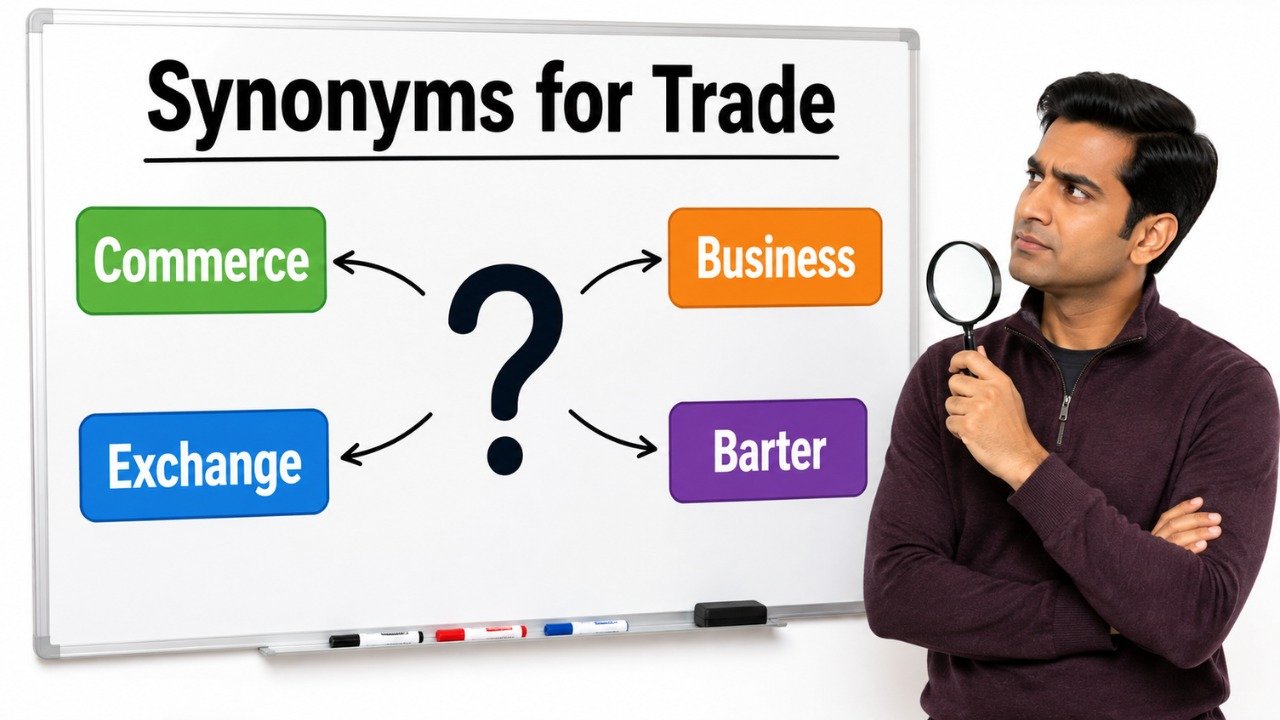
Quick Answer: The best synonyms for trade include commerce, exchange, business, transaction, barter, dealing, profession, occupation, craft, and swap. Use commerce for formal discussion of buying and selling, exchange when goods or services move between people, business for commercial activity, transaction for a specific deal, barter when items are exchanged without money, profession or occupation for a type of work, craft for a skilled trade, and swap in casual conversation when one thing is exchanged for another.
Pronunciation and Word Details
Word: Trade
Pronunciation: /treɪd/
Part of Speech: Noun and verb
Meaning: Trade means the activity of buying, selling, or exchanging goods and services, and it can also describe a skilled occupation or the act of exchanging one thing for another.
US Pronunciation:
UK Pronunciation:
What Does “Trade” Mean?
Trade means buying, selling, exchanging, or carrying out commercial activity between people, organizations, or regions.
As a noun, trade can describe commerce in general, a particular exchange, a skilled occupation, or an area of business. Someone may talk about international trade, the building trades, a trade agreement, or learning a trade.
As a verb, trade means to exchange one thing for another or to buy and sell goods or services. For example, two people may trade books, or businesses may trade products across different markets.
The meaning of trade changes according to context. In economic writing, it usually refers to commerce. In everyday conversation, it may mean swapping something. In career discussions, a trade often means a practical or skilled occupation.
Meaning, Tone, and Context of “Trade”
Trade is generally a neutral word. It can sound formal, professional, technical, or conversational depending on how it is used.
In economics and business, trade has a formal and technical meaning connected with commerce, markets, imports, exports, buying, and selling.
In everyday speech, trade can be casual. Someone might say they want to trade seats, trade books, or trade one item for another.
In career contexts, a trade refers to a skilled occupation that usually requires practical training and specialized ability. In this meaning, profession, occupation, craft, and vocation may sometimes work as alternatives.
The word can also describe a particular area of commercial activity, such as the clothing trade, construction trade, or publishing trade.
Because trade has several meanings, choosing the correct synonym depends strongly on the sentence.
When and How to Use “Trade”
For Commerce: Use trade when discussing the buying and selling of goods or services.
Example: International trade plays an important role in many economies.
For Exchange: Use trade when one person gives something and receives something else in return.
Example: The children agreed to trade books after class.
For Business Activity: Trade can describe commercial dealings within a particular industry.
Example: The company has been active in the regional trade for many years.
For Skilled Work: Use trade when referring to a practical occupation that requires specialized training.
Example: He decided to learn a trade after completing school.
For Transactions: Trade can describe a particular commercial exchange or deal.
Example: The two parties completed the trade successfully.
For Bartering: Trade can refer to exchanging goods or services without money.
Example: The neighbors sometimes trade fresh produce for household repairs.
For Casual Swapping: Trade works naturally when people exchange personal items.
Example: Would you like to trade seats with me?
For Markets: Trade can describe the buying and selling of financial or commercial assets.
Example: The market experienced heavy trade during the morning.
Best Synonyms for Trade
Commerce: The buying and selling of goods and services, especially on a large or formal scale.
Example: The city became an important center of commerce.
Exchange: The act of giving one thing and receiving another.
Example: The exchange of goods benefited both communities.
Business: Commercial activity involving the production, buying, or selling of goods and services.
Example: The region depends heavily on agricultural business.
Transaction: A specific act of buying, selling, or exchanging something.
Example: The transaction was completed before the end of the day.
Barter: The exchange of goods or services without using money.
Example: The farmers used barter to exchange produce for tools.
Dealing: Commercial activity involving buying, selling, or negotiation.
Example: His business involves dealing in antique furniture.
Profession: A type of work requiring knowledge, training, or skill.
Example: She entered a profession that matched her practical abilities.
Occupation: A person’s regular job or type of employment.
Example: Carpentry became his main occupation.
Craft: Skilled practical work requiring training and experience.
Example: She spent years mastering her craft.
Swap: A casual exchange of one thing for another.
Example: They arranged a quick swap of their seats.
50 Synonyms for Trade with Short Meanings
- Commerce: The buying and selling of goods or services.
- Exchange: Giving one thing and receiving another.
- Business: Commercial activity involving goods or services.
- Transaction: A specific commercial exchange or deal.
- Barter: Exchange conducted without money.
- Dealing: Commercial buying, selling, or negotiation.
- Profession: A regular field of skilled work.
- Occupation: A person’s usual job or employment.
- Craft: Skilled practical work or occupation.
- Swap: An informal exchange of one thing for another.
- Trading: The activity of buying, selling, or exchanging.
- Commerce Activity: Organized buying and selling.
- Commercial Activity: Business involving goods or services.
- Buying and Selling: The basic activity involved in commerce.
- Merchandising: Promoting and selling goods commercially.
- Marketing: Activities involved in bringing goods to buyers.
- Retailing: Selling goods directly to customers.
- Wholesaling: Selling goods in large quantities.
- Traffic: Commercial movement of goods or business.
- Dealings: Business relationships or commercial transactions.
- Negotiation: Discussion intended to reach an exchange or agreement.
- Bargaining: Negotiating terms, prices, or conditions.
- Interchange: Mutual exchange between people or groups.
- Transfer: Movement of something from one owner or place to another.
- Swapping: Exchanging one thing for another.
- Replacement: Giving up one thing for another.
- Substitution: Putting one thing in place of another.
- Deal: An agreement involving buying, selling, or exchange.
- Sale: Transfer of goods or services for money.
- Purchase: The act of buying something.
- Commercial Deal: A business agreement involving value.
- Market Activity: Buying and selling within a market.
- Enterprise: Organized commercial activity or business.
- Industry: A field of commercial or productive activity.
- Line of Work: A particular kind of occupation.
- Career: A long term area of work or employment.
- Vocation: Work suited to a person’s skills or interests.
- Calling: Work a person feels strongly suited to perform.
- Employment: Paid work or occupation.
- Job: Regular work performed for payment.
- Livelihood: Work that provides income.
- Skilled Work: Employment requiring specialized practical ability.
- Handicraft: Skilled work carried out mainly by hand.
- Specialty: A particular area of professional skill.
- Field: A particular area of work or activity.
- Practice: Regular professional or skilled activity.
- Industry Activity: Work connected with a particular commercial sector.
- Commercial Exchange: The transfer of goods, services, or value.
- Reciprocal Exchange: A mutual giving and receiving arrangement.
- Trading Activity: Organized buying, selling, or exchanging.
Read Also:
Synonyms for Sat
Synonyms for Trade by Context
When Trade Means Commerce
When trade refers broadly to buying and selling, commerce is usually the strongest synonym.
Commerce often sounds slightly more formal and is especially useful in economic, academic, and professional writing.
Other useful alternatives include business, commercial activity, trading, merchandising, and market activity.
Example: The region developed rapidly because of increased commerce.
Example: Cross border business created new opportunities for local producers.
When Trade Means Exchange
When trade means giving one thing in return for another, exchange is usually the most natural replacement.
Swap is more conversational, while interchange sounds more formal.
Example: They agreed to exchange books at the end of the week.
Example: The students arranged a swap of their assigned seats.
When Trade Means Barter
Barter is the best choice when money is not used.
In a barter arrangement, goods or services are directly exchanged for other goods or services.
Example: The two families used barter to exchange vegetables for repair work.
Example: The craftspeople exchanged their products directly rather than using money.
When Trade Means a Skilled Occupation
When trade describes a type of skilled work, profession, occupation, craft, vocation, and line of work can be suitable alternatives.
Craft is particularly useful when practical skill is important.
Example: Carpentry became his chosen occupation.
Example: She spent years learning the craft from experienced workers.
When Trade Means a Business Deal
Transaction is useful when trade refers to one specific commercial exchange.
Deal is more conversational, while commercial transaction sounds more formal.
Example: The transaction involved several valuable items.
Example: Both sides considered the deal successful.
When Trade Means to Swap Something
As a verb, trade can often be replaced by exchange, swap, transfer, or substitute.
Example: He exchanged his old equipment for a newer model.
Example: They decided to swap places before the meeting began.
Another Word for Trade
The best general replacement for trade is exchange when the sentence describes giving, receiving, or swapping something. When trade refers to large scale buying and selling, commerce is usually more accurate.
The correct alternative depends on meaning. Use transaction for a specific deal, barter when no money is involved, craft for skilled work, and swap for an informal exchange.
Original: The two communities increased trade during the summer.
Better Option: The two communities increased commerce during the summer.
Original: I agreed to trade my book for hers.
Better Option: I agreed to exchange my book for hers.
Original: He learned a trade after leaving school.
Better Option: He learned a skilled occupation after leaving school.
Original: They decided to trade seats.
Better Option: They decided to swap seats.
When Not to Use “Trade”
Trade can become unclear when the sentence does not show whether it means commerce, exchange, employment, or a specific transaction.
Choose a more precise synonym when clarity matters.
Weak: The report discusses trade.
Better: The report discusses international commerce.
The original sentence is too broad because trade could refer to many different activities.
Avoid trade when you specifically mean a profession and the commercial meaning could confuse readers.
Weak: Teaching became her trade.
Better: Teaching became her profession.
Avoid trade when barter is the precise meaning.
Weak: The villagers traded goods without money.
Better: The villagers bartered goods without money.
Avoid trade when discussing a single formal commercial agreement if transaction would be clearer.
Weak: The trade was recorded in the financial report.
Better: The transaction was recorded in the financial report.
Avoid repeating trade too many times in economic writing.
Weak: Trade increased because trade agreements encouraged more trade.
Better: Commerce increased because new agreements encouraged greater trading activity.
Words Commonly Confused With Trade
Trade vs Commerce: Trade and commerce both involve buying and selling. Commerce usually refers more broadly to organized commercial activity, while trade can also mean exchange, a specific deal, or skilled work.
Trade vs Business: Business can refer to an organization, commercial activity, or professional affairs. Trade is more closely connected with buying, selling, exchanging, or a specific occupational field.
Trade vs Exchange: Exchange focuses on giving one thing and receiving another. Trade may involve exchange, but it can also describe broader commercial activity.
Trade vs Barter: Barter specifically means exchanging goods or services without money. Trade can involve money or direct exchange.
Trade vs Transaction: Transaction usually refers to one specific completed commercial action. Trade can describe either a single exchange or an entire system of commercial activity.
Trade vs Profession: Profession describes a type of work or career. Trade can also mean an occupation, but it often refers more specifically to practical or skilled work.
Trade vs Craft: Craft emphasizes practical skill and skilled creation. Trade can refer to the occupation itself rather than only the skill involved.
Trade vs Swap: Swap is informal and normally describes exchanging one thing for another. Trade can sound more neutral and has several broader meanings.
Which Synonym Should You Choose?
Choose commerce when writing formally about large scale buying and selling, markets, imports, exports, or economic activity.
Choose exchange when describing the act of giving one thing and receiving another.
Choose business when discussing general commercial activity or an area of economic work.
Choose transaction when referring to one particular purchase, sale, or commercial exchange.
Choose barter when goods or services are exchanged without money.
Choose dealing when emphasizing repeated buying, selling, or commercial negotiation.
Choose profession when trade refers to a person’s career or field of work.
Choose occupation when you need a neutral word for someone’s regular employment.
Choose craft when practical skill, training, or workmanship is important.
Choose swap in casual speech when two people simply exchange items or positions.
In academic essays and reports, commerce, exchange, transaction, and commercial activity are usually more precise.
In professional emails, transaction, exchange, business, and commerce can work depending on the subject.
In casual conversation, swap, deal, exchange, and business usually sound natural.
Real Life Examples of “Trade” in Sentences
Original: Trade between the two regions increased significantly.
Better Option: Commerce between the two regions increased significantly.
Original: They agreed to trade their books.
Better Option: They agreed to exchange their books.
Original: He learned a trade from an experienced worker.
Better Option: He learned a craft from an experienced worker.
Original: The trade was completed in the afternoon.
Better Option: The transaction was completed in the afternoon.
Original: The families used trade instead of money.
Better Option: The families used barter instead of money.
Original: She works in the clothing trade.
Better Option: She works in the clothing industry.
Original: They decided to trade seats before the event began.
Better Option: They decided to swap seats before the event began.
Original: The country depends heavily on overseas trade.
Better Option: The country depends heavily on overseas commerce.
Original: The two businesses completed a valuable trade.
Better Option: The two businesses completed a valuable deal.
Original: Carpentry became his main trade.
Better Option: Carpentry became his main occupation.
Synonym Groups and Usage Differences
Commerce Group
Commerce, business, trading, merchandising, retailing, wholesaling, and commercial activity belong to the commerce group.
These words describe organized buying and selling.
Commerce is broad and formal, while retailing specifically refers to selling directly to customers. Wholesaling involves selling in larger quantities.
Example: The town became a major center of commerce.
Exchange Group
Exchange, swap, interchange, transfer, and substitution describe replacing or giving one thing for another.
Exchange is the most flexible word. Swap is more casual, while interchange is more formal.
Example: The two students agreed to exchange their materials.
Transaction Group
Transaction, deal, sale, purchase, dealing, and commercial exchange focus on specific acts of business.
Transaction is neutral and precise. Deal is more conversational.
Example: The transaction was completed after both sides approved the terms.
Barter Group
Barter, exchange, bargaining, and reciprocal exchange can describe arrangements where value passes between participants.
Barter is the most precise term when no money is used.
Example: The farmers relied on barter to obtain tools and supplies.
Occupation Group
Profession, occupation, vocation, career, employment, line of work, and livelihood refer to work.
Trade fits this group when it means a skilled occupation.
Example: He chose electrical work as his occupation.
Craft Group
Craft, skilled work, handicraft, specialty, and practice emphasize knowledge or practical ability.
Craft is especially appropriate when mastery, workmanship, or training matters.
Example: She developed her craft through years of careful practice.
Antonyms of Trade
The opposite of trade depends on whether trade means exchange, commerce, or professional activity.
Retention: Keeping something rather than exchanging it.
Possession: Continuing to own something instead of trading it.
Keeping: Holding something rather than giving it in exchange.
Isolation: Lack of commercial or economic interaction.
Self Sufficiency: Meeting needs without relying on outside exchange.
Withdrawal: Moving away from commercial participation or exchange.
Inactivity: Lack of business or trading activity.
Noncommercial Activity: Activity that is not intended for buying or selling.
Unemployment: Lack of paid occupation or work.
Refusal: Rejection of an offered exchange or deal.
Comparison: Trade vs Related Words
Trade vs Commerce
Trade and commerce are closely related, but commerce is broader and often more formal. Trade can describe buying and selling, exchanging goods, a transaction, or a skilled occupation.
Example With Trade: Trade between the neighboring regions increased.
Example With Commerce: Commerce became a major source of regional growth.
Trade vs Exchange
Trade can describe commercial activity or the act of exchanging something. Exchange focuses more directly on giving one thing and receiving another.
Example With Trade: She agreed to trade her old desk for a smaller one.
Example With Exchange: She agreed to exchange her old desk for a smaller one.
Trade vs Business
Business is broader than trade. It can describe a company, commercial activities, responsibilities, or professional matters. Trade focuses more directly on buying, selling, exchange, or skilled work.
Example With Trade: The town developed a strong textile trade.
Example With Business: The town developed a strong textile business sector.
Trade vs Barter
Trade can involve money, goods, services, or other forms of value. Barter specifically involves exchanging goods or services without money.
Example With Trade: The merchants traded goods throughout the region.
Example With Barter: The villagers bartered grain for tools.
Trade vs Transaction
Trade may refer to an entire system of commercial activity. Transaction normally describes one specific commercial action.
Example With Trade: International trade increased during the period.
Example With Transaction: The transaction was approved after review.
Trade vs Profession
Trade can mean a skilled occupation, particularly one involving practical training. Profession is broader and often refers to specialized careers requiring education, expertise, or formal qualifications.
Example With Trade: He learned a trade involving practical mechanical work.
Example With Profession: She entered the legal profession after completing her studies.
Trade vs Craft
Trade refers to an occupation or commercial activity. Craft emphasizes skill, technique, and workmanship.
Example With Trade: Carpentry became his trade.
Example With Craft: He spent many years perfecting his craft.
Trade vs Swap
Trade and swap can both mean exchanging one thing for another. Swap is more informal and is commonly used for everyday exchanges.
Example With Trade: Would you trade your seat for mine?
Example With Swap: Would you swap your seat for mine?
Common Phrases and Expressions With Trade
International Trade: Buying and selling goods or services between different countries or regions.
Foreign Trade: Commercial activity involving buyers and sellers in other countries.
Free Trade: Commerce conducted with relatively few restrictions or barriers.
Trade Agreement: An arrangement establishing rules for commercial exchange.
Trade Deal: An agreement involving commerce or exchange.
Trade Relations: Commercial connections between countries, regions, or organizations.
Trade Route: A path commonly used for transporting goods for commerce.
Trade Secret: Confidential business knowledge that provides commercial value.
Learn a Trade: Gain the skills needed for a practical occupation.
Trade Places: Exchange positions, roles, or locations with another person.
Common Mistakes to Avoid
One common mistake is assuming that every synonym for trade works in every context. Trade has several distinct meanings, so the replacement must match the intended idea.
Do not use commerce when the sentence simply means swapping two personal items. Commerce sounds too formal and commercial for a casual exchange.
Do not use barter when money is involved. Barter specifically refers to direct exchange without money.
Avoid using profession as a replacement when trade refers to buying and selling. Profession only works when trade means an occupation or field of work.
Do not confuse transaction with general trade. A transaction is usually one specific act, while trade may describe an entire market or system of commerce.
Avoid vague wording in formal writing. Instead of saying trade increased, explain whether you mean imports, exports, commercial activity, market transactions, or exchanges.
Repetition is another common issue. If trade appears several times in one paragraph, consider alternatives such as commerce, exchange, transaction, business, or trading activity when the meaning remains accurate.
Conclusion
Understanding synonyms for trade makes it easier to choose precise words for business, economics, careers, and everyday exchanges. Commerce is best for formal buying and selling, exchange works for giving one thing for another, transaction describes a specific commercial deal, barter applies when no money is used, and swap suits casual situations. When trade means skilled work, profession, occupation, and craft may be better choices. The best synonym always depends on whether the sentence refers to commerce, exchange, employment, or a particular deal.
FAQs About Synonyms for Trade
What Is the Best Synonym for Trade?
The best general synonym depends on meaning. Commerce is strongest for buying and selling, while exchange is best when one thing is given for another.
What Is a Formal Synonym for Trade?
Commerce is a strong formal synonym when trade refers to commercial activity. Transaction is better when discussing one specific deal.
What Is Another Word for Trade in Business?
Commerce, business, transaction, dealing, commercial activity, and trading are useful alternatives in business contexts.
What Is Another Word for Trade as an Occupation?
Profession, occupation, craft, vocation, career, and line of work can replace trade when it means a type of skilled employment.
Is Exchange a Synonym for Trade?
Yes. Exchange is a close synonym when trade means giving one thing and receiving another in return.
What Is the Difference Between Trade and Barter?
Trade can involve money or other forms of payment. Barter specifically means exchanging goods or services without using money.
What Is a Casual Synonym for Trade?
Swap is one of the most natural casual alternatives when two people exchange objects, places, or positions.
