
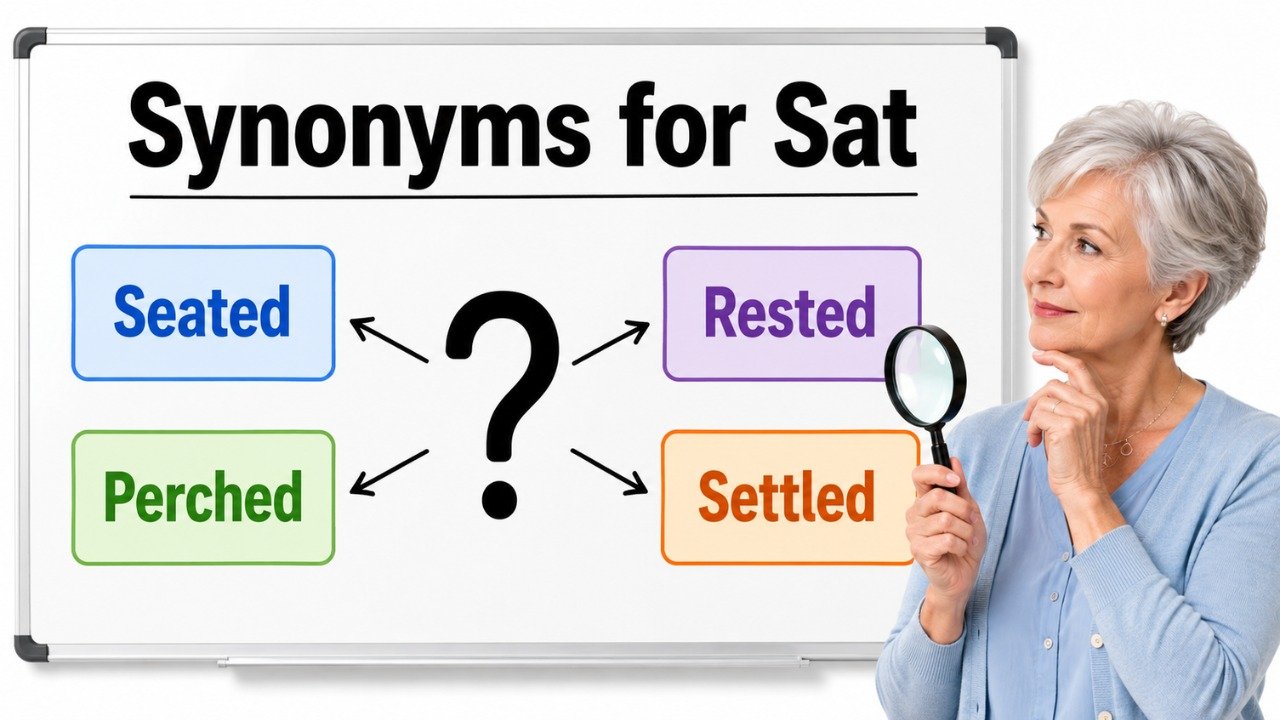
Quick Answer: The best synonyms for sat include seated, rested, settled, perched, remained, reclined, occupied, stayed, positioned, and waited. Seated is the clearest general alternative when someone was sitting in a chair or other place. Perched works for sitting on a narrow or raised surface, while settled suggests becoming comfortable. Remained and stayed fit situations where someone continued sitting for a period of time. Reclined is better when the body was leaning backward in a relaxed position.
Pronunciation and Word Details
Word: Sat
Pronunciation: /sæt/
Part of Speech: Verb
Meaning: Sat is the past tense and past participle of sit, meaning to have rested the body with the upper body upright and the weight supported mainly by the lower body.
US Pronunciation:
UK Pronunciation:
What Does “Sat” Mean?
Sat is the past tense and past participle form of the verb sit. It most commonly means that a person or animal rested with the body supported by a chair, seat, floor, ground, or another surface.
Example: She sat beside the window and read quietly.
Sat can also describe remaining somewhere for a period of time.
Example: The package sat on the table all afternoon.
In this use, sat does not literally describe the action of sitting. Instead, it means that something remained or stayed in a particular place.
Sat can also describe taking a particular position.
Example: He sat at the front of the room.
The word is common in both spoken and written English. Its exact meaning depends on whether the subject is a person, animal, object, organization, or group.
Meaning, Tone, and Context of “Sat”
Sat is a neutral and highly common English word. It works naturally in casual conversation, storytelling, descriptions, academic writing, reports, and everyday communication.
When sat describes a person, it usually refers to body position.
Example: Maria sat on the bench.
When it describes an object, sat can mean remained or stayed.
Example: The unopened letter sat on his desk.
In narrative writing, alternatives such as perched, settled, reclined, or rested can create a more specific image.
Example: The bird perched on the fence.
In formal writing, seated or remained may sometimes be more precise than sat.
Example: The guests were seated near the entrance.
The tone of sat itself is neither emotional nor strongly formal. Writers often choose another word when they want to describe exactly how, where, or why someone was sitting.
When and How to Use “Sat”
For Being in a Seated Position
Use sat when someone was resting with the body supported by a seat or surface.
Example: She sat on the sofa beside her sister.
For Taking a Seat
Sat can describe the action of moving into a seated position when the surrounding sentence makes that meaning clear.
Example: He entered the room and sat near the door.
For Remaining Somewhere
Sat can describe a person, object, or item that stayed in the same place.
Example: The box sat unopened for several days.
For Resting
Use sat when someone stopped moving and rested in a seated position.
Example: The hikers sat beneath a tree after the long walk.
For Sitting on a Raised Surface
Sat can describe someone positioned on an edge, ledge, stool, or other raised place.
Example: She sat on the edge of the wall.
For Waiting
Sat may suggest that someone remained seated while waiting.
Example: We sat in the lobby until our names were called.
For Descriptive Writing
Writers can replace sat with a more vivid verb when posture or position matters.
Example: The child perched on the edge of the chair.
Best Synonyms for Sat
Seated: Positioned on a chair, bench, floor, or another surface in a sitting posture.
Example: She was seated beside the fireplace.
Rested: Stopped moving and remained in a comfortable position.
Example: He rested on the bench after the long walk.
Settled: Became comfortably positioned in one place.
Example: She settled into the armchair with a book.
Perched: Sat on a narrow, high, or slightly unstable surface.
Example: The child perched on the edge of the stool.
Remained: Continued to stay in the same place or position.
Example: The folder remained on the desk overnight.
Reclined: Sat or lay while leaning backward in a relaxed position.
Example: He reclined in the chair after dinner.
Occupied: Took or used a particular seat, place, or position.
Example: She occupied a seat near the front.
Stayed: Continued to be in the same place.
Example: He stayed on the bench until sunset.
Positioned: Placed oneself or something in a particular location.
Example: She positioned herself beside the window.
Waited: Remained in one place until something happened.
Example: They waited quietly in the reception area.
50 Synonyms for Sat with Short Meanings
- Seated: Was positioned in a sitting posture.
- Rested: Stopped moving and relaxed in one place.
- Settled: Became comfortably positioned.
- Perched: Sat on a narrow or raised surface.
- Reclined: Leaned backward while sitting or resting.
- Remained: Continued to stay in the same position.
- Stayed: Continued being in one place.
- Occupied: Took or used a particular seat or place.
- Positioned: Placed oneself in a particular location.
- Waited: Remained somewhere until something happened.
- Lingered: Stayed somewhere longer than expected.
- Lounged: Sat or rested in a relaxed manner.
- Relaxed: Rested comfortably without activity.
- Paused: Stopped temporarily before continuing.
- Stopped: Ceased moving and remained somewhere.
- Was seated: Was in a sitting position.
- Took a seat: Moved into a seated position.
- Sat down: Moved from standing into a sitting position.
- Was sitting: Remained in a seated posture.
- Stayed seated: Continued sitting without getting up.
- Remained seated: Continued to occupy a sitting position.
- Made oneself comfortable: Settled into a relaxed position.
- Took a chair: Occupied an available chair.
- Took a place: Occupied a particular position.
- Occupied a seat: Used a chair or designated sitting place.
- Rested oneself: Stopped activity and sat for relief.
- Planted oneself: Sat or positioned oneself firmly in one place.
- Positioned oneself: Chose and occupied a particular place.
- Placed oneself: Moved into a chosen position.
- Installed oneself: Settled comfortably into a place.
- Ensconced oneself: Settled securely and comfortably.
- Nestled: Settled into a comfortable or protected position.
- Crouched: Lowered the body close to the ground with bent legs.
- Squatted: Rested with knees bent and the body lowered.
- Hunkered: Crouched or settled low in a position.
- Sprawled: Sat or lay with the body spread loosely.
- Slouched: Sat with a loose or bent posture.
- Hunched: Sat with the upper body bent forward.
- Leaned: Rested the body against something for support.
- Propped oneself: Supported the body against another surface.
- Basked: Sat or rested while enjoying warmth or comfort.
- Loitered: Remained somewhere without moving on.
- Tarried: Stayed somewhere for longer than necessary.
- Abided: Remained in a particular place.
- Stayed put: Remained exactly where one was.
- Held position: Continued occupying the same place.
- Rested in place: Remained without moving.
- Was positioned: Was located in a particular place.
- Was placed: Remained where something had been put.
- Lay idle: Remained unused or inactive in one place.
Read Also:
Synonyms for Responsible for Resume
Synonyms for Sat by Context
When Sat Means Was Seated
When sat simply describes someone being in a sitting position, useful alternatives include seated, was seated, was sitting, occupied a seat, and remained seated.
Example: She was seated near the window.
Example: He occupied a seat in the back row.
Seated is especially useful when the exact sitting position matters more than the action of moving into it.
When Sat Means Became Comfortable
When someone sat and became relaxed, use settled, nestled, lounged, relaxed, or made oneself comfortable.
Example: She settled into the large chair.
Example: He lounged on the sofa after work.
Settled suggests becoming comfortably established, while lounged suggests a particularly relaxed posture.
When Sat Means Perched
If someone sat on a narrow, raised, or awkward surface, perched is often the strongest alternative.
Example: The boy perched on the edge of the wall.
Perched creates a clearer physical image than the general verb sat.
When Sat Means Remained in One Place
For objects or people that continued to stay somewhere, alternatives include remained, stayed, lingered, stayed put, and rested in place.
Example: The package remained on the shelf for weeks.
Example: The bicycle stayed outside overnight.
These alternatives are especially useful when the subject is an object that cannot literally sit in the human sense.
When Sat Means Waited
When sitting is connected with waiting, use waited, remained, stayed, or lingered.
Example: They waited in the hallway for nearly an hour.
Example: She remained in the waiting area until her appointment.
Waited is usually the most precise choice when the purpose of sitting was to wait.
When Sat Describes Posture
Use reclined, slouched, hunched, sprawled, crouched, or leaned when the body position is important.
Example: He slouched in the chair during the long meeting.
Example: She reclined comfortably beside the window.
These words communicate details that sat alone does not provide.
Another Word for Sat
Seated is one of the best general alternatives to sat when describing a person in a sitting position. However, the best replacement depends on posture, location, duration, and purpose.
Use perched when someone was on an edge or narrow surface. Use settled when the person became comfortable. Use remained when something stayed in a place. Use waited when the main idea involves expecting something to happen.
Original: She sat beside the window.
Better Option: She was seated beside the window.
Original: The boy sat on the edge of the fence.
Better Option: The boy perched on the edge of the fence.
Original: He sat comfortably in the large chair.
Better Option: He settled comfortably into the large chair.
Original: The package sat on the table for three days.
Better Option: The package remained on the table for three days.
When Not to Use “Sat”
Sat is a useful everyday verb, but repeating it can make descriptive writing feel plain. A more specific verb may communicate posture, movement, mood, or purpose more clearly.
When Posture Matters
Sat does not explain whether someone was relaxed, bent forward, leaning backward, or balanced on an edge.
Weak: He sat lazily in the chair.
Better: He lounged lazily in the chair.
When Someone Is on a Narrow Surface
Perched often creates a clearer image than sat.
Weak: The bird sat on the thin branch.
Better: The bird perched on the thin branch.
When an Object Is Stationary
Objects can figuratively sit somewhere, but remained may sound more precise in formal writing.
Weak: The application sat unanswered for two weeks.
Better: The application remained unanswered for two weeks.
When the Purpose Is Waiting
Use waited when waiting is the main action.
Weak: We sat there for an hour before someone called us.
Better: We waited there for an hour before someone called us.
When Repetition Weakens a Paragraph
Repeating sat in several nearby sentences can make prose monotonous.
Weak: She sat by the window. Her brother sat beside her. Their mother sat across from them.
Better: She settled beside the window. Her brother took the seat beside her, while their mother remained across from them.
Words Commonly Confused With Sat
Sat vs Sit: Sat is the past tense and past participle of sit. Sit is the base form and is used for present actions, commands, and infinitives.
Example: I sit here every morning.
Example: I sat here yesterday.
Sat vs Seated: Sat describes the action or state of sitting. Seated often emphasizes being positioned in a seat.
Example: He sat beside his friend.
Example: He was seated beside his friend.
Sat vs Set: Sat comes from sit and usually describes being seated. Set usually means to place something somewhere.
Example: She sat on the chair.
Example: She set the book on the chair.
Sat vs Sitting: Sat refers to a completed or past situation. Sitting is the present participle and can describe an ongoing action.
Example: She sat there yesterday.
Example: She is sitting there now.
Sat vs Stayed: Sat usually describes a seated position, while stayed simply means remained somewhere.
Example: He sat in the kitchen.
Example: He stayed in the kitchen.
Sat vs Perched: Sat is general, while perched specifically suggests sitting on a narrow, high, or less secure surface.
Example: She sat on the wall.
Example: She perched on the wall.
Which Synonym Should You Choose?
Choose seated when you want a clear, neutral description of someone in a sitting position.
Choose settled when someone became comfortable in a chair, room, or other place.
Choose perched when a person or animal sat on a narrow, raised, or unstable surface.
Choose lounged when describing relaxed or lazy sitting.
Choose reclined when someone leaned backward while resting.
Choose slouched when someone sat with poor or relaxed posture.
Choose hunched when the body was bent forward.
Choose remained when an object or person continued to stay in one place.
Choose stayed when you need a simple conversational alternative for remaining somewhere.
Choose waited when the main purpose of remaining seated was expecting an event, person, or response.
Choose occupied when referring formally to someone using a specific seat or position.
Choose positioned when location matters more than the act of sitting.
In essays and reports, seated, remained, occupied, and positioned can provide greater precision. In descriptive writing, perched, settled, lounged, reclined, and slouched create stronger visual detail. In everyday conversation, sat, stayed, and waited are usually the most natural choices.
Real Life Examples of “Sat” in Sentences
Original: She sat near the front of the room.
Better Option: She was seated near the front of the room.
Original: The child sat on the edge of the stool.
Better Option: The child perched on the edge of the stool.
Original: He sat comfortably in his favorite chair.
Better Option: He settled comfortably into his favorite chair.
Original: We sat in the lobby for thirty minutes.
Better Option: We waited in the lobby for thirty minutes.
Original: The documents sat on the desk all week.
Better Option: The documents remained on the desk all week.
Original: She sat lazily on the sofa.
Better Option: She lounged lazily on the sofa.
Original: He sat back in the chair after dinner.
Better Option: He reclined in the chair after dinner.
Original: The student sat with his shoulders bent forward.
Better Option: The student hunched over in his chair.
Original: The guests sat in the available chairs.
Better Option: The guests occupied the available chairs.
Original: She sat beside the door and waited quietly.
Better Option: She positioned herself beside the door and waited quietly.
Synonym Groups and Usage Differences
Seating Group
This group includes seated, was seated, occupied a seat, took a seat, and remained seated. These alternatives focus directly on being positioned for sitting.
Example: The visitors were seated around the table.
Seated is especially useful when describing an established position rather than the movement of sitting down.
Comfort Group
This group includes settled, lounged, nestled, relaxed, and ensconced oneself. These words suggest comfort or relaxation.
Example: She settled into the chair with a warm drink.
Settled is neutral, while lounged suggests a looser and more relaxed posture.
Posture Group
This group includes perched, reclined, slouched, hunched, sprawled, crouched, and squatted.
Example: He slouched in the chair while listening.
Each word gives the reader additional information about body position.
Remaining Group
This group includes remained, stayed, lingered, abided, and stayed put. These synonyms focus on continuing to occupy a place.
Example: The folder remained on the table overnight.
This group works particularly well when sat refers figuratively to an object staying somewhere.
Waiting Group
This group includes waited, lingered, remained, and stayed.
Example: They waited in the reception area until noon.
Waited is best when expecting something is more important than the physical act of sitting.
Position Group
This group includes positioned, placed oneself, occupied, installed oneself, and took a place.
Example: She positioned herself beside the entrance.
These alternatives emphasize location and placement rather than posture.
Antonyms of Sat
The opposite of sat depends on whether sat describes body position, remaining somewhere, or resting.
Stood: Was upright on the feet.
Rose: Moved upward from a seated position.
Got up: Moved from sitting to standing.
Walked: Moved on foot instead of remaining seated.
Moved: Changed position or location.
Departed: Left a place.
Left: Went away from a location.
Advanced: Moved forward rather than remaining still.
Continued: Resumed movement or activity after stopping.
Proceeded: Moved onward instead of remaining in place.
Wandered: Moved around rather than staying in one location.
Ran: Moved quickly on foot instead of sitting.
Comparison: Sat vs Related Words
Sat vs Seated
Sat is the simple past form of sit and can describe either moving into or being in a sitting position. Seated generally emphasizes the resulting position.
Example With Sat: She sat beside the window.
Example With Seated: She was seated beside the window.
Seated often sounds slightly more formal or descriptive.
Sat vs Settled
Sat simply describes sitting, while settled suggests becoming comfortable or established.
Example With Sat: He sat in the armchair.
Example With Settled: He settled into the armchair with a book.
Settled gives more information about comfort and permanence.
Sat vs Perched
Sat is general. Perched describes sitting on a narrow, raised, or less stable surface.
Example With Sat: The child sat on the wall.
Example With Perched: The child perched on the wall.
Perched is more vivid when balance or height matters.
Sat vs Reclined
Sat normally suggests an upright seated posture. Reclined means leaning backward while resting.
Example With Sat: He sat in the chair.
Example With Reclined: He reclined in the chair.
Reclined communicates a more relaxed body position.
Sat vs Lounged
Sat is neutral, while lounged suggests relaxed, comfortable, or leisurely sitting.
Example With Sat: She sat on the sofa.
Example With Lounged: She lounged on the sofa.
Lounged is useful when mood and posture are important.
Sat vs Stayed
Sat usually refers to sitting, while stayed focuses on remaining in a place.
Example With Sat: He sat in the waiting room.
Example With Stayed: He stayed in the waiting room.
Someone can stay somewhere without sitting, so these words are not always interchangeable.
Sat vs Remained
Sat can figuratively mean stayed somewhere. Remained directly emphasizes continuing in the same place or condition.
Example With Sat: The unopened package sat on the table.
Example With Remained: The unopened package remained on the table.
Remained is often more precise for formal or factual writing.
Sat vs Waited
Sat describes body position, while waited explains why someone remained somewhere.
Example With Sat: We sat in the hallway for twenty minutes.
Example With Waited: We waited in the hallway for twenty minutes.
Choose waited when the delay or expectation is the main idea.
Common Phrases and Expressions With Sat
Sat Down: Moved from standing into a seated position.
Example: She sat down beside her friend.
Sat Still: Remained seated without moving.
Example: The child sat still during the photograph.
Sat Quietly: Remained seated without speaking or making much noise.
Example: He sat quietly while the others talked.
Sat Back: Leaned backward while seated or stopped taking an active role.
Example: She sat back and listened to the discussion.
Sat Up: Moved into or maintained a more upright seated position.
Example: He sat up when he heard his name.
Sat Around: Remained somewhere without doing much.
Example: They sat around talking after dinner.
Sat Beside: Occupied a position next to someone or something.
Example: She sat beside her grandmother.
Sat Across From: Occupied a position facing another person or object.
Example: He sat across from the interviewer.
Sat in Silence: Remained seated without speaking.
Example: They sat in silence for several minutes.
Sat Waiting: Remained seated while expecting someone or something.
Example: She sat waiting for the door to open.
Common Mistakes to Avoid
Confusing Sat With Sit
Sat is used for past actions, while sit is the base or present form.
Incorrect: Yesterday, I sit beside the window.
Better: Yesterday, I sat beside the window.
Using Sat After Have or Had Incorrectly
Sat is also the past participle of sit, so it can follow have, has, or had.
Incorrect: She had sit there for an hour.
Better: She had sat there for an hour.
Confusing Sat With Set
Sit refers to taking or being in a seated position. Set usually means placing something somewhere.
Incorrect: She sat the cup on the table.
Better: She set the cup on the table.
Choosing a Synonym That Changes the Posture
Perched, reclined, crouched, and slouched do not simply mean sat. Each describes a specific position.
Weak: He perched comfortably in a deep armchair.
Better: He settled comfortably into a deep armchair.
Use perched only when the surface or position makes that meaning natural.
Repeating Sat Too Often
Using sat several times in the same paragraph can make descriptive writing feel repetitive.
Weak: Liam sat by the window. Maya sat beside him. Their father sat near the door.
Better: Liam settled beside the window. Maya took the chair next to him, while their father remained near the door.
Replacing Sat When the Simple Word Is Better
Not every sentence needs a more elaborate synonym. Sat is often the clearest choice.
Unnatural: He ensconced himself on the kitchen chair for two minutes.
Better: He sat on the kitchen chair for two minutes.
Use vivid synonyms only when they add meaningful information.
Using Was Sat in Standard Active Sentences
In many contexts, was sitting or was seated is more natural than was sat.
Awkward: She was sat near the window all morning.
Better: She was sitting near the window all morning.
Also Correct: She was seated near the window all morning.
Using Sat for Every Stationary Object
Objects can figuratively sit somewhere, but formal writing may benefit from remained, stood, lay, or was located depending on the object.
Less Precise: The report sat in the archive for years.
Better: The report remained in the archive for years.
Conclusion
The best synonyms for sat depend on position, purpose, and context. Seated is a strong neutral replacement for a person in a sitting position, while settled suggests comfort and perched describes sitting on a narrow or raised surface. Reclined, lounged, slouched, and hunched add details about posture. When sat means that something stayed somewhere, remained or stayed may be more precise. Choosing among synonyms for sat helps make descriptions clearer, more natural, and more visually specific.
FAQs About Synonyms for Sat
What Is the Best Synonym for Sat?
Seated is one of the best general alternatives when sat describes a person in a sitting position. The best choice still depends on the exact context.
What Is Another Word for Sat Down?
Took a seat, settled, seated oneself, and lowered oneself into a chair can all replace sat down depending on the sentence.
What Is a Better Word for Sat in Descriptive Writing?
Perched, settled, lounged, reclined, slouched, and hunched are useful because they provide more information about posture or mood.
What Is a Formal Synonym for Sat?
Seated, remained, occupied, and positioned can work well in formal writing depending on the meaning of the sentence.
What Is a Synonym for Sat and Waited?
Waited, remained, stayed, and lingered are useful alternatives. Waited is usually best when expecting something is the main idea.
Is Seated the Same as Sat?
They are closely related, but not always identical. Sat is the past form of sit, while seated often emphasizes someone’s position after sitting down.
What Is the Opposite of Sat?
Stood is the most direct opposite when referring to body position. Rose, got up, moved, and left may also work depending on the context.
