
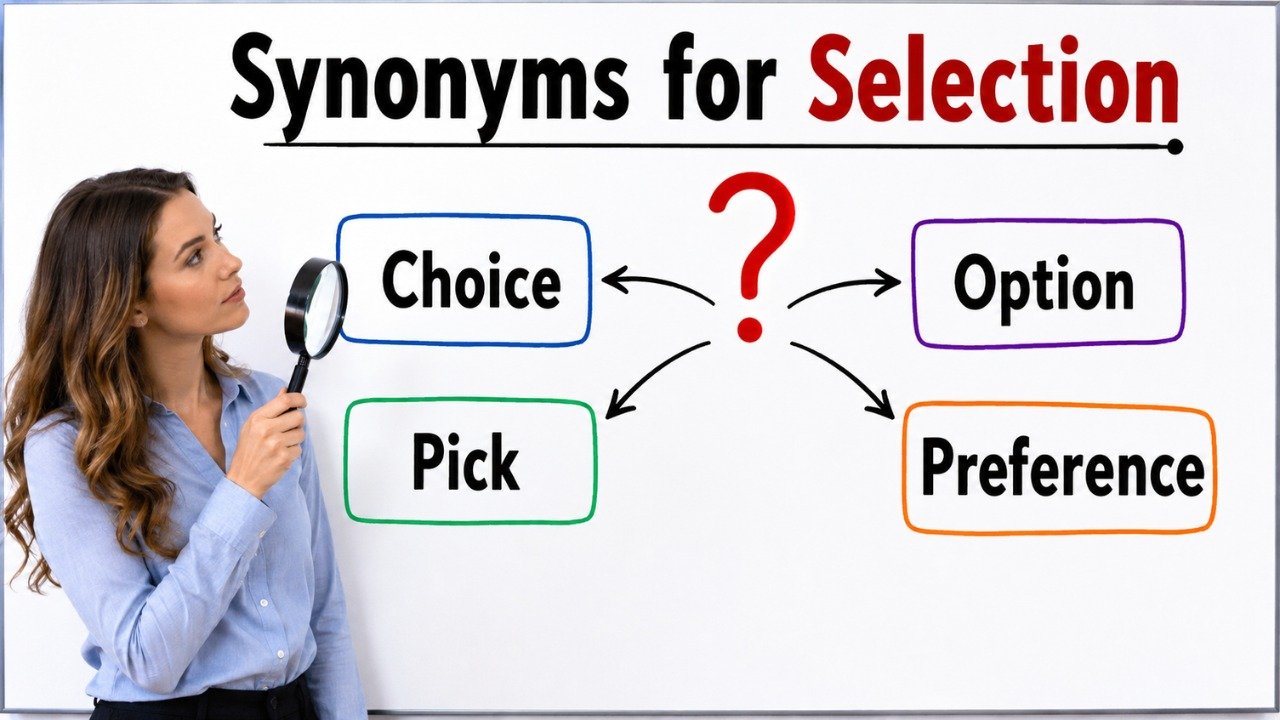
Quick Answer: The best synonyms for selection include choice, pick, decision, preference, assortment, range, variety, collection, shortlist, and curation. Among the most useful synonyms for selection, choose choice for a general decision, pick for casual speech, preference for a favored option, assortment for available products, range for breadth, shortlist for approved candidates, and curation for a carefully organized group.
Pronunciation and Word Details
Word: Selection.
Pronunciation: /sɪˈlekʃən/.
Part of Speech: Noun.
Meaning: The act of choosing, the person or thing chosen, or a group of available items.
US Pronunciation:
UK Pronunciation:
What Does “Selection” Mean?
Selection means the act of choosing someone or something from several possibilities. It can also refer to the item, person, or group that has been chosen.
As a noun, selection has several closely connected uses. It can describe a decision process, as in candidate selection. It can identify a chosen item, as in a musical selection. It can also describe a variety of available choices, as in a wide selection of books.
The exact meaning becomes clear from the surrounding sentence. In hiring, selection usually refers to evaluating and choosing applicants. In shopping, it often means an assortment or range. In publishing, music, or entertainment, it can mean an extract, passage, or chosen work.
Meaning, Tone, and Context of “Selection”
Selection is a neutral and versatile noun. It works naturally in formal writing, professional communication, academic discussion, reports, essays, and everyday conversation.
In formal contexts, selection often describes an organized process. Expressions such as candidate selection, selection criteria, and selection procedure suggest that choices are made according to clear standards.
In casual conversation, selection can refer to available variety. Someone might comment on the selection of food, clothing, books, or activities in a particular place.
The word can also sound thoughtful or deliberate. A carefully prepared selection suggests that someone evaluated several possibilities before choosing the final group.
In scientific writing, natural selection has a specialized meaning related to how certain inherited characteristics become more common across generations. In this context, selection should not be replaced casually with choice or preference.
When and How to Use “Selection”
For the Act of Choosing
Use selection when describing a process in which one or more options are evaluated and chosen.
Example: The selection of a new department leader will begin next week.
For a Chosen Person
Use selection when referring to someone who has been chosen for a position, award, team, or responsibility.
Example: Her selection as team captain was welcomed by the entire group.
For a Chosen Item
Use selection when identifying a particular piece, passage, song, product, or work chosen from a larger group.
Example: The class read a short selection from the novel.
For an Available Range
Use selection when describing the number or variety of choices available.
Example: The store offers a broad selection of notebooks and writing materials.
For Recruitment
Use selection when discussing the evaluation and appointment of employees, students, athletes, or participants.
Example: Experience is an important part of the candidate selection process.
For Careful Organization
Use selection when a group has been deliberately assembled for a particular audience or purpose.
Example: The exhibition presents a thoughtful selection of local artwork.
For Formal Decisions
Use selection when choice sounds too casual for a report, policy, or official process.
Example: Final selection will depend on qualifications, experience, and interview performance.
Best Synonyms for Selection
Choice
Synonym: Choice means the act of deciding between possibilities or the option that is chosen.
Example: Her first choice was the morning appointment.
Pick
Synonym: Pick is an informal word for a chosen person or thing.
Example: This book is my pick for the reading group.
Decision
Synonym: Decision refers to the conclusion reached after considering different options.
Example: The final decision will be announced on Friday.
Preference
Synonym: Preference means a stronger liking for one option over another.
Example: His preference was for a quiet workspace.
Assortment
Synonym: Assortment means a varied group of available items.
Example: The basket contained an assortment of fresh fruit.
Range
Synonym: Range describes the breadth or variety of choices available.
Example: The course provides a wide range of practical exercises.
Variety
Synonym: Variety emphasizes the presence of many different types.
Example: The menu includes a good variety of vegetarian dishes.
Collection
Synonym: Collection means a group of items gathered or organized together.
Example: The library displayed a collection of historical documents.
Shortlist
Synonym: Shortlist means a reduced group of the strongest candidates or options.
Example: Five applicants were added to the final shortlist.
Curation
Synonym: Curation means the careful selection and organization of items for a particular purpose.
Example: The curation of the exhibition took several months.
50 Synonyms for Selection with Short Meanings
- Choice: The act of choosing or the option chosen.
- Choosing: The process of deciding between possibilities.
- Pick: A person or thing chosen, especially informally.
- Picking: The act of choosing something from a group.
- Decision: A conclusion reached after considering options.
- Preference: A greater liking for one possibility.
- Election: A formal choice made through voting.
- Nomination: The act of proposing someone for selection.
- Appointment: The official choice of someone for a position.
- Designation: The formal naming of someone or something.
- Adoption: The choice to accept a plan, method, or proposal.
- Acceptance: Approval of a person, application, or offer.
- Recruitment: The process of finding and choosing suitable people.
- Shortlisting: The process of reducing options to the strongest few.
- Screening: The careful examination of candidates or possibilities.
- Filtering: The removal of unsuitable options.
- Sorting: The organization of items according to type or quality.
- Curation: Careful selection and arrangement for a purpose.
- Option: One possible choice among several.
- Alternative: A different choice or course of action.
- Chosen item: A particular thing selected from a group.
- Chosen candidate: A person selected for a role or opportunity.
- Chosen group: A set of people or things selected together.
- Final choice: The option selected after consideration.
- Preferred option: The possibility favored over the others.
- Assortment: A varied group of available items.
- Range: A broad set of available choices.
- Variety: A number of different types or forms.
- Array: An impressive or organized display of choices.
- Collection: A group of items gathered together.
- Lineup: A group of people, products, or activities presented together.
- Offering: Something made available for people to choose.
- Catalog: An organized list or group of available items.
- Inventory: The complete supply of available goods or materials.
- Stock: The goods currently available for use or purchase.
- Set: A group of related items.
- Group: Several people or things considered together.
- Batch: A quantity of items handled or chosen at one time.
- Sample: A smaller part chosen to represent a larger whole.
- Cross section: A representative group taken from a larger population.
- Compilation: A group of works collected from different sources.
- Anthology: A selected collection of writing, music, or art.
- Medley: A varied mixture of selected elements.
- Mixture: A group containing different types of things.
- Blend: A combination of different selected elements.
- Combination: Two or more things chosen and joined together.
- Roster: An official list of selected members.
- Squad: A selected group organized for a shared purpose.
- Extract: A chosen part taken from a longer work.
- Excerpt: A short passage selected from a larger text.
Read Also:
Synonyms for Fly

Synonyms for Selection by Context
When Selection Means the Act of Choosing
Choice is the most flexible alternative when selection describes a decision between possibilities. Choosing and picking focus more directly on the action itself.
Decision is useful when the process has reached a conclusion. Preference is better when the choice is based on personal taste rather than formal evaluation.
Example: The selection of the final design required careful discussion.
Alternative: The choice of the final design required careful discussion.
When Selection Means a Chosen Person or Thing
Pick works well in casual speech when referring to a chosen item or person. Final choice is clearer when several possibilities were considered before one was selected.
Chosen candidate is suitable in recruitment, competitions, scholarships, and appointments.
Example: Their selection for the leadership role had extensive experience.
Alternative: Their chosen candidate for the leadership role had extensive experience.
When Selection Means an Available Range
Assortment, range, variety, and array are useful when selection describes available choices.
Assortment often refers to a mixed group of items. Range emphasizes breadth. Variety emphasizes differences. Array suggests an organized or impressive display.
Example: The shop has a large selection of art supplies.
Alternative: The shop has a large assortment of art supplies.
When Selection Means a Collection
Collection, compilation, anthology, set, and lineup describe groups that have been assembled.
Collection is the broadest term. Compilation often refers to material gathered from several places. Anthology is common for poems, stories, essays, songs, or artwork. Lineup is useful for performers, activities, products, or participants.
Example: The book contains a selection of short stories.
Alternative: The book contains an anthology of short stories.
When Selection Means Candidate Evaluation
Recruitment, screening, filtering, shortlisting, nomination, and appointment describe different stages of choosing people.
Recruitment covers the broader effort to find and attract applicants. Screening removes unsuitable candidates. Shortlisting identifies the strongest remaining applicants. Appointment refers to the official final choice.
Example: The selection of applicants will include two interviews.
Alternative: The screening of applicants will include two interviews.
When Selection Means a Representative Part
Sample and cross section are useful when a smaller group represents a larger population.
Extract and excerpt are better when a passage is taken from a longer written or spoken work.
Example: The survey used a selection of adults from different age groups.
Alternative: The survey used a cross section of adults from different age groups.
Another Word for Selection
Choice is usually the best single replacement for selection because it can describe both the act of choosing and the result of that process. However, the best alternative depends on the intended meaning.
Use assortment for a group of available products, shortlist for a reduced list of candidates, collection for gathered items, and excerpt for part of a written work.
Original: The final selection will be announced tomorrow.
Better Option: The final choice will be announced tomorrow.
Original: The shop has an excellent selection of teas.
Better Option: The shop has an excellent assortment of teas.
Original: The committee reviewed the selection of candidates.
Better Option: The committee reviewed the shortlist of candidates.
Original: We read a selection from the opening chapter.
Better Option: We read an excerpt from the opening chapter.
When Not to Use “Selection”
Selection can sound vague when a more specific word would explain what was chosen or how the process worked.
When Describing Personal Taste
Preference is often clearer when the choice is based on individual liking.
Weak: Her selection is to work near a window.
Better: Her preference is to work near a window.
When Referring to Available Products
Assortment, range, or variety may communicate the intended meaning more precisely.
Weak: The market has a good selection.
Better: The market has a good variety of fresh produce.
When Describing a Final Decision
Decision or final choice may sound more direct than selection.
Weak: We reached our selection after a long discussion.
Better: We reached our decision after a long discussion.
When Referring to Written Material
Excerpt, extract, or passage is usually clearer when only part of a text is presented.
Weak: Read the selection on the next page.
Better: Read the excerpt on the next page.
When Explaining Recruitment Stages
Selection may be too broad when the exact stage is screening, shortlisting, interviewing, or appointment.
Weak: The company completed the selection yesterday.
Better: The hiring panel completed the final interviews yesterday.
When the Word Becomes Repetitive
Repeated use of selection can make a paragraph sound mechanical. Replace some instances with choice, process, shortlist, range, or collection according to meaning.
Weak: The selection committee completed the selection after reviewing the selection criteria.
Better: The selection committee made its final choice after reviewing the required criteria.
Words Commonly Confused With Selection
Selection vs Choice: Selection can refer to a process, a chosen item, or a range of available items. Choice usually refers to a decision or the thing chosen.
Selection vs Option: An option is one possibility available before a decision. A selection is the act or result of choosing an option.
Selection vs Assortment: Selection can describe any available group of choices. Assortment specifically suggests a varied mixture of items.
Selection vs Collection: A selection is usually chosen from a larger group. A collection is a group of items gathered together, whether every item was carefully chosen or not.
Selection vs Preference: Selection is the choice that is made. Preference is the option someone likes more, even when that option is not ultimately chosen.
Selection vs Election: Selection is a broad choosing process. Election is a formal process in which people vote for a candidate or proposal.
Selection vs Recruitment: Recruitment involves finding and attracting suitable applicants. Selection involves evaluating candidates and choosing among them.
Selection vs Shortlist: Selection can refer to the complete choosing process. A shortlist is the reduced group of leading options that remain before the final decision.
Which Synonym Should You Choose?
Choose choice when you need a broad and natural replacement for the act or result of choosing.
Choose pick in casual speech when identifying a favorite person, item, book, activity, or product.
Choose decision when emphasizing the final conclusion reached after consideration.
Choose preference when discussing personal taste, priority, or a favored possibility.
Choose assortment when describing a mixed group of products, foods, colors, or physical items.
Choose range when emphasizing the breadth of available possibilities.
Choose variety when emphasizing differences among the available options.
Choose collection when describing items gathered and presented together.
Choose shortlist when discussing the strongest candidates remaining in a formal process.
Choose screening when referring to the examination and removal of unsuitable candidates.
Choose curation when the items were carefully selected and arranged for a particular audience.
Choose anthology when describing a selected collection of poems, stories, essays, music, or artwork.
Choose excerpt when referring to a short part taken from a larger text.
Choose appointment when someone has been officially chosen for a position.
Choose sample or cross section in research, surveys, testing, or analysis when a smaller group represents a larger population.
Real Life Examples of “Selection” in Sentences
Original: The restaurant offers a large selection of desserts.
Better Option: The restaurant offers a large variety of desserts.
Original: Her selection for the scholarship surprised no one.
Better Option: Her choice for the scholarship surprised no one.
Original: The committee discussed the selection of a new chairperson.
Better Option: The committee discussed the appointment of a new chairperson.
Original: This selection from the book introduces the central character.
Better Option: This excerpt from the book introduces the central character.
Original: We were impressed by the selection of handmade items.
Better Option: We were impressed by the assortment of handmade items.
Original: The final selection included six experienced applicants.
Better Option: The final shortlist included six experienced applicants.
Original: His selection was based mainly on convenience.
Better Option: His decision was based mainly on convenience.
Original: The exhibition features a selection of modern paintings.
Better Option: The exhibition features a collection of modern paintings.
Original: The survey included a selection of local residents.
Better Option: The survey included a cross section of local residents.
Original: Careful selection of materials can improve the final result.
Better Option: Careful choosing of materials can improve the final result.
Synonym Groups and Usage Differences
Choice and Decision Group
Choice, decision, pick, preference, and final choice all relate to deciding between alternatives.
Choice is broad and neutral. Decision emphasizes a conclusion. Pick is informal. Preference emphasizes personal liking. Final choice shows that the process is complete.
Example: After reviewing every proposal, the committee made its final choice.
Evaluation and Recruitment Group
Recruitment, screening, filtering, shortlisting, nomination, and appointment relate to choosing people for roles or opportunities.
Recruitment finds possible candidates. Screening evaluates basic suitability. Filtering removes weak options. Shortlisting identifies leading candidates. Nomination proposes a person. Appointment officially places someone in a role.
Example: Screening reduced the applicant group before interviews began.
Variety and Availability Group
Assortment, range, variety, array, offering, inventory, and stock describe what is available.
Assortment suggests mixed items. Range emphasizes breadth. Variety highlights differences. Array suggests an organized display. Offering refers to something made available. Inventory and stock refer to available supplies.
Example: The course offers a broad range of subjects.
Collection and Organization Group
Collection, compilation, anthology, set, lineup, roster, and catalog describe organized groups.
Collection is general. Compilation combines material from several sources. Anthology contains selected creative works. Set contains related items. Lineup presents people, events, or products. Roster lists selected members. Catalog organizes available items.
Example: The anthology contains poems from several different periods.
Representative Group
Sample, cross section, group, and batch can refer to smaller sets chosen from a larger whole.
Sample is common in research and testing. Cross section emphasizes representation of different parts of a population. Batch refers to items handled together. Group is the broadest alternative.
Example: The researchers interviewed a representative cross section of residents.
Written and Creative Works Group
Excerpt, extract, passage, anthology, and compilation are useful when selection refers to written, musical, or artistic material.
Excerpt and extract refer to a smaller portion of a larger work. Anthology describes several selected works. Compilation combines separate pieces into one organized collection.
Example: The teacher read an excerpt from the final chapter.
Mixture and Combination Group
Medley, mixture, blend, and combination describe selections made from different types of elements.
Medley often suggests a pleasing variety. Mixture is neutral. Blend suggests that elements have been combined smoothly. Combination emphasizes that separate things have been joined.
Example: The performance presented a medley of traditional songs.
Antonyms of Selection
The opposite of selection depends on whether the word refers to choosing, approval, inclusion, or available variety.
Rejection: The refusal to choose or accept someone or something.
Exclusion: The act of leaving someone or something out.
Elimination: The removal of an option or candidate from consideration.
Dismissal: The rejection or removal of a person, idea, or possibility.
Refusal: A decision not to accept an offer, request, or option.
Omission: The act of failing to include something.
Disqualification: The removal of a candidate for failing to meet requirements.
Scarcity: A very limited amount or number of available options.
Uniformity: A lack of meaningful variety or difference.
Limitation: A restriction on the number or range of possibilities.
Repetition: The presence of the same type rather than a varied range.
Randomness: The absence of deliberate or careful choice.
Comparison: Selection vs Related Words
Selection vs Choice
Selection is broader than choice. It can describe the choosing process, the chosen result, or the range of items available. Choice usually describes the decision itself or the chosen option.
Example With Selection: The selection process included a written test and two interviews.
Example With Choice: Her first choice was the applicant with the most experience.
Selection vs Option
An option is a possibility available before a decision. Selection is what happens when one or more options are chosen.
Example With Selection: The final selection will depend on cost and quality.
Example With Option: Remote attendance is available as an option.
Selection vs Assortment
Selection can refer to any available group, while assortment emphasizes variety within that group.
Example With Selection: The shop has a useful selection of office supplies.
Example With Assortment: The gift box contains an assortment of pens and notebooks.
Selection vs Range
Selection may refer to chosen or available items. Range focuses on the breadth between different types, levels, sizes, or possibilities.
Example With Selection: The course includes a selection of practical activities.
Example With Range: The course covers a wide range of professional skills.
Selection vs Collection
Selection usually suggests that items were chosen from a larger group. Collection focuses on items gathered together.
Example With Selection: The gallery displayed a selection of the artist’s early work.
Example With Collection: The gallery received a collection of more than one hundred paintings.
Selection vs Preference
Selection is the option that someone chooses. Preference is the option that someone likes more.
Example With Selection: Her selection was approved by the committee.
Example With Preference: Her preference was for the smaller meeting room.
Selection vs Shortlist
Selection can describe the entire process of choosing. A shortlist contains the leading candidates or possibilities that remain before a final choice.
Example With Selection: Candidate selection will continue throughout the month.
Example With Shortlist: Three candidates remain on the shortlist.
Selection vs Curation
Selection simply means choosing. Curation suggests careful choosing, organization, presentation, and attention to the needs of an audience.
Example With Selection: The program includes a selection of short films.
Example With Curation: The curation of the film program created a clear theme.
Common Phrases and Expressions With “Selection”
Selection Process: The complete method used to evaluate and choose.
Selection Criteria: The standards used to judge candidates or options.
Selection Committee: A group responsible for choosing someone or something.
Final Selection: The person, item, or group chosen at the end of a process.
Careful Selection: A choice made after thoughtful evaluation.
Wide Selection: A large range of available choices.
Limited Selection: A small number or range of available choices.
Candidate Selection: The process of choosing a suitable applicant.
Random Selection: A method in which choices are made without personal preference.
Natural Selection: A biological process in which inherited traits affect survival and reproduction.
Common Mistakes to Avoid
Repeating Selection Too Often
Using selection several times in one paragraph can make the writing sound stiff and repetitive. Replace it with choice, process, shortlist, assortment, or range when the meaning allows.
Repetitive: The selection team reviewed the selection criteria before making its selection.
Improved: The selection team reviewed the criteria before making its final choice.
Using Selection Instead of Option
Selection is not always interchangeable with option. An option is available before a choice is made.
Incorrect: Working remotely is one selection available to employees.
Correct: Working remotely is one option available to employees.
Using Selection Instead of Preference
A preference describes what someone likes more. It does not always describe the choice that was finally made.
Unclear: My selection is to meet in the afternoon.
Clearer: My preference is to meet in the afternoon.
Using a General Word in a Specific Context
Selection may be too broad when the exact meaning is shortlist, assortment, excerpt, appointment, or sample.
General: The report includes a selection of customer comments.
Specific: The report includes a representative sample of customer comments.
Confusing Selection With Collection
A collection may contain everything gathered, while a selection usually contains only chosen items.
Incorrect: The complete selection contains every letter the author wrote.
Correct: The complete collection contains every letter the author wrote.
Choosing an Unnatural Formal Synonym
Words such as designation, appointment, election, and curation have specific uses. They should not replace selection in every context.
Unnatural: The restaurant has a large designation of meals.
Natural: The restaurant has a large selection of meals.
Leaving the Meaning Vague
Selection can mean a process, a chosen item, or an available variety. Add enough detail to make the intended meaning obvious.
Vague: The selection was successful.
Clearer: The candidate selection process successfully identified three qualified applicants.
Conclusion
The best synonyms for selection depend on what the word means in the sentence. Choice, decision, and pick describe choosing. Assortment, range, and variety describe available options. Collection and anthology refer to organized groups, while shortlist, screening, and appointment suit recruitment contexts. Excerpt is best for part of a written work, and curation suggests careful organization. Choosing the most precise alternative makes your writing clearer, more natural, and more informative.
FAQs About Synonyms for Selection
What Is the Best Synonym for Selection?
Choice is the best general synonym for selection. It works for both the act of choosing and the option that is chosen.
What Is Another Word for a Wide Selection?
Range, variety, assortment, and array are strong alternatives. Range emphasizes breadth, while variety emphasizes differences among the options.
What Is a Formal Synonym for Selection?
Decision, appointment, designation, nomination, and curation can be formal alternatives. The correct word depends on what is being chosen.
What Is a Synonym for Candidate Selection?
Recruitment, screening, shortlisting, evaluation, and appointment are useful alternatives. Each word describes a different stage of the process.
Is Assortment the Same as Selection?
They are similar when discussing available items. Assortment emphasizes a mixture of different items, while selection has a broader meaning.
What Is Another Word for a Selection of Writing?
Excerpt, extract, passage, anthology, or compilation may be appropriate. Use excerpt for a short part and anthology for a collection of separate works.
Can Pick Replace Selection?
Pick can replace selection in informal situations. It is natural for favorite items or personal recommendations but may sound too casual in formal reports.
