
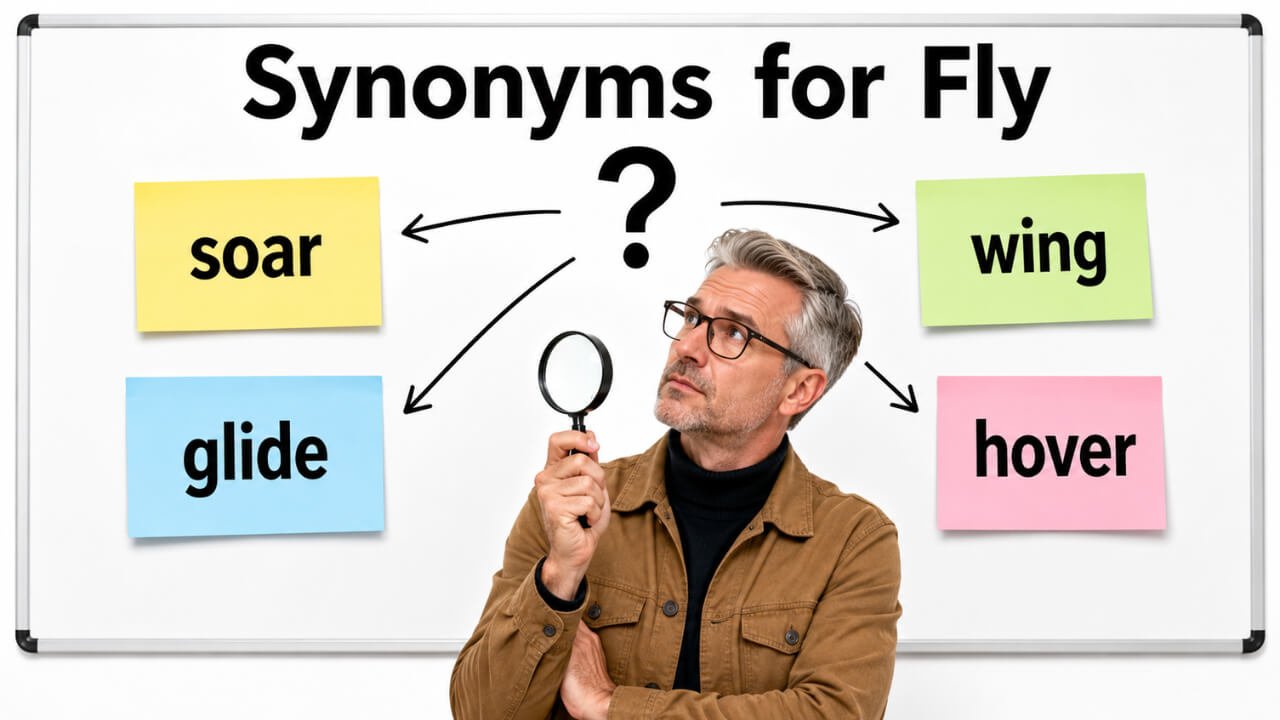
Quick Answer: The best synonyms for fly include soar, glide, hover, wing, jet, dart, zoom, flee, escape, and hoist. When fly means moving through the air, choose soar, glide, or wing. For travel by aircraft, use jet, travel by air, or take a plane. Choose dart or zoom for fast movement, flee or escape for leaving danger, and hoist when referring to displaying a flag.
Pronunciation and Word Details
Word: Fly
Pronunciation: /flaɪ/
Part of Speech: Verb, noun, and informal adjective
Meaning: To move through the air, travel in an aircraft, move very quickly, escape, or display something such as a flag.
US Pronunciation:
UK Pronunciation:
What Does “Fly” Mean?
Fly commonly means to move through the air using wings, an aircraft, or another form of aerial movement. It is most often used as a verb, but it can also function as a noun or an informal adjective.
As a verb, fly can describe the movement of birds, insects, aircraft, objects, or people traveling by plane.
Example: Birds fly south when the weather becomes colder.
Fly can also mean traveling through the air in an aircraft.
Example: We will fly to the capital on Friday.
In descriptions of speed, fly means to move or pass extremely quickly.
Example: The cyclist flew down the hill.
When someone leaves suddenly, especially to avoid danger or punishment, fly can mean flee or escape.
Example: The villagers had to fly from the approaching danger.
Fly can also mean raising or displaying a flag.
Example: The school will fly its flag during the ceremony.
As a noun, a fly is a small winged insect. In informal language, fly may also describe something stylish, fashionable, or impressive. However, most searches for synonyms for fly concern the verb and its different meanings.
Meaning, Tone, and Context of “Fly”
Fly is usually a neutral and common word. It appears naturally in everyday conversation, stories, reports, travel descriptions, science writing, and figurative expressions.
When referring to birds, insects, or aircraft, fly has a direct and literal meaning.
Literal Use: The eagle can fly above the mountain range.
When describing fast movement or passing time, fly becomes more expressive and figurative.
Figurative Use: The afternoon flew by because we were busy.
In travel contexts, fly is conversational and widely understood.
Travel Use: They plan to fly abroad next month.
In formal writing, a more specific synonym may provide greater precision. Soar describes high or impressive movement. Glide suggests smooth movement. Hover means remaining in nearly one position in the air. Flee describes escaping from danger.
Fly can sound energetic when it describes speed, freedom, progress, or rapid change. It can sound serious when it refers to escaping from danger. Its exact tone depends on the sentence and the intended meaning.
When and How to Use “Fly”
For Movement Through the Air: Use fly when a bird, insect, aircraft, or object moves above the ground.
Example: A flock of birds flew over the lake.
For Air Travel: Use fly when someone travels in an aircraft.
Example: We are flying to another city for the conference.
For Operating an Aircraft: Use fly when someone controls or pilots an aircraft.
Example: She learned to fly a small aircraft.
For Fast Movement: Use fly when someone or something moves with great speed.
Example: The ball flew across the field.
For Rapidly Passing Time: Use fly when time seems to pass very quickly.
Example: The weekend flew by.
For Escape: Use fly when someone leaves quickly to avoid danger, capture, or trouble.
Example: The family was forced to fly from the conflict.
For Displaying a Flag: Use fly when a flag is raised or displayed.
Example: The building flies the national flag each morning.
For Figurative Progress: Use fly to describe rapid success, growth, or improvement.
Example: Her career began to fly after the successful project.
Best Synonyms for Fly
Soar: To fly or rise high in a smooth and impressive way.
Example: The eagle soared above the cliffs.
Glide: To move smoothly and quietly through the air.
Example: The bird glided across the calm sky.
Hover: To remain in the air near one position.
Example: The helicopter hovered above the field.
Wing: To travel through the air using wings or an aircraft.
Example: The geese winged their way across the valley.
Jet: To travel quickly by aircraft.
Example: The executives jetted to another city for the meeting.
Dart: To move suddenly and quickly in a particular direction.
Example: The swallow darted between the trees.
Zoom: To move very quickly, often with a rushing sound.
Example: The aircraft zoomed across the sky.
Flee: To leave quickly because of danger or fear.
Example: Residents fled when the fire approached.
Escape: To get away from danger, control, or confinement.
Example: The prisoner attempted to escape during the night.
Hoist: To raise something, especially a flag, into a higher position.
Example: The crew hoisted the flag before departure.
50 Synonyms for Fly with Short Meanings
- Soar: To rise or fly high in the air.
- Glide: To move smoothly through the air.
- Hover: To remain nearly still in the air.
- Wing: To travel through the air.
- Flit: To move lightly and quickly from place to place.
- Flutter: To fly with quick and gentle wing movements.
- Swoop: To move rapidly downward through the air.
- Circle: To fly around an area in a curved path.
- Coast: To move smoothly with little effort.
- Cruise: To travel steadily and comfortably through the air.
- Drift: To move slowly through the air without clear control.
- Sail: To move smoothly and gracefully through the air.
- Sweep: To move quickly and powerfully across an area.
- Skim: To move lightly just above a surface.
- Streak: To move extremely quickly through the air.
- Dart: To move suddenly and rapidly.
- Zip: To move quickly and energetically.
- Zoom: To travel at high speed.
- Race: To move very quickly toward a destination.
- Rush: To move with speed and urgency.
- Dash: To move suddenly and quickly.
- Bolt: To run or move away unexpectedly.
- Speed: To move at a fast rate.
- Hurry: To move or act more quickly than usual.
- Travel by Air: To make a journey using an aircraft.
- Take a Plane: To travel somewhere in an aircraft.
- Jet: To travel quickly by aircraft.
- Aviate: To operate or travel in an aircraft.
- Pilot: To control and guide an aircraft.
- Take Off: To leave the ground and enter the air.
- Lift Off: To rise from the ground into the air.
- Ascend: To move upward.
- Climb: To rise gradually to a higher altitude.
- Launch: To send an aircraft or object into the air.
- Become Airborne: To rise from the ground and begin flying.
- Depart: To leave a place.
- Leave: To go away from a location.
- Flee: To escape quickly from danger.
- Escape: To get away from danger or control.
- Get Away: To leave or escape successfully.
- Run Away: To leave quickly to avoid trouble.
- Vanish: To disappear suddenly from sight.
- Hoist: To raise a flag or object.
- Raise: To move something into a higher position.
- Wave: To move a flag or object through the air.
- Display: To show a flag or symbol publicly.
- Stream: To extend and move freely in the wind.
- Float: To remain suspended or move gently in the air.
- Buzz: To fly or move with a low humming sound.
- Whiz: To move rapidly through the air.
Read Also:
Synonyms for Fashion

Synonyms for Fly by Context
When Fly Means Moving Through the Air
Use these synonyms for birds, insects, aircraft, or objects moving above the ground.
Soar: Best for high, powerful, or impressive flight.
Example: The hawk soared above the open countryside.
Glide: Best for smooth movement with little visible effort.
Example: The swan glided toward the water.
Wing: Best for literary descriptions of traveling through the air.
Example: The birds winged their way toward warmer lands.
Flutter: Best for quick, light, repeated wing movements.
Example: A butterfly fluttered near the flowers.
Swoop: Best for sudden downward or curved movement.
Example: The owl swooped toward the ground.
Hover: Best for remaining close to one place in the air.
Example: A hummingbird hovered beside the plant.
When Fly Means Traveling by Aircraft
These alternatives describe journeys made through the air.
Travel by Air: A clear and neutral phrase suitable for formal writing.
Example: Many employees travel by air for international meetings.
Take a Plane: A natural phrase for everyday conversation.
Example: We decided to take a plane instead of driving.
Jet: An energetic word for rapid air travel.
Example: The performers jetted across the country.
Aviate: A technical and less common word connected with operating aircraft.
Example: Early inventors wanted to aviate across long distances.
Pilot: Best when someone controls an aircraft.
Example: She piloted the aircraft safely through the storm.
When Fly Means Moving Quickly
Fly can describe extremely fast movement, even when nothing actually enters the air.
Dart: Suggests sudden and sharply directed movement.
Example: The child darted across the road.
Zoom: Suggests fast, energetic movement.
Example: The motorcycle zoomed past the entrance.
Streak: Emphasizes extreme speed and a visible path.
Example: A flash of light streaked across the sky.
Race: Suggests moving rapidly toward a destination.
Example: He raced toward the station.
Rush: Adds a sense of urgency.
Example: She rushed into the office with the documents.
When Fly Means Escaping
Fly sometimes means leaving quickly because of danger, fear, or possible capture.
Flee: The strongest general replacement for escaping danger.
Example: The animals fled from the spreading fire.
Escape: Emphasizes successfully getting away.
Example: The workers escaped through a rear exit.
Bolt: Suggests a sudden and unexpected escape.
Example: The frightened horse bolted from the gate.
Get Away: A conversational phrase for escaping.
Example: The suspect tried to get away before help arrived.
Run Away: Describes leaving a place to avoid trouble or control.
Example: The child threatened to run away from home.
When Fly Means Raising or Displaying a Flag
Fly can mean showing a flag or allowing it to move in the wind.
Hoist: Emphasizes raising the flag.
Example: The sailors hoisted the flag at sunrise.
Raise: A simple alternative for moving a flag upward.
Example: They raised the flag before the event.
Display: Emphasizes showing the flag publicly.
Example: The office displayed a flag near the entrance.
Wave: Describes moving a flag through the air.
Example: Supporters waved flags during the celebration.
Stream: Describes a flag extending and moving in the wind.
Example: Colorful flags streamed above the street.
Another Word for Fly
The best single replacement for fly is often soar when the meaning involves rising or moving freely through the air. However, no single synonym works for every meaning of fly.
Use glide for smooth flight, hover for staying in one position, jet for air travel, dart for quick movement, flee for escaping, and hoist for raising a flag.
Original: The eagle flew above the mountains.
Better Option: The eagle soared above the mountains.
Original: We will fly to the coastal city tomorrow.
Better Option: We will travel by air to the coastal city tomorrow.
Original: The rabbit flew into the bushes.
Better Option: The rabbit darted into the bushes.
Original: The residents had to fly from danger.
Better Option: The residents had to flee from danger.
When Not to Use “Fly”
Do not use fly when a more specific word would make the sentence clearer. Fly has several meanings, so it can occasionally sound vague or create confusion.
Weak: The bird flew in the sky.
Better: The eagle soared high above the valley.
The better sentence explains how the bird moved and creates a clearer image.
Avoid fly in formal writing when you mean sending information quickly. Readers may interpret the word literally.
Weak: The document flew to every department.
Better: The document was distributed quickly to every department.
Do not use fly when describing escape unless the context makes the meaning obvious.
Weak: The workers flew from the building.
Better: The workers fled from the burning building.
Avoid repeating fly several times in the same paragraph.
Weak: The plane flew overhead while birds flew away and leaves flew through the air.
Better: The plane passed overhead while birds scattered and leaves swirled through the air.
Do not replace fly with soar when the movement is low, slow, or downward. Soar normally suggests height, freedom, or impressive upward movement.
Weak: The insect soared around the kitchen table.
Better: The insect buzzed around the kitchen table.
Words Commonly Confused With Fly
Fly vs Flee: Fly usually means moving through the air, while flee means escaping from danger. Fly can sometimes mean escape, but flee is clearer in modern writing.
Example With Fly: The birds fly toward the coast each winter.
Example With Flee: The animals flee when they sense danger.
Fly vs Soar: Fly is a general word for aerial movement. Soar suggests rising high or moving impressively with little effort.
Example With Fly: Small aircraft fly over the area regularly.
Example With Soar: Eagles soar above the mountain peaks.
Fly vs Glide: Fly covers any movement through the air. Glide describes smooth and controlled movement without obvious effort.
Example With Fly: The bird flew across the lake.
Example With Glide: The bird glided silently across the lake.
Fly vs Hover: Fly involves movement through the air. Hover means staying near one position while remaining airborne.
Example With Fly: The helicopter flew toward the coast.
Example With Hover: The helicopter hovered above the rescue area.
Fly vs Float: Fly usually involves controlled or powered movement. Float suggests gentle movement caused by air, wind, or lack of weight.
Example With Fly: The aircraft flew above the clouds.
Example With Float: A feather floated through the open window.
Fly vs Flight: Fly is commonly a verb, while flight is usually a noun referring to the act or journey of flying.
Example With Fly: We will fly early in the morning.
Example With Flight: Our flight leaves early in the morning.
Which Synonym Should You Choose?
Choose Soar: When describing high, graceful, powerful, or impressive movement.
Choose Glide: When the movement is smooth, quiet, and effortless.
Choose Hover: When something remains in nearly the same place in the air.
Choose Wing: When writing literary, descriptive, or poetic sentences about air travel.
Choose Jet: When describing fast travel by aircraft in conversation or energetic writing.
Choose Travel by Air: When writing formal reports, plans, notices, or travel information.
Choose Pilot: When someone is controlling an aircraft.
Choose Dart: When something moves suddenly in a clear direction.
Choose Zoom: When describing exciting or extremely fast movement.
Choose Flee: When someone leaves because of danger, fear, or conflict.
Choose Escape: When the focus is on successfully getting away.
Choose Hoist: When a flag is physically raised.
Choose Display: When a flag or symbol is shown publicly.
For formal essays and reports, use precise words such as travel by air, ascend, flee, escape, display, or operate. In casual conversation, fly, jet, zoom, get away, and take a plane sound more natural.
Real Life Examples of “Fly” in Sentences
Original: The eagle flew over the mountain.
Better Option: The eagle soared over the mountain.
Original: The small bird flew quietly across the garden.
Better Option: The small bird glided quietly across the garden.
Original: The helicopter flew above the building for several minutes.
Better Option: The helicopter hovered above the building for several minutes.
Original: We will fly to the northern region next week.
Better Option: We will travel by air to the northern region next week.
Original: The aircraft flew into the sky.
Better Option: The aircraft took off and climbed into the sky.
Original: The child flew across the playground.
Better Option: The child dashed across the playground.
Original: The ball flew past the goalkeeper.
Better Option: The ball streaked past the goalkeeper.
Original: The frightened animal flew from the noise.
Better Option: The frightened animal fled from the noise.
Original: The prisoners tried to fly during the night.
Better Option: The prisoners tried to escape during the night.
Original: The building flew several flags during the ceremony.
Better Option: The building displayed several flags during the ceremony.
Synonym Groups and Usage Differences
Aerial Movement Group
This group includes soar, glide, hover, wing, flutter, swoop, circle, and skim. These words describe different ways of moving through the air.
Soar suggests height and freedom. Glide suggests smoothness. Hover suggests remaining in one position. Flutter describes repeated light wing movements. Swoop describes a rapid downward motion.
Example: The eagle soared while smaller birds fluttered among the trees.
Air Travel Group
This group includes travel by air, take a plane, jet, aviate, pilot, cruise, and depart.
Travel by air is neutral and formal. Take a plane is conversational. Jet suggests fast or frequent travel. Pilot refers to controlling the aircraft rather than simply traveling in it.
Example: The team traveled by air while an experienced captain piloted the aircraft.
Speed Group
This group includes dart, zip, zoom, race, rush, dash, streak, speed, and whiz.
Dart suggests a sudden change of position. Zoom suggests energetic speed. Streak emphasizes extremely fast movement. Rush adds urgency. Whiz often suggests speed combined with a rushing sound.
Example: The vehicle zoomed along the road while a bird darted across its path.
Escape Group
This group includes flee, escape, bolt, get away, run away, depart, and vanish.
Flee is best when danger causes someone to leave. Escape emphasizes freedom from danger or control. Bolt suggests sudden movement. Vanish focuses on disappearing from view.
Example: The deer bolted into the forest to escape the approaching noise.
Upward Movement Group
This group includes ascend, climb, take off, lift off, launch, and become airborne.
Ascend is formal and general. Climb suggests gradual upward movement. Take off is standard for aircraft. Lift off is often used when a vehicle rises from a launch area.
Example: The aircraft took off and climbed steadily above the clouds.
Flag Display Group
This group includes hoist, raise, display, wave, fly, and stream.
Hoist and raise focus on lifting the flag. Display focuses on showing it. Wave describes active movement. Stream describes free movement in the wind.
Example: They hoisted the flag and watched it stream in the morning wind.
Antonyms of Fly
The opposite of fly changes according to the intended meaning. A word that opposes aerial movement may not oppose escape, speed, or flag display.
Land: To return to the ground after flying.
Descend: To move downward from a higher position.
Settle: To come to rest after moving through the air.
Ground: To prevent an aircraft or person from flying.
Stay: To remain in the same place instead of leaving.
Remain: To continue being present.
Approach: To move toward something rather than flee from it.
Surrender: To stop escaping or resisting.
Crawl: To move very slowly rather than fly or speed.
Linger: To remain for a long time instead of moving quickly.
Lower: To move a flag or object downward.
Conceal: To hide something rather than display it.
Comparison: Fly vs Related Words
Fly vs Soar
Fly is the general word for movement through the air. Soar describes high, graceful, or impressive flight.
Example With Fly: Birds fly across the lake every morning.
Example With Soar: Eagles soar above the highest cliffs.
Use fly for ordinary movement and soar when height or majesty matters.
Fly vs Glide
Fly can involve flapping, engines, speed, or changing direction. Glide suggests smooth movement with little effort or power.
Example With Fly: The aircraft flew through changing weather.
Example With Glide: The aircraft glided toward the landing area.
Use glide when smoothness and control are important.
Fly vs Hover
Fly normally involves movement from one location to another. Hover means remaining nearly still while airborne.
Example With Fly: The helicopter flew toward the village.
Example With Hover: The helicopter hovered above the village.
Use hover when the position changes very little.
Fly vs Flee
Fly usually describes aerial movement. Flee describes leaving quickly because of danger or fear.
Example With Fly: The geese fly south each year.
Example With Flee: Families fled the area before the storm arrived.
Use flee for escape because it is clearer and less likely to be misunderstood.
Fly vs Float
Fly usually involves controlled movement, wings, or mechanical power. Float suggests being carried gently by air or remaining suspended.
Example With Fly: The insect flew toward the window.
Example With Float: A piece of paper floated across the room.
Use float when movement is gentle, uncontrolled, or caused by air currents.
Fly vs Jet
Fly is the general term for traveling by aircraft. Jet suggests traveling quickly, often over a considerable distance.
Example With Fly: We will fly to the city tomorrow.
Example With Jet: The speakers jetted across the country for several events.
Use jet for energetic or informal descriptions of rapid air travel.
Common Phrases and Expressions With “Fly”
Fly High: To rise high in the air or achieve great success.
Example: Her confidence helped her fly high in her career.
Fly Away: To leave by flying or disappear into the distance.
Example: The birds flew away when the door opened.
Fly Off: To leave suddenly or become separated through movement.
Example: The hat flew off in the strong wind.
Fly By: To pass quickly, especially when referring to time.
Example: The holiday seemed to fly by.
Fly Over: To travel above a place.
Example: Several aircraft fly over the town each day.
Fly the Flag: To raise, display, or represent a flag.
Example: The building will fly the flag during the ceremony.
Let Fly: To release, throw, shout, or attack with force.
Example: The archer let fly and watched the arrow cross the field.
On the Fly: While an activity is happening, often without advance preparation.
Example: The manager adjusted the schedule on the fly.
Time Flies: Time seems to pass very quickly.
Example: Time flies when people are enjoying themselves.
Fly Into a Rage: To become extremely angry very suddenly.
Example: He flew into a rage after hearing the accusation.
Common Mistakes to Avoid
One common mistake is using a synonym without checking which meaning of fly appears in the sentence. Soar, flee, jet, and hoist are all alternatives, but they cannot replace one another in every context.
Incorrect: The family soared from the dangerous area.
Correct: The family fled from the dangerous area.
Avoid using soar for ordinary, low, or awkward movement. Soar suggests height, grace, success, or impressive upward motion.
Unnatural: The fly soared around the waste container.
Natural: The fly buzzed around the waste container.
Do not confuse fly with flee. Fly usually concerns air movement, while flee concerns escape from danger.
Use the correct verb forms. The standard past tense of fly is flew. The past participle is flown.
Present: The bird flies over the river.
Past: The bird flew over the river.
Past Participle: The bird has flown over the river.
Do not write flyed as the standard past tense.
Remember that flies can be a verb or a plural noun.
Verb: She flies to the city every month.
Plural Noun: Several flies entered through the window.
Avoid vague figurative uses when the reader may not understand what moved quickly.
Vague: Everything began to fly after the meeting.
Clear: Work progressed rapidly after the meeting.
Repetition is another common problem. Use synonyms only when they preserve the intended meaning and improve the rhythm of the paragraph.
Conclusion
The best synonyms for fly depend on what the word means in a sentence. Use soar for high and impressive movement, glide for smooth flight, hover for staying in one aerial position, and jet for air travel. Choose dart, zoom, or streak for speed. Flee and escape work best for leaving danger, while hoist and display suit flags. Understanding these differences helps you select synonyms for fly that sound natural, precise, and appropriate for each context.
FAQs About Synonyms for Fly
What Is the Best Synonym for Fly?
Soar is often the best synonym when fly means moving high through the air. The best choice changes with context, so glide, hover, jet, flee, or hoist may be more accurate.
What Is Another Word for Flying in the Air?
Useful alternatives include soaring, gliding, hovering, winging, fluttering, swooping, and cruising.
What Is a Formal Synonym for Fly?
Travel by air is a formal alternative for making a journey by aircraft. Ascend, aviate, pilot, and flee may also work in specific formal contexts.
What Is a Synonym for Fly Quickly?
Dart, zoom, streak, zip, whiz, race, rush, and dash all describe fast movement.
Can Flee Be Used as a Synonym for Fly?
Yes. Flee can replace fly when the meaning is to escape from danger. Flee is usually clearer in modern writing.
What Is a Synonym for Fly a Flag?
Hoist, raise, display, wave, and stream can replace fly when discussing a flag. Hoist emphasizes lifting it, while display emphasizes showing it publicly.
What Are the Past Forms of Fly?
The past tense is flew, and the past participle is flown. For example, the bird flew away, and the bird has flown away.
