
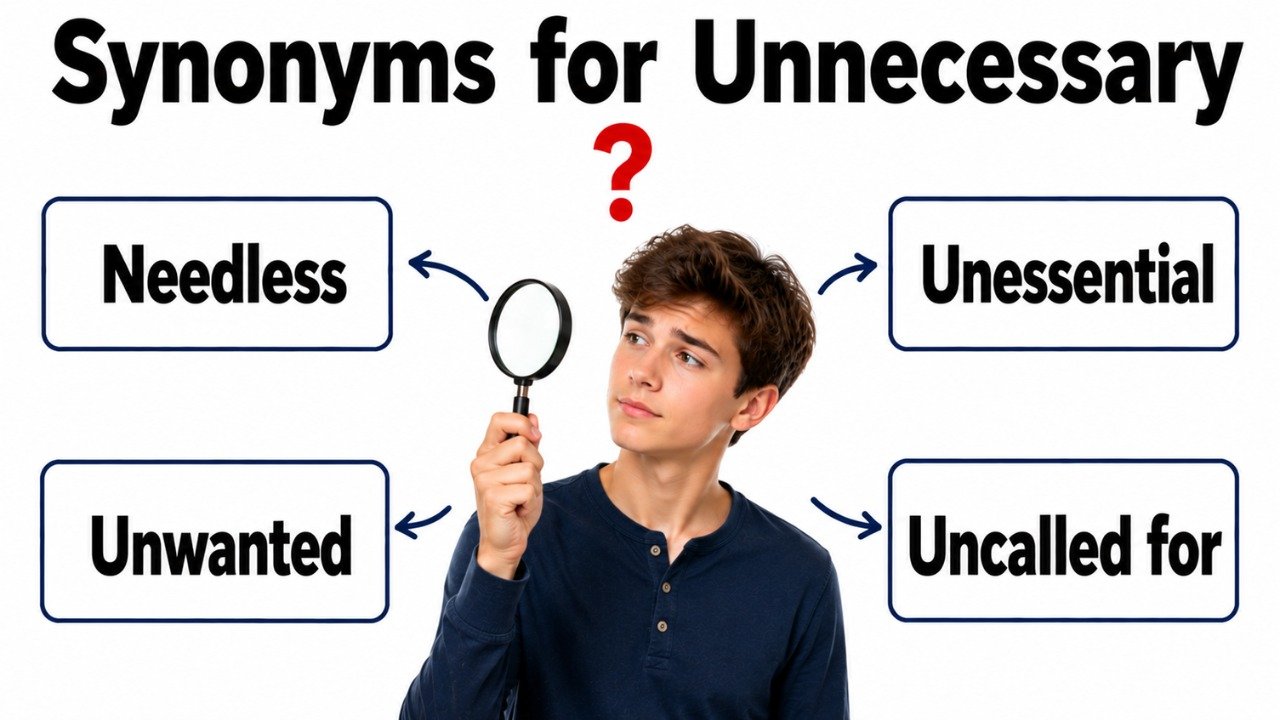
Quick Answer: The best synonyms for unnecessary include needless, avoidable, nonessential, superfluous, redundant, excessive, unneeded, unwarranted, gratuitous, and dispensable. Use needless for something that serves no useful purpose, avoidable for a problem that could have been prevented, redundant for repeated information, excessive for more than is reasonable, and superfluous for formal writing about extra details. Unwarranted describes something without a valid reason, while dispensable refers to something that can be removed without causing difficulty.
Pronunciation and Word Details
Word: Unnecessary.
Pronunciation: /ʌnˈnesəseri/.
Part of Speech: Adjective.
Meaning: Not needed, required, useful, or appropriate in a particular situation.
US Pronunciation:
UK Pronunciation:
What Does “Unnecessary” Mean?
Unnecessary means not needed, not required, or not useful in a particular situation. It is an adjective used to describe an action, object, expense, detail, risk, rule, or problem that could be removed or avoided.
The word often suggests that something adds no real value.
Example: The report contains several unnecessary details.
It can also describe something that causes avoidable trouble, expense, or discomfort.
Example: Poor planning created unnecessary delays.
Unnecessary may appear before a noun.
Example: The meeting involved unnecessary discussion.
It may also appear after a linking verb.
Example: A second meeting seems unnecessary.
The meaning changes slightly according to context. An unnecessary item is not needed. An unnecessary expense is not worth the cost. An unnecessary risk should not be taken. An unnecessary comment may be inappropriate or unhelpful.
The word does not always mean completely useless. Something may have a purpose but still be unnecessary because the same result can be achieved without it.
Meaning, Tone, and Context of “Unnecessary”
Unnecessary has a neutral but often critical tone. It communicates that something lacks a practical need, sufficient value, or reasonable justification.
Neutral Use: The word can simply identify something that is not required.
Example: You may remove any unnecessary files from the folder.
Critical Use: It can express disapproval when an action wastes time, money, or effort.
Example: The complicated process creates unnecessary work.
Formal Use: Unnecessary is suitable for reports, essays, policies, instructions, professional messages, and academic writing.
Example: The revised procedure eliminates unnecessary administrative tasks.
Conversational Use: The word is also natural in everyday speech.
Example: Buying another chair would be unnecessary.
Polite Use: It can soften a refusal by focusing on need rather than personal preference.
Example: Thank you for offering, but further assistance is unnecessary.
Strong Use: In discussions about danger, harm, or expense, the word may carry serious criticism.
Example: The decision placed workers at unnecessary risk.
Technical Use: It may describe extra processes, duplicated data, unused features, or inefficient steps.
Example: Removing unnecessary code may improve performance.
Unnecessary is usually less emotional than pointless or ridiculous. It is also broader than redundant, which specifically refers to repetition or duplication.
When and How to Use “Unnecessary”
For Items That Are Not Needed
Use unnecessary when an object, feature, or resource is not required.
Example: Remove unnecessary items from the work area.
For Avoidable Problems
Use unnecessary when better planning or behavior could have prevented a difficulty.
Example: Clear instructions can prevent unnecessary confusion.
For Excessive Spending
Use unnecessary when money is spent on something that provides little value.
Example: The family reduced unnecessary expenses.
For Repeated Information
Use unnecessary when words, facts, or details add nothing new.
Example: The editor removed unnecessary explanations from the article.
For Extra Steps
Use unnecessary when a process contains actions that do not improve the result.
Example: The new system removes several unnecessary steps.
For Unjustified Behavior
Use unnecessary when an action has no sufficient reason.
Example: His unnecessarily harsh response upset the entire group.
For Avoidable Risk
Use unnecessary when someone accepts danger without a meaningful benefit.
Example: Ignoring the warning would create an unnecessary risk.
For Formal Refusal
Use unnecessary to state politely that something is not required.
Example: A printed copy is unnecessary because the document is available digitally.
For Simplifying Writing
Use unnecessary when identifying words, phrases, examples, or sections that can be removed.
Example: Delete unnecessary words to make the sentence clearer.
For Evaluating Rules
Use unnecessary when a requirement creates effort without supporting a clear purpose.
Example: The committee reviewed whether the additional rule was unnecessary.
Best Synonyms for Unnecessary
Needless
Synonym: Not needed and serving no useful purpose.
Example: The argument caused needless tension between the teams.
Avoidable
Synonym: Capable of being prevented through better action or judgment.
Example: Careful preparation can reduce avoidable mistakes.
Nonessential
Synonym: Not required for the main purpose or result.
Example: Nonessential features were removed from the basic version.
Superfluous
Synonym: More than is needed or useful.
Example: The editor deleted several superfluous descriptions.
Redundant
Synonym: Repeated, duplicated, or no longer needed.
Example: The second paragraph was redundant because it repeated the introduction.
Excessive
Synonym: Greater than what is reasonable, necessary, or appropriate.
Example: Excessive decoration made the room feel crowded.
Unneeded
Synonym: Not required or wanted for a particular purpose.
Example: The update removed unneeded files.
Unwarranted
Synonym: Not justified by the facts or circumstances.
Example: The minor error received unwarranted criticism.
Gratuitous
Synonym: Included without a clear reason or useful purpose.
Example: The article contained gratuitous personal remarks.
Dispensable
Synonym: Able to be removed or omitted without causing a serious problem.
Example: Several dispensable tasks were removed from the schedule.
50 Synonyms for Unnecessary with Short Meanings
- Needless: Not needed or useful.
- Avoidable: Capable of being prevented.
- Nonessential: Not required for the main purpose.
- Superfluous: More than is needed.
- Redundant: Repeated or no longer required.
- Excessive: Greater than what is reasonable.
- Unneeded: Not required in the situation.
- Unwarranted: Lacking a valid reason or justification.
- Gratuitous: Added without a useful purpose.
- Dispensable: Able to be removed without serious loss.
- Inessential: Not necessary to the central purpose.
- Optional: Available by choice rather than required.
- Extraneous: Irrelevant or unrelated to the main subject.
- Surplus: Greater than the amount needed.
- Extra: Added beyond the normal requirement.
- Unrequired: Not demanded by a rule or situation.
- Unjustified: Not supported by a good reason.
- Uncalled For: Not appropriate, deserved, or necessary.
- Pointless: Having no useful purpose or result.
- Purposeless: Lacking a clear aim or function.
- Useless: Unable to provide practical value.
- Futile: Unlikely to produce a useful result.
- Wasteful: Using more time, money, or resources than needed.
- Irrelevant: Not connected to the subject or purpose.
- Immaterial: Not important to the matter being considered.
- Peripheral: Not central to the main issue.
- Incidental: Secondary rather than essential.
- Supplementary: Added to the main material but not always required.
- Expendable: Able to be removed, lost, or replaced.
- Removable: Capable of being taken away without damage.
- Preventable: Able to be stopped before occurring.
- Repetitive: Repeating the same material or action too often.
- Duplicative: Copying something that already exists.
- Tautological: Repeating the same meaning in different words.
- Pleonastic: Using more words than are needed to express a meaning.
- Overdone: Carried further than necessary or appropriate.
- Overstated: Expressed more strongly than the facts support.
- Overelaborate: More complicated or detailed than needed.
- Immoderate: Greater than reasonable limits.
- Noncritical: Not essential to success or safety.
- Nonmandatory: Not officially required.
- Noncompulsory: Not required by a rule or authority.
- Elective: Chosen voluntarily rather than required.
- Secondary: Less important than the main concern.
- Minor: Small or limited in importance.
- Trivial: Too unimportant to deserve serious attention.
- Unimportant: Having little relevance or value.
- Spare: Additional and available beyond immediate need.
- Supernumerary: Present in addition to the required number.
- Discardable: Able to be removed or thrown away without significant loss.
Read Also:
Synonyms for Humble
Synonyms for Unnecessary by Context
When Unnecessary Means Not Needed
Use these alternatives when something is not required for a purpose.
Needless: A clear and common replacement for something that has no practical need.
Example: The disagreement caused needless stress.
Unneeded: A direct word for something that is not required.
Example: Delete any unneeded documents.
Nonessential: Appropriate when something is useful but not required.
Example: Nonessential activities were postponed.
Inessential: A slightly more formal alternative to nonessential.
Example: The summary excludes inessential information.
Dispensable: Best when something can be removed without affecting the outcome.
Example: The committee identified several dispensable procedures.
When Unnecessary Means Avoidable
Use these synonyms when a problem could have been prevented.
Avoidable: Best for errors, delays, accidents, costs, and conflicts.
Example: Better communication would have prevented the avoidable dispute.
Preventable: Suitable for events that could be stopped through reasonable action.
Example: The investigation examined several preventable failures.
Needless: Useful when an avoidable event causes harm or difficulty.
Example: The misunderstanding led to needless anxiety.
Uncalled For: Suitable for behavior or comments that were not appropriate.
Example: The insulting remark was completely uncalled for.
When Unnecessary Means More Than Needed
Use these words when the amount, length, force, or detail is too great.
Excessive: Best for amounts, costs, pressure, noise, or behavior beyond reasonable limits.
Example: Excessive detail can make instructions difficult to follow.
Superfluous: A formal term for extra material that adds no value.
Example: The final paragraph was superfluous.
Surplus: Useful for extra goods, resources, staff, or amounts.
Example: The organization sold its surplus equipment.
Extra: A simple conversational word for something beyond the requirement.
Example: The extra explanation was unnecessary.
Immoderate: A formal word for something beyond reasonable limits.
Example: The proposal involved immoderate spending.
When Unnecessary Means Repeated
Use these alternatives when information, work, or content appears more than once.
Redundant: Best for duplicated information, positions, systems, or features.
Example: The editor removed a redundant sentence.
Repetitive: Suitable when the same idea or action occurs too frequently.
Example: The final section became repetitive.
Duplicative: Common in formal writing about repeated work, systems, or procedures.
Example: The departments combined their duplicative processes.
Tautological: Used when a statement repeats the same idea unnecessarily.
Example: The phrase was tautological because both words expressed the same meaning.
Pleonastic: A technical language term for using more words than necessary.
Example: The editor shortened the pleonastic expression.
When Unnecessary Means Unjustified
Use these words when an action lacks a sufficient reason.
Unwarranted: Best for criticism, concern, interference, or conclusions without proper support.
Example: The evidence did not support the unwarranted accusation.
Unjustified: Suitable when facts do not support an action, expense, or belief.
Example: The sudden increase in fees appeared unjustified.
Gratuitous: Best for remarks, violence, details, or actions added without a meaningful reason.
Example: The speaker avoided gratuitous criticism.
Uncalled For: A natural expression for rude, harsh, or inappropriate behavior.
Example: Her personal comment was uncalled for.
When Unnecessary Means Irrelevant
Use these alternatives when information does not support the main subject.
Extraneous: Best for details that come from outside the central issue.
Example: Remove extraneous information from the application.
Irrelevant: Suitable for facts that do not relate to the question.
Example: The response included several irrelevant examples.
Immaterial: A formal term for information that does not affect a decision.
Example: The minor date difference was immaterial to the conclusion.
Peripheral: Appropriate for an issue that is related but not central.
Example: The discussion focused too heavily on peripheral concerns.
When Unnecessary Means Without Purpose
Use these alternatives when an action has no useful aim or likely result.
Pointless: A direct word for something that serves no useful purpose.
Example: Continuing the argument seemed pointless.
Purposeless: Best for an action that lacks a clear aim.
Example: The changes appeared random and purposeless.
Futile: Suitable for an effort that is unlikely to succeed.
Example: Further debate would be futile without additional evidence.
Useless: Stronger than unnecessary because it suggests no practical value.
Example: The damaged tool was useless.
Wasteful: Best when unnecessary activity consumes time, money, energy, or materials.
Example: Printing hundreds of unused copies was wasteful.
When Unnecessary Means Optional
Use these alternatives when something may be included but is not required.
Optional: The clearest word for something available by choice.
Example: Attendance at the evening session is optional.
Nonmandatory: Suitable for rules, programs, and official requirements.
Example: The additional workshop is nonmandatory.
Noncompulsory: A formal word for something that people do not have to complete.
Example: Participation in the survey is noncompulsory.
Elective: Common for courses or activities chosen voluntarily.
Example: Art is an elective subject in the program.
Supplementary: Suitable for additional material that supports the main content.
Example: The teacher provided supplementary reading.
Another Word for Unnecessary
The best general replacement for unnecessary is needless. It is natural, widely understood, and suitable for actions, expenses, problems, risks, and complications that serve no useful purpose.
The most accurate alternative depends on context. Use avoidable for preventable problems, redundant for repeated material, excessive for unreasonable amounts, superfluous for formal writing, and unwarranted for something lacking justification.
Original: The change caused unnecessary confusion.
Better Option: The change caused needless confusion.
Original: The report contains unnecessary repetition.
Better Option: The report contains redundant material.
Original: The department introduced unnecessary rules.
Better Option: The department introduced superfluous rules.
Original: The delay created unnecessary costs.
Better Option: The delay created avoidable costs.
When Not to Use “Unnecessary”
Unnecessary is broad and useful, but another word may communicate the exact problem more clearly.
When Something Is Repeated
Use redundant, repetitive, or duplicative when repetition is the main issue.
Weak: The second explanation was unnecessary.
Better: The second explanation was redundant.
When an Amount Is Too Great
Use excessive when something is necessary in a smaller amount.
Weak: The project required unnecessary spending.
Better: The project involved excessive spending.
When a Problem Could Have Been Prevented
Use avoidable or preventable to emphasize responsibility or missed opportunities.
Weak: The mistake caused unnecessary delays.
Better: The avoidable mistake caused significant delays.
When Something Is Completely Useless
Unnecessary may sound too mild when an object or action has no practical value.
Weak: The broken device is unnecessary.
Better: The broken device is useless.
When an Effort Cannot Succeed
Use futile when the issue is the lack of a possible result.
Weak: Further attempts would be unnecessary.
Better: Further attempts would be futile.
When Information Is Unrelated
Use irrelevant or extraneous when the content does not support the topic.
Weak: The report contains unnecessary information.
Better: The report contains irrelevant information.
When an Action Lacks Justification
Use unwarranted or unjustified when there is no valid reason for an action.
Weak: The manager expressed unnecessary concern.
Better: The manager expressed unwarranted concern.
When Something Is Simply a Choice
Use optional rather than unnecessary when an item may still be useful.
Weak: The evening workshop is unnecessary.
Better: The evening workshop is optional.
When the Word Sounds Too Critical
Unnecessary can imply that someone used poor judgment. Choose optional, additional, or supplementary when a neutral tone is more appropriate.
Weak: The guide includes unnecessary examples for advanced readers.
Better: The guide includes supplementary examples for readers who want more practice.
When the Sentence Is Vague
Identify what makes the thing unnecessary.
Weak: The process includes unnecessary parts.
Better: The process includes three redundant approval stages.
Words Commonly Confused With Unnecessary
Unnecessary vs Needless: Both mean not needed. Needless often emphasizes that harm, trouble, or effort serves no useful purpose. Unnecessary is broader and more neutral.
Unnecessary vs Redundant: Unnecessary means not required. Redundant specifically means repeated, duplicated, or no longer useful.
Unnecessary vs Excessive: Unnecessary means that something is not needed at all. Excessive means that some amount may be needed, but the amount is too great.
Unnecessary vs Avoidable: Unnecessary describes something that is not needed. Avoidable describes something that could have been prevented.
Unnecessary vs Optional: Unnecessary suggests that something adds little or no value. Optional means that people may choose whether to include or do it.
Unnecessary vs Superfluous: Both describe something beyond what is needed. Superfluous is more formal and often refers to extra details, words, features, or possessions.
Unnecessary vs Irrelevant: Unnecessary means not required for the purpose. Irrelevant means not related to the subject.
Unnecessary vs Useless: Unnecessary means not needed in a particular situation. Useless means unable to perform a useful function.
Unnecessary vs Futile: Unnecessary means not required. Futile describes an action that is unlikely to succeed.
Unnecessary vs Unwarranted: Unnecessary focuses on lack of need. Unwarranted focuses on lack of evidence, permission, or justification.
Which Synonym Should You Choose?
For General Writing: Choose needless when something serves no useful purpose.
For Formal Writing: Choose superfluous or inessential when discussing extra material, details, or requirements.
For Academic Essays: Choose extraneous for unrelated information and redundant for repeated points.
For Reports: Choose duplicative for repeated procedures and nonessential for items that are not central.
For Avoidable Problems: Choose avoidable or preventable for delays, errors, costs, accidents, and disputes.
For Repeated Information: Choose redundant, repetitive, tautological, or duplicative.
For Excessive Amounts: Choose excessive, surplus, immoderate, or overdone.
For Unjustified Actions: Choose unwarranted, unjustified, gratuitous, or uncalled for.
For Casual Speech: Choose needless, extra, pointless, or not needed.
For Polite Communication: Choose optional, nonessential, or not required.
For Rules and Requirements: Choose nonmandatory, noncompulsory, elective, or optional.
For Expenses: Choose avoidable when the cost could have been prevented and wasteful when resources were used carelessly.
For Descriptions and Details: Choose superfluous, extraneous, or irrelevant.
For Failed Efforts: Choose futile when an action cannot achieve the desired result.
For Removable Features: Choose dispensable, expendable, or noncritical.
For Emails: Choose unnecessary for a neutral professional tone and redundant when discussing repeated messages or information.
For Conversation: Choose not needed, extra, pointless, or needless according to the strength of your criticism.
Real Life Examples of “Unnecessary” in Sentences
Original: The long introduction contains unnecessary details.
Better Option: The long introduction contains superfluous details.
Original: Poor communication caused unnecessary confusion.
Better Option: Poor communication caused avoidable confusion.
Original: The application asks several unnecessary questions.
Better Option: The application asks several irrelevant questions.
Original: The second approval stage is unnecessary.
Better Option: The second approval stage is redundant.
Original: The team made an unnecessary attempt to repair the damaged part.
Better Option: The team made a futile attempt to repair the damaged part.
Original: The manager gave the employee unnecessary criticism.
Better Option: The manager gave the employee unwarranted criticism.
Original: The project included unnecessary spending.
Better Option: The project included excessive spending.
Original: The speech included an unnecessary personal comment.
Better Option: The speech included a gratuitous personal comment.
Original: An additional printed copy is unnecessary.
Better Option: An additional printed copy is optional.
Original: The complicated form creates unnecessary work.
Better Option: The complicated form creates needless work.
Synonym Groups and Usage Differences
Lack of Need Group
This group includes needless, unneeded, nonessential, inessential, and dispensable. These words describe something that is not required for a purpose.
Needless is common and often critical. Unneeded is direct and practical. Nonessential and inessential are more neutral. Dispensable emphasizes that something can be removed.
Example: The revised plan removes several nonessential tasks.
Avoidability Group
This group includes avoidable, preventable, needless, and unnecessary. These words describe problems that did not have to happen.
Avoidable often suggests that better decisions could have prevented the result. Preventable is especially suitable for accidents, errors, harm, or failures.
Example: Most of the delays were avoidable.
Excess Group
This group includes excessive, superfluous, surplus, extra, immoderate, and overdone. These words describe something beyond a reasonable or required amount.
Excessive emphasizes quantity or degree. Superfluous describes material that adds no value. Surplus refers to an amount beyond current need. Overdone often describes style, decoration, or effort.
Example: The presentation contained excessive technical detail.
Repetition Group
This group includes redundant, repetitive, duplicative, tautological, and pleonastic. These terms identify repeated information, actions, or meanings.
Redundant is the most common choice. Duplicative is useful in professional writing. Tautological and pleonastic are technical terms used in language analysis.
Example: The final two sentences were redundant.
Lack of Relevance Group
This group includes irrelevant, extraneous, immaterial, peripheral, and incidental. These words describe content that does not support the main issue.
Irrelevant is direct. Extraneous is more formal. Immaterial means that information does not affect the decision. Peripheral describes something connected but not central.
Example: The editor removed extraneous background information.
Lack of Justification Group
This group includes unwarranted, unjustified, gratuitous, and uncalled for. These words describe actions or reactions that lack a good reason.
Unwarranted is suitable for concern, criticism, assumptions, and interference. Gratuitous often describes details or behavior included without a clear purpose. Uncalled for is more conversational.
Example: The evidence led to unwarranted speculation.
Lack of Purpose Group
This group includes pointless, purposeless, useless, futile, and wasteful. These words are generally stronger than unnecessary.
Pointless means that something has no meaningful purpose. Futile means an attempt is unlikely to succeed. Wasteful emphasizes poor use of resources.
Example: Continuing the same argument would be pointless.
Optionality Group
This group includes optional, nonmandatory, noncompulsory, elective, and supplementary. These terms describe things that may be chosen but are not required.
Optional is the clearest general choice. Elective is common in education. Supplementary describes material that supports the main content.
Example: The final practice activity is optional.
Removability Group
This group includes dispensable, expendable, removable, discardable, and noncritical. These words describe things that can be removed without seriously affecting the result.
Dispensable is usually neutral. Expendable can sound harsh when used for people. Noncritical is common in technical or operational contexts.
Example: The system can operate without the noncritical feature.
Antonyms of Unnecessary
The opposite of unnecessary depends on whether the sentence refers to need, importance, usefulness, obligation, or relevance.
Necessary: Needed to achieve a purpose or result.
Essential: Absolutely required or extremely important.
Required: Demanded by a rule, condition, or situation.
Needed: Necessary for a particular purpose.
Indispensable: So important that it cannot be removed or replaced.
Vital: Extremely important for success, health, or survival.
Crucial: Decisive or extremely important.
Important: Having significant value or influence.
Relevant: Directly connected to the subject.
Useful: Able to provide practical value.
Helpful: Making a task, situation, or result easier or better.
Justified: Supported by a valid reason or evidence.
Warranted: Appropriate and supported by the circumstances.
Mandatory: Officially required.
Compulsory: Required by a rule or authority.
Obligatory: Required by law, duty, or custom.
Beneficial: Producing a helpful or positive result.
Purposeful: Having a clear aim or intention.
Meaningful: Having value, importance, or purpose.
Critical: Essential to success, safety, or operation.
Comparison: Unnecessary vs Related Words
Unnecessary vs Needless
Unnecessary is a broad word for anything that is not required. Needless often emphasizes avoidable harm, effort, trouble, or worry.
Example With Unnecessary: The form includes an unnecessary section.
Example With Needless: The error caused needless anxiety.
Unnecessary vs Redundant
Unnecessary refers to anything not needed. Redundant specifically describes repeated information, duplicated work, or something no longer required.
Example With Unnecessary: The additional meeting was unnecessary.
Example With Redundant: The second summary was redundant.
Unnecessary vs Excessive
Unnecessary means that something is not required. Excessive means that the amount or degree is greater than necessary.
Example With Unnecessary: A second copy is unnecessary.
Example With Excessive: The report contains excessive detail.
Unnecessary vs Avoidable
Unnecessary describes a lack of need. Avoidable emphasizes that an unwanted event could have been prevented.
Example With Unnecessary: The additional step is unnecessary.
Example With Avoidable: The delay was avoidable.
Unnecessary vs Optional
Unnecessary suggests that something is not useful or required. Optional means that it is available but not compulsory.
Example With Unnecessary: Repeating the explanation is unnecessary.
Example With Optional: The final activity is optional.
Unnecessary vs Superfluous
Both words refer to something beyond what is needed. Superfluous is more formal and often used for words, details, possessions, or features.
Example With Unnecessary: The report includes unnecessary information.
Example With Superfluous: The editor removed superfluous descriptions.
Unnecessary vs Irrelevant
Unnecessary means not required. Irrelevant means not connected to the subject or decision.
Example With Unnecessary: The extra signature is unnecessary.
Example With Irrelevant: The applicant included irrelevant personal details.
Unnecessary vs Useless
Unnecessary means not needed in the present situation. Useless means unable to provide any practical benefit.
Example With Unnecessary: Another calculator is unnecessary.
Example With Useless: The broken calculator is useless.
Unnecessary vs Futile
Unnecessary describes something that does not need to be done. Futile describes an effort that cannot produce the desired result.
Example With Unnecessary: Another discussion is unnecessary.
Example With Futile: Another attempt to repair the destroyed document would be futile.
Unnecessary vs Unwarranted
Unnecessary focuses on need. Unwarranted focuses on whether evidence or circumstances justify an action.
Example With Unnecessary: The additional inspection was unnecessary.
Example With Unwarranted: The available facts did not support the unwarranted accusation.
Common Phrases and Expressions With “Unnecessary”
Unnecessary Delay: A delay that could have been prevented or avoided.
Unnecessary Expense: Money spent without sufficient need or benefit.
Unnecessary Risk: Danger accepted without a reasonable purpose.
Unnecessary Detail: Information that does not improve understanding.
Unnecessary Repetition: Words, ideas, or actions repeated without adding value.
Unnecessary Stress: Worry or pressure that could have been avoided.
Unnecessary Confusion: Misunderstanding caused by unclear or excessive information.
Unnecessary Complication: A difficulty added without improving the result.
Unnecessary Work: Effort that does not contribute meaningfully to the goal.
Unnecessary Comment: A remark that is irrelevant, unhelpful, or inappropriate.
Common Mistakes to Avoid
Using Unnecessary When You Mean Excessive
Something can be necessary in a smaller amount but excessive in its current amount.
Weak: The hospital used unnecessary safety measures.
Better: The hospital used excessive safety measures.
The first sentence suggests that no safety measures were needed. The second correctly states that the number or degree was too great.
Using Unnecessary When You Mean Redundant
Use redundant when something repeats information or work that already exists.
Weak: The final paragraph is unnecessary because it repeats the introduction.
Better: The final paragraph is redundant because it repeats the introduction.
Confusing Unnecessary With Optional
Optional does not mean useless. An optional activity may still be valuable.
Weak: The additional practice exercise is unnecessary for interested learners.
Better: The additional practice exercise is optional.
Using Useless as an Exact Replacement
Useless is stronger than unnecessary. An unnecessary object may still work perfectly.
Weak: The spare chair is useless because nobody needs it today.
Better: The spare chair is currently unnecessary.
Using Avoidable for Objects
Avoidable usually describes events, problems, costs, mistakes, or consequences rather than physical objects.
Unnatural: The extra chair is avoidable.
Natural: The extra chair is unnecessary.
Using Unwarranted Without a Question of Justification
Unwarranted is best when evidence or circumstances do not support an action.
Weak: The unused cable is unwarranted.
Better: The unused cable is unnecessary.
Repeating Unnecessary Too Often
Repeated use can make writing sound vague and monotonous.
Repetitive: The unnecessary meeting caused unnecessary delays and unnecessary expenses.
Improved: The needless meeting caused avoidable delays and excessive expenses.
Failing to Explain Why Something Is Unnecessary
A judgment is more convincing when it includes a reason.
Vague: The new rule is unnecessary.
Clear: The new rule is unnecessary because the existing policy already addresses the issue.
Using More Unnecessary Incorrectly
More unnecessary is grammatically possible when comparing degrees, but it often sounds awkward. A more precise word is usually better.
Awkward: The second approval is more unnecessary than the first.
Better: The second approval is even less useful than the first.
Confusing Unnecessary With Not Possible
Unnecessary means not needed, not impossible.
Incorrect: Completing the task today is unnecessary because the equipment is broken.
Better: Completing the task today is impossible because the equipment is broken.
Using a Strong Synonym in a Polite Message
Pointless, useless, and futile can sound harsh.
Harsh: Your additional explanation is pointless.
Polite: An additional explanation is unnecessary.
Writing Unnecessary as Two Words
Unnecessary is written as one word.
Incorrect: The additional step is un necessary.
Correct: The additional step is unnecessary.
Conclusion
The most useful synonyms for unnecessary include needless, avoidable, nonessential, superfluous, redundant, excessive, unwarranted, and dispensable. Use needless for trouble with no purpose, avoidable for preventable problems, redundant for repeated information, and excessive for unreasonable amounts. Superfluous works well in formal writing, while optional is better for something available by choice. Understanding these differences helps you select synonyms for unnecessary that make reports, essays, emails, instructions, and everyday conversations clearer and more precise.
FAQs About Synonyms for Unnecessary
What Is the Best Synonym for Unnecessary?
Needless is the best general synonym for unnecessary. It describes something that is not needed and serves no useful purpose.
What Is a Formal Synonym for Unnecessary?
Superfluous, inessential, extraneous, and dispensable are useful formal alternatives. The best choice depends on whether the issue involves excess, relevance, or importance.
Are Unnecessary and Redundant the Same?
Not exactly. Unnecessary means not needed, while redundant specifically describes something repeated, duplicated, or no longer required.
What Word Means an Unnecessary Expense?
Avoidable expense is appropriate when the cost could have been prevented. Wasteful expense emphasizes careless use of money, while excessive expense refers to an unreasonable amount.
What Is a Polite Alternative to Unnecessary?
Optional, nonessential, not required, and supplementary are polite alternatives. They sound less critical than pointless or useless.
Can Excessive Replace Unnecessary?
Only when some amount is needed but the actual amount is too great. Excessive does not mean completely unnecessary.
What Is the Opposite of Unnecessary?
Common opposites include necessary, essential, required, indispensable, relevant, useful, mandatory, and justified.
