
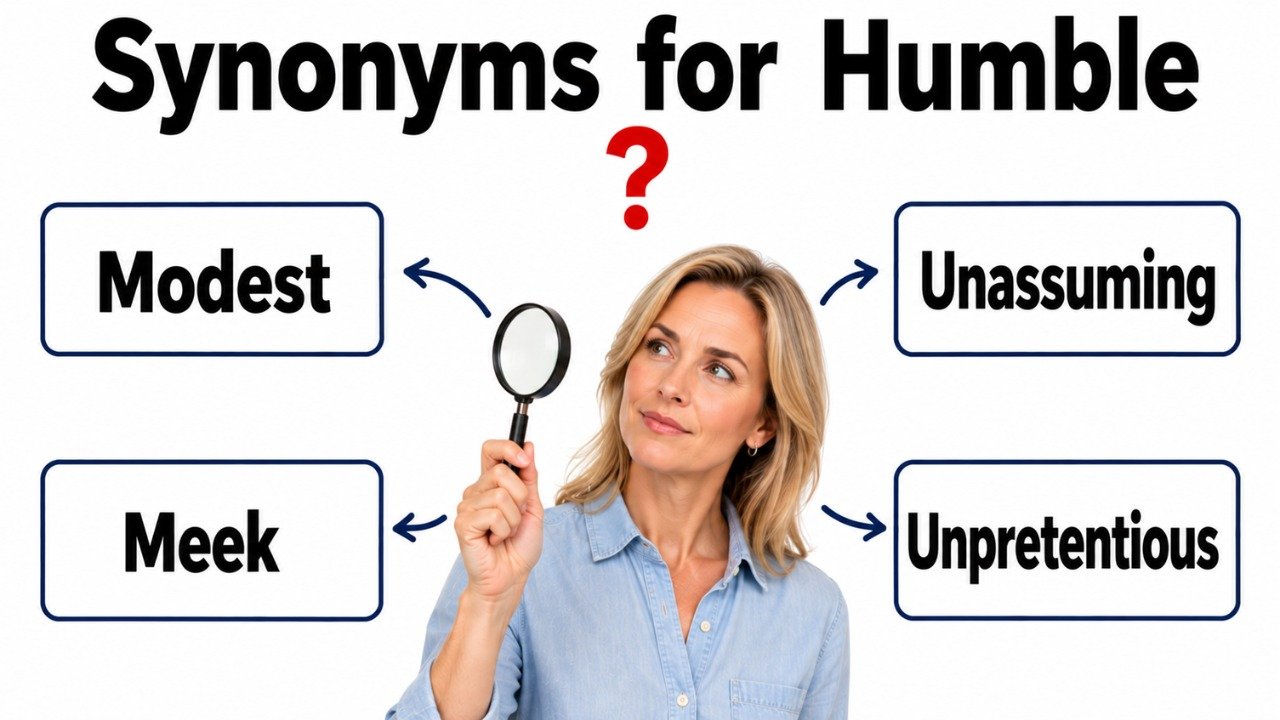
Quick Answer: The best synonyms for humble include modest, unassuming, unpretentious, meek, respectful, gracious, down to earth, lowly, simple, and self effacing. Modest is the strongest general replacement for someone who does not boast about achievements. Unassuming and unpretentious suit people who do not seek attention or status. Meek describes a gentle and submissive personality. Respectful and gracious work well for polite behavior. Lowly describes a lower position, while simple can describe an ordinary lifestyle, home, or background. These synonyms for humble should be chosen according to tone, meaning, and sentence context.
Pronunciation and Word Details
Word: Humble.
Pronunciation: /ˈhʌm.bəl/.
Part of Speech: Adjective and verb.
Meaning: Not proud or boastful, simple in status, or made to recognize personal limits.
US Pronunciation:
UK Pronunciation:
What Does “Humble” Mean?
Humble means not believing or acting as though you are more important than other people. As an adjective, it commonly describes a modest person who does not boast about abilities, success, wealth, or social position.
The word can also describe something simple, ordinary, or limited in size and importance. A humble home is usually plain rather than luxurious. Humble beginnings refer to an ordinary or financially limited background.
As a verb, humble means to reduce someone’s pride, make someone recognize personal limitations, or defeat someone who was overly confident.
Personality: A humble person recognizes personal strengths without acting superior.
Behavior: She remained humble after receiving the award.
Background: He came from a humble family with limited resources.
Possession: They welcomed us into their humble home.
Verb Use: The unexpected defeat humbled the confident team.
Humble can therefore express modesty, simplicity, respect, low status, limited resources, or the reduction of excessive pride.
Meaning, Tone, and Context of “Humble”
Humble usually has a positive, respectful, and approving tone when it describes a person’s character. It suggests that someone is aware of personal abilities but does not seek excessive praise or attention.
The word is common in formal writing, casual conversation, personal descriptions, speeches, essays, biographies, and professional communication. It may describe leaders, students, athletes, artists, workers, or anyone who treats others with respect despite personal success.
Humble can also have a neutral or slightly negative meaning when it describes low status, limited wealth, or an ordinary background. In older or literary writing, it may refer to a low social rank.
Positive Tone: She is talented but remains humble.
Respectful Tone: He gave a humble response to the praise.
Formal Tone: The speaker expressed humble gratitude for the recognition.
Conversational Tone: She is successful, but she is still down to earth.
Economic Context: He grew up in humble circumstances.
Literary Context: The ruler listened to the concerns of his humblest citizens.
As a verb, humble may sound strong because it suggests that someone’s pride has been reduced through failure, correction, embarrassment, or defeat.
Strong Verb Use: The loss humbled the previously unbeaten competitor.
When and How to Use “Humble”
For a Modest Personality
Use humble to describe someone who does not boast, seek constant praise, or act superior.
Example: Despite her remarkable talent, she remained humble.
For Success Without Arrogance
Use humble when a successful person continues to behave respectfully and modestly.
Example: The successful writer was humble about her achievements.
For Respectful Communication
Use humble to express politeness, gratitude, or respect, especially in formal statements.
Example: I offer my humble thanks to everyone who supported the project.
For Recognizing Personal Limits
Use humble when someone accepts that they do not know everything or cannot succeed alone.
Example: A humble learner is willing to listen and improve.
For a Simple Lifestyle
Use humble to describe a life that is ordinary, modest, or free from luxury.
Example: They lived a humble life in a quiet village.
For an Ordinary Home or Possession
Use humble for something that is simple, small, or not expensive.
Example: The family invited us into their humble home.
For a Modest Background
Use humble when describing a person who began life with limited wealth, status, or opportunity.
Example: She rose from humble beginnings to become a respected leader.
For Low Rank or Position
Use humble when referring to a position that has little authority, importance, or prestige.
Example: He began his career in a humble office role.
For Reducing Pride
Use humble as a verb when an experience causes someone to become less proud.
Example: The difficult experience humbled him and changed his attitude.
For Defeat or Correction
Use humble when an overly confident person or group is clearly defeated or corrected.
Example: The new team humbled the defending champions.
Best Synonyms for Humble
Modest
Synonym: Not boastful or overly proud about abilities, success, or possessions.
Example: She remained modest despite receiving several awards.
Unassuming
Synonym: Not seeking attention or acting important.
Example: His unassuming manner made everyone feel comfortable.
Unpretentious
Synonym: Natural and sincere without trying to appear impressive.
Example: They chose an unpretentious restaurant with a relaxed atmosphere.
Meek
Synonym: Quiet, gentle, and willing to accept the authority of others.
Example: His meek response surprised those who expected an argument.
Self Effacing
Synonym: Avoiding attention and speaking modestly about personal abilities.
Example: Her self effacing humor made her achievements seem less important.
Down to Earth
Synonym: Practical, friendly, and unaffected by status or success.
Example: The famous performer remained down to earth and approachable.
Respectful
Synonym: Showing consideration and proper regard for other people.
Example: The student gave a respectful answer to the teacher.
Gracious
Synonym: Polite, kind, and modest, especially when receiving praise or success.
Example: She was gracious when accepting the honor.
Lowly
Synonym: Having a low position, rank, status, or level of importance.
Example: He began in a lowly position and gradually earned greater responsibility.
Simple
Synonym: Plain, ordinary, and without luxury or unnecessary display.
Example: They preferred a simple life away from unnecessary attention.
50 Synonyms for Humble with Short Meanings
- Modest: Not boastful about abilities, success, or possessions.
- Unassuming: Not seeking attention or acting important.
- Unpretentious: Natural and not designed to impress others.
- Self Effacing: Directing attention away from personal achievements.
- Down to Earth: Practical, friendly, and unaffected by status.
- Meek: Quiet, gentle, and not forcefully assertive.
- Mild: Gentle in personality, behavior, or manner.
- Gentle: Kind, calm, and not harsh or forceful.
- Reserved: Quiet and controlled in expressing thoughts or emotions.
- Quiet: Not loud, boastful, or demanding attention.
- Soft Spoken: Speaking calmly and gently.
- Respectful: Showing consideration and proper regard for others.
- Deferential: Showing respect for another person’s authority or experience.
- Courteous: Polite and considerate in behavior.
- Gracious: Kind, polite, and modest when receiving praise.
- Polite: Behaving with good manners and respect.
- Considerate: Thinking carefully about the feelings and needs of others.
- Unobtrusive: Not attracting unnecessary attention.
- Retiring: Quiet, shy, and unwilling to seek attention.
- Unassertive: Not strongly expressing personal opinions or demands.
- Timid: Lacking confidence or courage in social situations.
- Submissive: Willing to accept another person’s control or authority.
- Docile: Calm, obedient, and easy to guide.
- Compliant: Willing to follow instructions, rules, or requests.
- Lowly: Having little rank, status, or importance.
- Ordinary: Normal and not especially important or impressive.
- Plain: Simple and without decoration or luxury.
- Simple: Basic, modest, and free from unnecessary display.
- Basic: Limited to essential features or needs.
- Poor: Having little money or few material resources.
- Meager: Small or insufficient in amount or quality.
- Small: Limited in size, scale, or importance.
- Limited: Restricted in amount, power, wealth, or opportunity.
- Common: Ordinary and not connected with high social status.
- Unsophisticated: Simple and lacking fashionable or advanced qualities.
- Rustic: Simple and connected with rural life.
- Unadorned: Plain and without decoration.
- Austere: Simple and without comfort, luxury, or decoration.
- Spartan: Very simple and containing only what is necessary.
- Menial: Relating to work considered low in status or importance.
- Chastened: Made less proud through criticism or experience.
- Abashed: Embarrassed and less confident after a mistake.
- Contrite: Feeling sincere regret for wrongdoing.
- Remorseful: Feeling deep regret about an action.
- Penitent: Feeling sorry and willing to correct wrongdoing.
- Subdued: Made quieter, calmer, or less confident.
- Deflated: Having lost confidence, pride, or enthusiasm.
- Defeated: Overcome in a contest, argument, or challenge.
- Brought Low: Reduced in pride, power, or position.
- Humiliated: Made to feel ashamed or lose dignity.
Read Also:
Synonyms for Students

Synonyms for Humble by Context
When Humble Means Modest
The strongest synonyms are modest, unassuming, self effacing, reserved, quiet, and down to earth.
Modest is the most flexible replacement. It describes someone who does not exaggerate achievements or seek excessive praise. Unassuming suggests that a person does not behave as though they are important. Self effacing describes someone who deliberately avoids drawing attention to personal success.
Example With Humble: She remained humble after winning the competition.
Example With Modest: She remained modest after winning the competition.
Example With Unassuming: Her unassuming response made her success even more admirable.
When Humble Means Unpretentious
Useful synonyms include unpretentious, simple, plain, natural, unadorned, and down to earth.
Unpretentious describes a person, place, or object that does not try to appear more important, fashionable, or expensive than it really is.
Example With Humble: They stayed in a humble guesthouse.
Example With Unpretentious: They stayed in an unpretentious guesthouse.
Example With Simple: They stayed in a simple guesthouse.
When Humble Means Respectful
Use respectful, deferential, courteous, polite, gracious, and considerate when humble describes someone’s attitude toward others.
Respectful is neutral and widely useful. Deferential suggests special respect for someone with authority, experience, or higher rank. Gracious describes kind and modest behavior, particularly when receiving praise.
Example: The employee gave a respectful response to the criticism.
Example: She was gracious when others praised her work.
When Humble Means Meek
Useful alternatives include meek, mild, gentle, submissive, docile, unassertive, and timid.
Meek and submissive can suggest a lack of confidence or power, while humble does not necessarily imply weakness. A humble person may be confident but choose not to boast.
Example With Humble: He was humble but confident.
Example With Meek: He gave a meek reply and avoided disagreement.
When Humble Means Simple or Poor
Use simple, plain, ordinary, poor, meager, basic, rustic, austere, or spartan when humble refers to living conditions, possessions, or surroundings.
Simple and plain are often neutral. Poor directly refers to limited financial resources. Austere and spartan describe conditions without comfort or decoration.
Example: She grew up in a simple rural home.
Example: The room was spartan but clean.
When Humble Means Low in Status
Use lowly, ordinary, common, menial, or limited when humble describes social rank, employment, or importance.
Lowly is the closest option for a position of little rank or prestige. Menial is usually applied to work that is considered unskilled or low in status.
Example: He started in a lowly position within the organization.
Example: She performed menial tasks before earning a leadership role.
When Humble Means Made Less Proud
Use chastened, subdued, deflated, abashed, brought low, or defeated when humble functions as a verb.
Chastened suggests that someone learned a lesson through criticism or failure. Deflated describes a sudden loss of pride or confidence. Subdued suggests that someone became quieter or less forceful.
Example With Humbled: The disappointing result humbled the confident player.
Example With Chastened: The confident player was chastened by the disappointing result.
Example With Deflated: The result left the player feeling deflated.
Another Word for Humble
Modest is usually the best single replacement for humble when describing a person who does not boast or act superior. However, the best alternative depends on the intended meaning.
Use unassuming for someone who avoids attention, unpretentious for a natural person or simple place, lowly for rank, simple for living conditions, and chastened when someone has been made less proud.
Original: She is humble about her achievements.
Better Option: She is modest about her achievements.
Original: He remained humble despite his fame.
Better Option: He remained down to earth despite his fame.
Original: They lived in a humble house near the village.
Better Option: They lived in a simple house near the village.
Original: The defeat made the team humble.
Better Option: The defeat left the team chastened.
When Not to Use “Humble”
Do not use humble when a more specific word would communicate the intended meaning more clearly.
Humble can describe modesty, simplicity, low status, or reduced pride. Without enough context, readers may not know which meaning is intended.
Weak: She has a humble personality.
Better: She has a modest and unassuming personality.
Avoid using humble as a synonym for shy when the person is simply nervous or uncomfortable around others.
Weak: He was too humble to speak during the meeting.
Better: He was too shy to speak during the meeting.
Do not use humble when submissive is the intended meaning. Humility does not require someone to accept unfair treatment or avoid expressing an opinion.
Weak: Good employees should be humble and never question a decision.
Better: Good employees should be respectful while expressing reasonable concerns.
Avoid using humble to describe poverty when the financial meaning needs to be direct.
Weak: The family was very humble and could not afford food.
Better: The family was poor and could not afford enough food.
Do not use humble when you mean humiliated. Humble is often positive, while humiliated refers to painful embarrassment and loss of dignity.
Weak: He felt humble when everyone laughed at his mistake.
Better: He felt humiliated when everyone laughed at his mistake.
Avoid repeated use of humble when describing several qualities.
Weak: She was humble, gave a humble speech, and accepted the award in a humble way.
Better: She was modest, gave a gracious speech, and accepted the award without seeking attention.
Do not confuse a humble person with someone who lacks confidence. A person can be highly confident and still remain modest.
Weak: She does not believe in her abilities because she is humble.
Better: She believes in her abilities but does not boast about them.
Words Commonly Confused With Humble
Humble vs Modest: Humble describes a lack of excessive pride and may also describe simple circumstances. Modest usually focuses on avoiding boastfulness or excessive display.
Humble vs Meek: Humble suggests modesty and respect. Meek suggests gentleness, submission, or unwillingness to oppose others.
Humble vs Shy: Humble refers to attitude and pride. Shy refers to nervousness or discomfort in social situations.
Humble vs Unassuming: Humble is broad and can describe personality, status, or circumstances. Unassuming mainly describes someone who does not seek attention or appear important.
Humble vs Unpretentious: Humble often describes modest character. Unpretentious describes someone or something that does not try to appear impressive or sophisticated.
Humble vs Respectful: Humble concerns how someone views personal importance. Respectful concerns how someone treats other people.
Humble vs Submissive: Humble people can confidently express opinions without boasting. Submissive people tend to accept another person’s authority or control.
Humble vs Lowly: Humble may be a positive personality trait. Lowly usually refers to a low rank, position, or social level.
Humble vs Humiliated: Humble is often positive and voluntary. Humiliated means deeply embarrassed or made to feel ashamed.
Humble vs Chastened: Humble may describe a lasting personality trait. Chastened describes someone whose confidence or pride has been reduced by a difficult experience.
Which Synonym Should You Choose?
Choose modest when describing someone who does not boast about talent, success, wealth, or achievements.
Choose unassuming when describing someone who avoids attention and does not act important.
Choose unpretentious when describing a natural person, simple place, or ordinary lifestyle without artificial display.
Choose down to earth in casual speech when someone remains practical and approachable despite success or fame.
Choose self effacing when someone deliberately minimizes personal achievements or redirects praise.
Choose respectful in emails, professional communication, and reports when focusing on polite treatment of other people.
Choose deferential in formal writing when someone shows special respect toward authority, rank, age, or experience.
Choose gracious when describing kind and modest behavior while receiving praise, awards, criticism, or success.
Choose meek when emphasizing gentleness and unwillingness to argue, but remember that it can suggest weakness.
Choose simple or plain when describing a home, lifestyle, meal, background, or possession without luxury.
Choose lowly when discussing a position, rank, or role with little importance or prestige.
Choose poor when financial hardship is the intended meaning.
Choose menial for work that is considered low in status or requires little specialized skill.
Choose chastened when someone has learned humility through criticism, failure, or correction.
Choose deflated when someone has suddenly lost pride, confidence, or enthusiasm.
Choose humiliated only when someone has suffered painful embarrassment or loss of dignity.
In essays and formal reports, modest, unassuming, respectful, and unpretentious are usually clearer than conversational expressions. In casual conversation, down to earth often sounds natural and friendly.
Real Life Examples of “Humble” in Sentences
Original: She remained humble after receiving the promotion.
Better Option: She remained modest after receiving the promotion.
Original: The successful actor was surprisingly humble.
Better Option: The successful actor was surprisingly down to earth.
Original: He gave a humble response to the praise.
Better Option: He gave a gracious response to the praise.
Original: She came from a humble background.
Better Option: She came from a modest background.
Original: They lived in a humble cottage.
Better Option: They lived in a simple cottage.
Original: He began his career in a humble position.
Better Option: He began his career in a lowly position.
Original: The teacher appreciated her humble attitude.
Better Option: The teacher appreciated her respectful attitude.
Original: His humble manner made him easy to approach.
Better Option: His unassuming manner made him easy to approach.
Original: The unexpected loss humbled the team.
Better Option: The unexpected loss chastened the team.
Original: The criticism left the confident speaker feeling humble.
Better Option: The criticism left the confident speaker feeling deflated.
Synonym Groups and Usage Differences
Modesty Group
This group includes modest, unassuming, self effacing, reserved, and down to earth.
These words describe people who do not boast or seek excessive praise. Modest is the broadest choice. Unassuming emphasizes a lack of attention seeking, while self effacing suggests deliberately minimizing personal importance.
Example: Despite her expertise, she remained modest and willing to learn.
Respect Group
This group includes respectful, deferential, courteous, gracious, polite, and considerate.
These words focus on treatment of others rather than personal pride. Deferential is especially suitable when someone recognizes another person’s authority or experience.
Example: The candidate gave a courteous answer to every question.
Gentle Personality Group
This group includes meek, mild, gentle, quiet, soft spoken, docile, and unassertive.
These terms describe calm or nonaggressive behavior. Some can suggest weakness or limited confidence, so they should not automatically replace humble.
Example: His soft spoken manner created a calm atmosphere.
Simplicity Group
This group includes simple, plain, ordinary, unpretentious, unadorned, austere, spartan, and rustic.
These words describe homes, lifestyles, clothing, surroundings, or possessions without luxury or display.
Example: The family preferred a simple home with only essential furniture.
Low Status Group
This group includes lowly, common, menial, poor, meager, small, and limited.
These terms refer to low rank, limited resources, or reduced importance. They can sound negative, while humble often sounds more respectful.
Example: He accepted a lowly role to gain experience in the industry.
Humbled Emotion Group
This group includes chastened, abashed, contrite, remorseful, penitent, subdued, and deflated.
These words describe different emotional results after a mistake, failure, or correction. Contrite and remorseful involve regret, while deflated mainly involves lost confidence.
Example: She appeared contrite after realizing that her comments had caused harm.
Defeat Group
This group includes defeated, brought low, subdued, and humiliated.
These words relate to the verb meaning of humble. They suggest that someone’s pride, power, or confidence has been reduced.
Example: The previously unbeaten team was defeated by a less experienced opponent.
Antonyms of Humble
The opposite of humble depends on whether the word refers to personality, social status, living conditions, or reduced pride.
Arrogant: Believing or behaving as though one is superior to others.
Proud: Having a high opinion of personal importance or achievement.
Boastful: Frequently speaking with excessive pride about achievements.
Conceited: Having an overly favorable opinion of oneself.
Vain: Excessively concerned with appearance, ability, or admiration.
Egotistical: Focusing excessively on personal importance.
Self Important: Behaving as though one deserves special attention or respect.
Pretentious: Trying to appear more important, cultured, or impressive than one really is.
Assertive: Confidently expressing personal opinions and needs.
Dominant: Exercising control, authority, or influence over others.
Powerful: Having considerable authority, strength, or influence.
Prestigious: Respected and admired because of high status or achievement.
Grand: Impressive, luxurious, or important in appearance.
Luxurious: Providing expensive comfort and high quality.
Wealthy: Having a large amount of money or valuable possessions.
Exalted: Raised to a high rank, position, or level of importance.
Comparison: Humble vs Related Words
Humble vs Modest
Humble and modest both describe someone who does not boast. Humble can also refer to simple circumstances, low status, or an experience that reduces pride. Modest usually focuses on controlled behavior, limited claims, or avoidance of excessive display.
Example With Humble: She remained humble despite becoming a respected expert.
Example With Modest: She was modest when discussing her professional achievements.
Humble vs Unassuming
Humble focuses on a lack of excessive pride. Unassuming focuses on not attracting attention or acting important.
Example With Humble: The leader was humble enough to admit his mistake.
Example With Unassuming: The leader entered the room with an unassuming manner.
Humble vs Unpretentious
Humble commonly describes character. Unpretentious describes people, places, or things that are natural and do not attempt to appear impressive.
Example With Humble: He was humble about his success.
Example With Unpretentious: His office was comfortable and unpretentious.
Humble vs Meek
Humble means modest and free from arrogance. Meek means quiet, gentle, and often unwilling to resist or argue.
Example With Humble: She was humble but confident in her decision.
Example With Meek: She gave a meek reply and accepted the criticism without protest.
Humble vs Shy
Humble describes someone’s attitude toward personal importance. Shy describes social nervousness or discomfort.
Example With Humble: He thanked the audience without boasting about his work.
Example With Shy: He felt shy when speaking before the large audience.
Humble vs Respectful
Humble relates to personal pride. Respectful relates to the consideration shown toward another person.
Example With Humble: The winner remained humble after the contest.
Example With Respectful: The winner was respectful toward every competitor.
Humble vs Lowly
Humble can describe a positive quality of character. Lowly usually describes a position or status with little importance.
Example With Humble: The manager was humble and approachable.
Example With Lowly: He started in a lowly position before becoming a manager.
Humble vs Humiliated
Humble is usually positive and describes modesty. Humiliated is negative and describes deep embarrassment or loss of dignity.
Example With Humble: She felt humble after hearing the stories of other volunteers.
Example With Humiliated: She felt humiliated when her private mistake was discussed publicly.
Humble vs Chastened
Humble can describe a permanent personality trait. Chastened describes someone made less confident or proud by criticism, failure, or punishment.
Example With Humble: He has always been humble about his abilities.
Example With Chastened: He appeared chastened after his careless decision failed.
Common Phrases and Expressions With “Humble”
Humble Beginnings: An ordinary or financially limited start in life.
Humble Background: A family or social background without wealth or high status.
Humble Home: A simple and modest place of residence.
Humble Opinion: A polite expression used when sharing a personal view.
Humble Request: A respectful or modest appeal for help or consideration.
Humble Gratitude: Deep thanks expressed without pride or entitlement.
Humble Servant: A traditional phrase expressing service, loyalty, or modesty.
Remain Humble: Continue behaving modestly despite success or praise.
Feel Humbled: Feel deeply grateful, honored, or aware of personal limitations.
Humble Yourself: Deliberately reduce personal pride and accept correction.
Eat Humble Pie: Admit that you were wrong and accept embarrassment.
A Humbling Experience: An event that reduces pride or reveals personal limitations.
Common Mistakes to Avoid
Treating Humble as a Sign of Weakness
A humble person does not necessarily lack confidence. Humility means recognizing personal value without believing that others are less important.
Confident people can remain humble while clearly expressing their opinions and abilities.
Confusing Humble With Shy
Shyness involves social discomfort or nervousness. Humility involves modesty and controlled pride.
A person may be outgoing and confident while still being humble.
Confusing Humble With Submissive
Submissive means willing to accept another person’s control. Humble means avoiding arrogance.
Do not suggest that humility requires silence, obedience, or acceptance of unfair behavior.
Confusing Humble With Humiliated
Humble is generally positive. Humiliated describes painful embarrassment.
Use humbled when someone becomes more aware of personal limits. Use humiliated when someone loses dignity or feels ashamed.
Using Humble as a Vague Compliment
Calling someone humble without giving context may sound empty or unclear.
Instead, explain the behavior that demonstrates humility.
Vague: She is very humble.
Clear: She openly credits her team and never boasts about her achievements.
Using the Wrong Synonym for Status
Modest and unassuming describe personality, while lowly and menial describe rank or work.
Incorrect: She has a menial personality.
Correct: She has a modest personality.
Using Poor as a Complete Replacement
Poor may describe limited money, but it does not express modesty or respectful behavior.
Incorrect: He remained poor after becoming successful.
Correct: He remained humble after becoming successful.
Repeating Humble Too Often
Repeated use can make writing sound flat.
Replace it with modest, gracious, unassuming, respectful, or unpretentious when the context allows.
Overusing Self Effacing Language
Self effacing behavior can appear humble, but excessive self criticism is not the same as healthy humility.
A humble person can accept praise without denying genuine ability.
Ignoring the Verb Meaning
Humble is also a verb. It can mean reducing someone’s pride through experience, defeat, or correction.
Adjective: She is a humble leader.
Verb: The unexpected failure humbled the leader.
Conclusion
The most useful synonyms for humble include modest, unassuming, unpretentious, gracious, respectful, meek, simple, lowly, and down to earth. Choose modest for a person who does not boast, unassuming for someone who avoids attention, and unpretentious for natural behavior or simple surroundings. Use lowly for rank, simple for lifestyle, and chastened when an experience reduces pride. Understanding these differences helps you describe personality, behavior, status, and circumstances with greater accuracy, sensitivity, and variety.
FAQs About Synonyms for Humble
What Is the Best Synonym for Humble?
Modest is the best general synonym for humble. It describes someone who does not boast or claim excessive importance.
What Is a Positive Synonym for Humble?
Unassuming, gracious, modest, respectful, and down to earth are positive alternatives. They describe someone who behaves naturally without arrogance.
Is Meek the Same as Humble?
Not exactly. Humble means modest and free from excessive pride. Meek suggests gentleness, submission, or unwillingness to resist.
What Is Another Word for a Humble Person?
A humble person may be described as modest, unassuming, unpretentious, gracious, self effacing, or down to earth.
What Is a Synonym for Humble Beginnings?
Modest beginnings, simple beginnings, poor beginnings, ordinary beginnings, and limited circumstances can express a similar meaning.
What Is the Difference Between Humble and Humiliated?
Humble describes modest character or reduced pride. Humiliated means deeply embarrassed or made to feel ashamed.
Can Humble Be Used as a Verb?
Yes. As a verb, humble means to reduce someone’s pride or make someone recognize personal limitations. For example, a difficult defeat may humble an overly confident team.
