
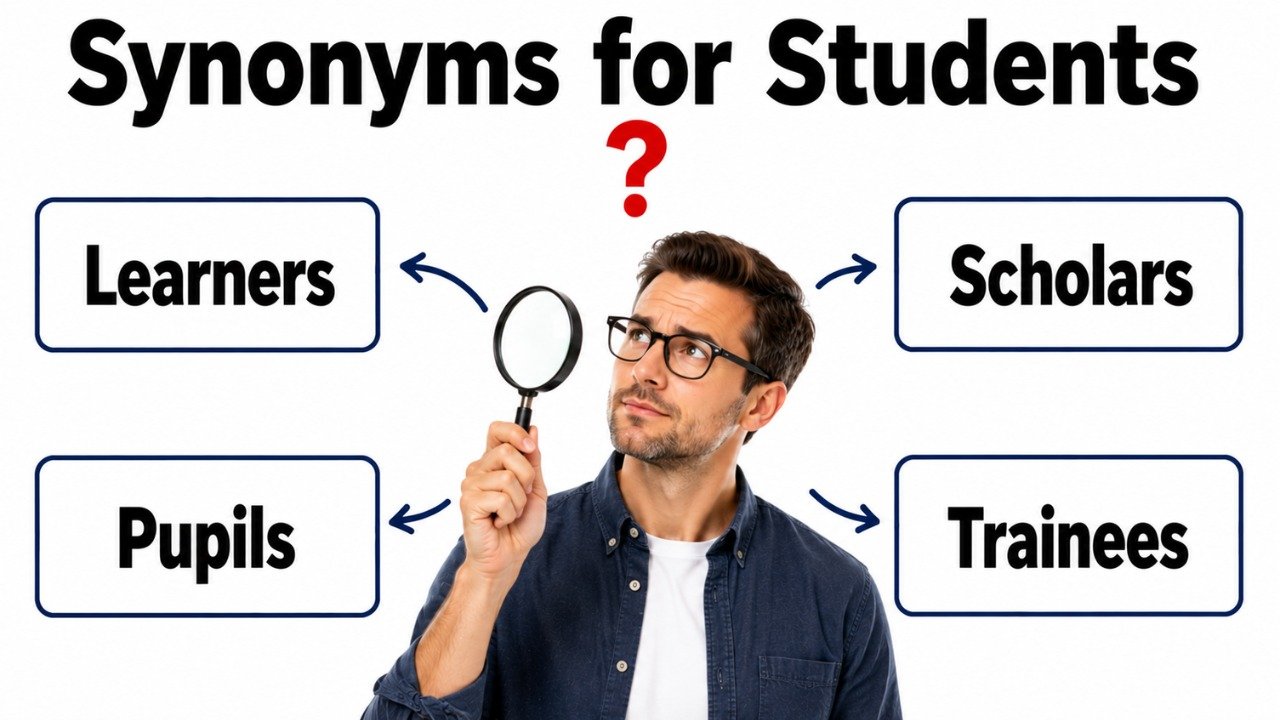
Quick Answer: The best synonyms for students include learners, pupils, scholars, apprentices, trainees, undergraduates, graduate students, enrollees, attendees, and schoolchildren. Learners is the broadest and most flexible alternative. Pupils is commonly used for children in school, while undergraduates and graduate students identify university education levels. Trainees suits workplace instruction, apprentices suits practical trade education, and scholars works best in academic or literary writing. The right choice depends on the age, institution, subject, and type of learning involved.
Pronunciation and Word Details
Word: Students.
Pronunciation: /ˈstuːdənts/.
Part of Speech: Plural noun.
Meaning: People who study at a school, college, university, training center, or another place of learning.
US Pronunciation:
UK Pronunciation:
What Does “Students” Mean?
Students are people who are studying a subject, developing a skill, or receiving instruction. Students is the plural form of student and functions as a countable noun.
The word most commonly refers to people enrolled in a school, college, university, course, or training program. It can describe children, teenagers, adults, or professionals, depending on the educational setting.
Example: The students completed their science project.
Students may also describe people who study a subject independently.
Example: Serious students of history often compare several interpretations of an event.
The word can identify people by education level, subject, institution, or learning purpose.
By Education Level: Primary school students, secondary school students, college students, and university students.
By Subject: Art students, language students, science students, and music students.
By Status: New students, returning students, international students, and full time students.
By Learning Method: Online students, classroom students, independent students, and distance learners.
Students is a broad and neutral term. A more specific synonym can improve clarity when the reader needs to know the age, level, role, or type of education being discussed.
Meaning, Tone, and Context of “Students”
Students has a neutral, respectful, and widely understood tone. It works naturally in formal, academic, professional, and conversational writing.
Academic Context: Students is frequently used in essays, educational reports, research, school policies, and teaching materials.
Example: Students benefit from clear instructions and timely feedback.
Formal Context: The word is appropriate in official communication about enrollment, attendance, assessment, behavior, and educational support.
Example: All students must submit the form before registration closes.
Conversational Context: Students is also natural in everyday discussions about school, classes, homework, or campus life.
Example: The students are preparing for their final examination.
Professional Context: Instructors, administrators, counselors, and trainers use students when discussing people receiving structured education.
Example: The instructor gave the students additional practice materials.
Literary Context: Writers may use scholars, disciples, or students of a subject when describing deep intellectual study.
Example: Students of philosophy continue to examine questions about knowledge and truth.
Technical Context: Educational research may distinguish students by age, grade, enrollment status, performance level, or learning needs.
Example: The study examined how students responded to different teaching methods.
Students is usually the safest general term. However, pupils, learners, trainees, apprentices, undergraduates, and other alternatives can provide more specific information.
When and How to Use “Students”
For General Education
Use students when referring broadly to people receiving formal education.
Example: Students should have access to a safe and supportive learning environment.
For School Learners
Use students for children or teenagers attending primary or secondary school.
Example: The teacher encouraged the students to ask questions.
For College or University Education
Use students when discussing people enrolled in higher education.
Example: Many university students balance coursework with other responsibilities.
For a Specific Subject
Use students when identifying people who study a particular field.
Example: Medical students require both theoretical knowledge and practical experience.
For Independent Study
Use students to describe people who seriously examine a topic even without formal enrollment.
Example: Students of literature often study language, culture, history, and interpretation.
For Educational Policies
Use students in rules, notices, reports, and institutional instructions.
Example: Students must follow the safety procedures during laboratory sessions.
For Research and Data
Use students when describing a study population in educational research.
Example: The survey asked students about their classroom experiences.
For Training Programs
Students can describe people in structured courses, although learners or trainees may be more precise in workplace settings.
Example: The students practiced the procedure under careful supervision.
For Inclusive Communication
Students is generally inclusive because it does not specify age, gender, background, or ability.
Example: Every student deserves meaningful opportunities to learn.
Best Synonyms for Students
Learners
Synonym: People who are gaining knowledge, understanding, or skills.
Example: The course gives learners time to practice each new concept.
Pupils
Synonym: Children or young people taught at a school, especially in primary education.
Example: The pupils listened carefully to the classroom instructions.
Scholars
Synonym: People engaged in serious or advanced academic study.
Example: Young scholars presented their research at the academic event.
Apprentices
Synonym: People learning a skilled trade through instruction and practical work.
Example: The apprentices practiced their techniques under an experienced craftsperson.
Trainees
Synonym: People receiving instruction for a job, role, or practical skill.
Example: The trainees completed a workplace safety exercise.
Undergraduates
Synonym: University or college students studying for their first degree.
Example: The undergraduates attended a lecture on environmental science.
Graduate Students
Synonym: Students pursuing advanced education after completing a first degree.
Example: The graduate students conducted independent research.
Enrollees
Synonym: People officially registered in a course, program, or institution.
Example: All enrollees received access to the course materials.
Attendees
Synonym: People who are present at a class, workshop, seminar, or event.
Example: Workshop attendees participated in several practical activities.
Schoolchildren
Synonym: Children who attend school.
Example: The museum created an educational program for schoolchildren.
50 Synonyms for Students with Short Meanings
- Learners: People gaining knowledge or skills.
- Pupils: Children or young people receiving school instruction.
- Scholars: People involved in serious academic study.
- Apprentices: People learning a skilled trade through practice.
- Trainees: People receiving preparation for a job or skill.
- Undergraduates: Students working toward their first college degree.
- Graduate Students: Students completing advanced study after a first degree.
- Postgraduates: Students pursuing education beyond an undergraduate degree.
- Enrollees: People officially registered in a course or institution.
- Attendees: People present at a class, workshop, or educational event.
- Schoolchildren: Children who attend school.
- School Pupils: Young learners receiving formal school education.
- Class Members: People belonging to the same class or course.
- Course Members: People registered for a particular course.
- Class Participants: People actively taking part in a class.
- Course Participants: People involved in a structured learning program.
- Program Participants: People taking part in an educational program.
- Workshop Participants: People learning through a workshop.
- Seminar Participants: People attending and contributing to a seminar.
- Class Attendees: People present during a lesson or class.
- Course Attendees: People attending a course.
- Candidates: People studying or preparing for an examination or qualification.
- Examinees: People taking an examination.
- Interns: People gaining supervised practical experience in a workplace.
- Residents: Advanced medical graduates receiving supervised professional training.
- Cadets: People receiving organized military, police, or service training.
- Novices: People who are new to a subject or activity.
- Beginners: People at the earliest stage of learning.
- Newcomers: People who have recently joined a class or institution.
- Freshmen: First year students in some educational systems.
- First Year Students: Students in the first year of a program.
- Seniors: Students in the final year of certain school or college programs.
- Final Year Students: Students completing the last year of a course.
- College Students: People studying at a college.
- University Students: People enrolled at a university.
- Secondary Students: Students receiving secondary education.
- Primary Students: Children receiving primary education.
- Adult Learners: Adults participating in education or training.
- Young Learners: Children or young people developing knowledge and skills.
- Language Learners: People studying a language.
- Independent Learners: People who study mainly through self directed effort.
- Distance Learners: People studying away from a physical classroom.
- Online Learners: People receiving instruction through online courses.
- Vocational Learners: People studying practical career related skills.
- Student Teachers: People training to become qualified teachers.
- Research Students: Students completing study based mainly on research.
- Doctoral Candidates: Advanced students working toward doctoral qualifications.
- Disciples: Followers who learn from a teacher, leader, or tradition.
- Protégés: People guided and supported by experienced mentors.
- Educatees: People who receive education or instruction.
Read Also:
Synonyms for Dead
Synonyms for Students by Context
When Students Means General Learners
Learners is the broadest alternative to students. It includes children, adults, independent learners, workplace trainees, and people in formal education.
Learners: Suitable for nearly every type of educational setting.
Example: Learners need regular opportunities to apply new knowledge.
Class Participants: Useful when emphasizing active involvement.
Example: The class participants discussed the reading in small groups.
Course Members: Useful for people registered in the same course.
Example: Course members received the updated timetable.
When Students Means Schoolchildren
Pupils and schoolchildren are useful when describing children in primary or secondary education.
Pupils: Common for children receiving classroom instruction.
Example: The pupils completed a short reading exercise.
Schoolchildren: Clearly identifies children who attend school.
Example: Local schoolchildren visited the science exhibition.
Young Learners: A warm and inclusive term for children developing knowledge or skills.
Example: The activity introduces young learners to basic vocabulary.
Primary Students: Best when identifying children in primary education.
Example: Primary students often benefit from visual learning materials.
When Students Means University Learners
Use alternatives that identify a specific level of higher education.
Undergraduates: Students pursuing their first college or university degree.
Example: Undergraduates may choose from several introductory courses.
Graduate Students: Students completing advanced study after a first degree.
Example: Graduate students often complete specialized research.
Postgraduates: A broad term for students studying beyond an undergraduate degree.
Example: Postgraduates attended a seminar on research methods.
Doctoral Candidates: Advanced students completing doctoral research.
Example: Doctoral candidates presented their research proposals.
Research Students: Students whose programs focus heavily on original investigation.
Example: Research students met regularly with their academic supervisors.
When Students Means Workplace Learners
Trainees, interns, apprentices, and participants may be more precise in professional settings.
Trainees: People preparing for a role, job, or practical responsibility.
Example: The trainees practiced responding to emergency situations.
Interns: People gaining supervised workplace experience.
Example: The interns attended an orientation session.
Apprentices: People learning a trade through instruction and practical work.
Example: The apprentices learned how to use the equipment safely.
Program Participants: People taking part in a structured development program.
Example: Program participants completed several workplace assignments.
When Students Means Academic Researchers
Scholars and research students work well when referring to serious or advanced study.
Scholars: People devoted to academic study or research.
Example: Scholars continue to debate the meaning of the ancient text.
Research Students: People enrolled in programs centered on research.
Example: Research students collected evidence from several sources.
Candidates: People preparing for a degree, examination, or qualification.
Example: The candidates submitted their final research papers.
When Students Means Beginners
Beginners, novices, and newcomers emphasize limited experience.
Beginners: People at the first stage of learning.
Example: The course is designed for beginners.
Novices: People who are inexperienced in a subject or skill.
Example: Novices should practice the basic techniques before attempting advanced work.
Newcomers: People who have recently entered a class, institution, or field.
Example: The teacher welcomed the newcomers and explained the routine.
When Students Means People Taking a Course
Use enrollment and attendance terms when discussing participation rather than educational identity.
Enrollees: People officially registered in a program or course.
Example: Enrollees must complete the registration form.
Attendees: People present at a class, seminar, or workshop.
Example: Seminar attendees received a summary of the presentation.
Course Participants: People actively involved in a structured course.
Example: Course participants completed a practical assessment.
Workshop Participants: People taking part in a short learning event.
Example: Workshop participants practiced the new method together.
Another Word for Students
The best general replacement for students is learners. Learners is broad, inclusive, and suitable for formal education, independent study, workplace training, and skill development.
However, the best alternative depends on the context. Pupils is more specific for schoolchildren, undergraduates suits first degree education, trainees works for workplace instruction, and apprentices identifies people learning a skilled trade.
Original: The students completed the online lesson.
Better Option: The learners completed the online lesson.
Original: The students practiced repairing the equipment.
Better Option: The apprentices practiced repairing the equipment.
Original: The students attended the first university lecture.
Better Option: The undergraduates attended the first university lecture.
Original: The students received instruction for their new workplace roles.
Better Option: The trainees received instruction for their new workplace roles.
When Not to Use “Students”
Students is a useful general word, but it may be too broad when the educational level, learning role, or type of instruction matters.
When the Age Group Matters
Use pupils, schoolchildren, young learners, or adult learners when age is important.
Weak: The program helps students improve early reading skills.
Better: The program helps young learners improve early reading skills.
When the Education Level Matters
Use undergraduates, graduate students, postgraduates, or doctoral candidates when discussing higher education.
Weak: The research grant is available to students completing doctoral work.
Better: The research grant is available to doctoral candidates.
When Describing Workplace Instruction
Use trainees, interns, or apprentices when the learning happens in a professional setting.
Weak: The students practiced using the factory equipment.
Better: The trainees practiced using the factory equipment.
When Describing a Skilled Trade
Students may sound too general for people receiving supervised trade instruction.
Weak: The students learned how to install the wiring.
Better: The apprentices learned how to install the wiring.
When Attendance Is More Important Than Enrollment
Use attendees or participants when referring to a workshop, seminar, short course, or event.
Weak: The students asked questions during the one day seminar.
Better: The seminar attendees asked questions during the session.
When Discussing Serious Academic Study
Use scholars or research students when emphasizing advanced intellectual work.
Weak: Students have studied this historical question for generations.
Better: Scholars have studied this historical question for generations.
When the Word Becomes Repetitive
Replace repeated uses of students with accurate contextual alternatives.
Weak: Students attended the course, students completed the activities, and students submitted feedback.
Better: Course participants attended the sessions, completed the activities, and submitted feedback.
When the Person Is Not Formally Enrolled
Learner may be more accurate for someone studying independently.
Weak: She is a student of photography but is not taking a formal course.
Better: She is an independent learner of photography.
Words Commonly Confused With Students
Students vs Learners: Students are usually connected to organized education or a specific subject of study. Learners is broader and includes anyone developing knowledge or skills.
Students vs Pupils: Students may be any age, while pupils usually refers to children taught in a school.
Students vs Scholars: Students is a general educational term. Scholars usually refers to people involved in serious, advanced, or specialized academic study.
Students vs Trainees: Students study a subject or complete an educational program. Trainees prepare for a particular job, responsibility, or practical skill.
Students vs Apprentices: Students may learn mainly through lessons and coursework. Apprentices learn a skilled trade through supervised practice and instruction.
Students vs Interns: Students are primarily engaged in education. Interns gain practical workplace experience, although an intern may also be a student.
Students vs Candidates: Students are enrolled in a learning program. Candidates are people seeking a qualification, taking an examination, or being considered for an academic award.
Students vs Classmates: Students describes people who study. Classmates describes students who belong to the same class.
Students vs Attendees: Students usually have an ongoing educational role. Attendees are simply present at a class, seminar, workshop, or event.
Which Synonym Should You Choose?
For General Educational Writing: Choose learners when you need a broad and inclusive alternative.
For Primary School: Choose pupils, schoolchildren, primary students, or young learners.
For Secondary School: Choose secondary students, school pupils, or teenagers when age is relevant.
For College and University: Choose college students or university students for general higher education.
For First Degree Programs: Choose undergraduates.
For Advanced Degree Programs: Choose graduate students or postgraduates.
For Doctoral Study: Choose doctoral candidates or research students.
For Academic Essays: Choose scholars when referring to people engaged in serious academic study.
For Workplace Training: Choose trainees.
For Practical Trade Education: Choose apprentices.
For Supervised Work Experience: Choose interns.
For Short Courses and Workshops: Choose attendees, participants, or enrollees.
For Examination Contexts: Choose candidates or examinees.
For New Learners: Choose beginners, novices, newcomers, or first year students.
For Online Education: Choose online learners or distance learners.
For Adult Education: Choose adult learners.
For Formal Reports: Choose the most precise group label, such as undergraduates, trainees, or course participants.
For Casual Conversation: Students is usually the most natural word unless a more specific role is important.
Real Life Examples of “Students” in Sentences
Original: The students practiced basic reading skills.
Better Option: The young learners practiced basic reading skills.
Original: The students attended a workshop on workplace safety.
Better Option: The trainees attended a workshop on workplace safety.
Original: The students are completing their first university degrees.
Better Option: The undergraduates are completing their first university degrees.
Original: The students conducted advanced laboratory research.
Better Option: The graduate students conducted advanced laboratory research.
Original: The students learned the trade from experienced workers.
Better Option: The apprentices learned the trade from experienced workers.
Original: The students registered for the weekend course.
Better Option: The enrollees registered for the weekend course.
Original: The students took part in the professional seminar.
Better Option: The seminar participants took part in the discussion.
Original: The students have examined this philosophical question for centuries.
Better Option: Scholars have examined this philosophical question for centuries.
Original: The students completed supervised work at the hospital.
Better Option: The interns completed supervised work at the hospital.
Original: The students prepared for the final qualifying examination.
Better Option: The candidates prepared for the final qualifying examination.
Synonym Groups and Usage Differences
General Learning Group
This group includes learners, students, class members, and course participants. These terms describe people gaining knowledge or skills.
Learners is the broadest choice. Students usually suggests formal or structured education. Class members belong to a particular class, while course participants emphasizes active involvement.
Example: The course gives learners several ways to practice.
School Education Group
This group includes pupils, schoolchildren, primary students, secondary students, and young learners.
Pupils and schoolchildren usually refer to children. Primary students and secondary students identify education levels. Young learners emphasizes age and development rather than institutional status.
Example: The teacher prepared a vocabulary game for the young learners.
Higher Education Group
This group includes college students, university students, undergraduates, graduate students, postgraduates, research students, and doctoral candidates.
Undergraduates are completing a first degree. Graduate students and postgraduates are completing advanced education. Research students focus heavily on independent investigation, while doctoral candidates work toward doctoral qualifications.
Example: The research students presented their early findings.
Workplace Learning Group
This group includes trainees, interns, apprentices, cadets, and residents.
Trainees prepare for a job or responsibility. Interns gain supervised workplace experience. Apprentices learn a trade. Cadets receive structured service training. Residents complete advanced supervised medical training.
Example: The trainees completed a practical safety assessment.
Participation Group
This group includes attendees, enrollees, class participants, workshop participants, and seminar participants.
Enrollees are officially registered. Attendees are present at an event. Participants actively take part in a class, workshop, seminar, or program.
Example: Workshop participants practiced the technique in pairs.
Experience Level Group
This group includes beginners, novices, newcomers, freshmen, first year students, seniors, and final year students.
Beginners and novices have limited experience. Newcomers have recently joined. First year students are beginning a program, while final year students are approaching completion.
Example: The beginner course introduces novices to essential skills.
Academic Study Group
This group includes scholars, candidates, research students, disciples, and protégés.
Scholars engage in serious study. Candidates seek a qualification. Research students investigate academic questions. Disciples learn from a particular teacher or tradition. Protégés receive guidance from experienced mentors.
Example: Scholars continue to interpret the surviving documents.
Antonyms of Students
Students does not have one exact antonym because it identifies an educational role. Its opposites depend on whether the contrast involves teaching, expertise, participation, or enrollment.
Teachers: People who educate students.
Instructors: People who provide lessons or practical instruction.
Educators: People professionally involved in teaching and education.
Professors: Senior teachers and researchers in higher education.
Lecturers: People who teach through formal talks or university courses.
Tutors: People who provide individual or small group instruction.
Trainers: People who prepare others for jobs, skills, or responsibilities.
Mentors: Experienced people who guide less experienced learners.
Experts: People with advanced knowledge or skill rather than beginner status.
Masters: Highly skilled people who may teach apprentices.
Graduates: People who have completed a course or degree.
Alumni: Former students of a school, college, or university.
Nonparticipants: People who do not take part in a class or program.
Nonattendees: People who are not present at a course or educational event.
Unenrolled Individuals: People who are not officially registered as students.
Comparison: Students vs Related Words
Students vs Learners
Students usually belong to a formal course, institution, or recognized field of study. Learners includes anyone developing knowledge or skills, even without formal enrollment.
Example With Students: The students submitted their assignments before the deadline.
Example With Learners: Independent learners can study at their own pace.
Students vs Pupils
Students can refer to people of any age. Pupils usually refers to children in primary or secondary school.
Example With Students: The university students attended the lecture.
Example With Pupils: The pupils completed a spelling exercise.
Students vs Scholars
Students is a general term for people who study. Scholars suggests serious, advanced, or expert academic work.
Example With Students: The students read an introduction to ancient history.
Example With Scholars: Scholars continue to debate the purpose of the ancient structure.
Students vs Trainees
Students often study broad subjects or qualifications. Trainees prepare for a specific job, duty, or practical skill.
Example With Students: The students studied business management.
Example With Trainees: The trainees practiced handling customer requests.
Students vs Apprentices
Students may learn mainly through lessons, reading, and assignments. Apprentices learn a skilled trade through supervised practical experience.
Example With Students: The students studied the principles of electrical systems.
Example With Apprentices: The apprentices installed electrical components under supervision.
Students vs Interns
Students focus mainly on education. Interns focus on gaining practical workplace experience.
Example With Students: The students completed a classroom assignment.
Example With Interns: The interns assisted with supervised workplace tasks.
Students vs Enrollees
Students describes an educational identity. Enrollees emphasizes official registration in a course or program.
Example With Students: The students attended their weekly lesson.
Example With Enrollees: All enrollees received confirmation of registration.
Students vs Attendees
Students usually participate in ongoing learning. Attendees are simply people present at an event, class, or seminar.
Example With Students: The students completed a twelve week course.
Example With Attendees: The conference attendees listened to the presentation.
Students vs Candidates
Students are people engaged in learning. Candidates are people seeking a qualification, taking an examination, or being considered for an academic result.
Example With Students: The students reviewed the course materials.
Example With Candidates: The candidates prepared for the certification examination.
Common Phrases and Expressions With “Students”
Student Body: All students enrolled at a particular institution.
Student Life: The academic, social, and personal experiences of students.
Student Council: A group of students chosen to represent the student community.
Student Services: Support provided to students by an educational institution.
Student Achievement: The educational progress or performance of students.
Student Engagement: The level of attention, interest, and participation shown by students.
Student Enrollment: The process or total number of students officially registered.
Student Support: Academic, emotional, financial, or practical help for students.
Student Assessment: The process of evaluating students’ knowledge, skills, or progress.
Student Participation: The involvement of students in lessons, activities, or discussions.
Common Mistakes to Avoid
Treating Every Alternative as an Exact Synonym
Not every alternative can replace students in every sentence.
Incorrect: The apprentices submitted their university history essays.
Better: The students submitted their university history essays.
Use apprentices only when people are learning a practical trade through supervised experience.
Using Pupils for All Age Groups
Pupils often refers to children and may sound unnatural for adult or university education.
Weak: The postgraduate pupils presented their research.
Better: The postgraduate students presented their research.
Using Scholars Too Broadly
Scholars suggests serious or advanced academic study. It is not always suitable for ordinary classroom learners.
Weak: The kindergarten scholars practiced writing letters.
Better: The young learners practiced writing letters.
Confusing Students With Classmates
Classmates are people in the same class. They are not a general replacement for all students.
Incorrect: The school has eight hundred classmates.
Correct: The school has eight hundred students.
Confusing Attendees With Enrollees
Attendees are present at an event. Enrollees are officially registered.
Weak: All attendees must pay their course fees before registration.
Better: All enrollees must pay their course fees before registration.
Using Trainees for Academic Learners
Trainees usually prepare for a practical role or job.
Weak: The literature trainees analyzed a poem.
Better: The literature students analyzed a poem.
Repeating Students Too Often
Repeated use can make a paragraph sound mechanical.
Repetitive: The students entered the room, the students opened their books, and the students began the task.
Improved: The students entered the room, opened their books, and began the task.
Choosing an Unnecessarily Formal Word
Educatees is grammatically valid but uncommon in everyday English.
Unnatural: The educatees completed their homework.
Natural: The students completed their homework.
Using Student as an Adjective Incorrectly
Student can modify another noun, but the plural form is not usually used before that noun.
Incorrect: The school provides students services.
Correct: The school provides student services.
Forgetting Subject Verb Agreement
Students is plural and requires a plural verb.
Incorrect: The students is preparing for the examination.
Correct: The students are preparing for the examination.
Using a Vague Group Label
A specific term can make formal writing more informative.
Vague: The students participated in the study.
Clear: The first year university students participated in the study.
Conclusion
The most useful synonyms for students include learners, pupils, scholars, trainees, apprentices, undergraduates, enrollees, and participants. Learners is the strongest general alternative, while pupils suits schoolchildren and undergraduates identifies first degree university students. Use trainees for workplace instruction, apprentices for trade education, and scholars for serious academic study. Choosing a context specific term helps readers understand the learners’ age, education level, setting, and purpose. Clear word choice makes educational writing more precise, natural, and informative.
FAQs About Synonyms for Students
What Is the Best Synonym for Students?
Learners is the best broad synonym for students because it works for formal education, independent study, online courses, and practical skill development.
Can Pupils Replace Students?
Pupils can replace students when referring to children or young people in school. It is less suitable for adults or university students.
What Is a Formal Synonym for Students?
Scholars is a formal alternative when referring to serious academic study. Enrollees is appropriate when emphasizing official registration.
What Do You Call University Students?
University students may be called undergraduates, graduate students, postgraduates, research students, or doctoral candidates, depending on their education level.
What Do You Call Students in Workplace Training?
Trainees is the most common term. Interns, apprentices, residents, and cadets may be more precise in particular professions.
Are Learners and Students the Same?
They are similar, but learners is broader. A student usually follows structured education, while a learner may study independently or informally.
What Is the Opposite of Students?
Students has no single exact opposite. Role based opposites include teachers, instructors, educators, trainers, mentors, and professors.
