
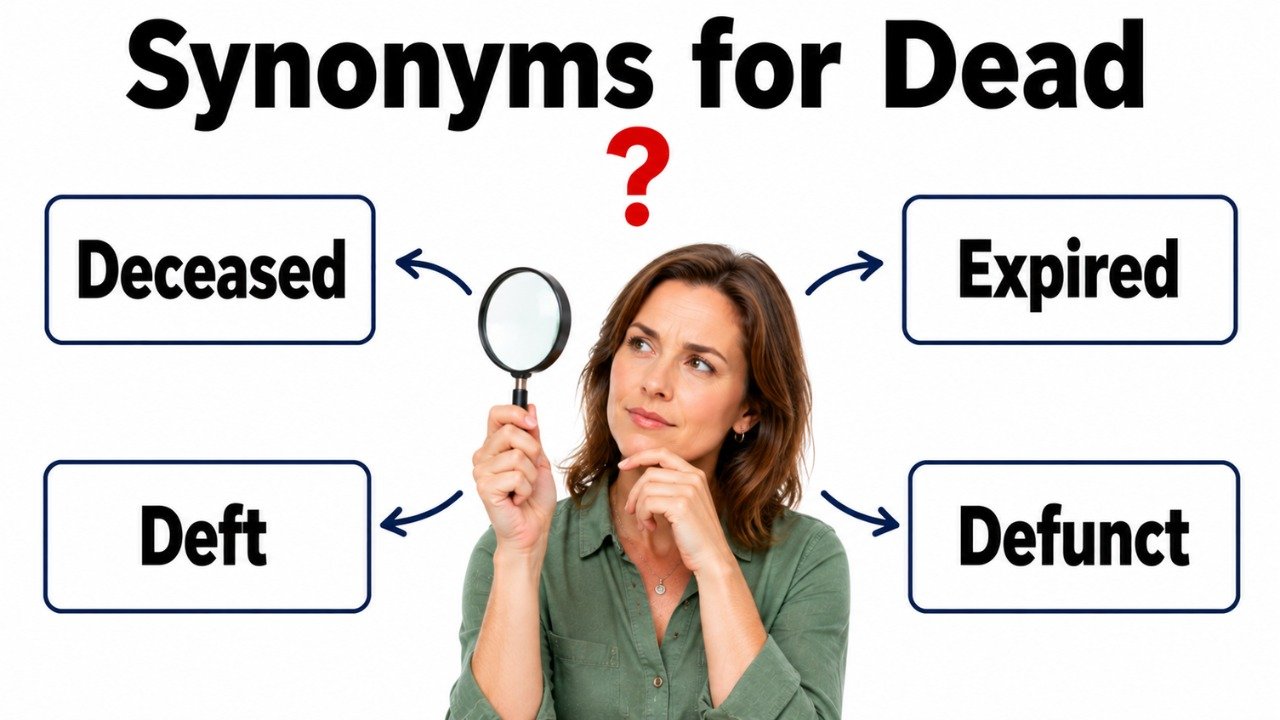
Quick Answer: The best synonyms for dead include deceased, lifeless, late, departed, passed away, extinct, defunct, inactive, numb, and exhausted. Use deceased in formal or official writing about a person. Choose passed away or departed when you want a gentle and respectful expression. Lifeless describes a body or something without energy. Extinct is best for species, while defunct suits organizations or systems that no longer exist. Inactive and inoperative describe machines or services. Numb refers to lost feeling, while exhausted describes extreme tiredness.
Pronunciation and Word Details
Word: Dead.
Pronunciation: /ded/.
Part of Speech: Adjective.
Meaning: No longer alive, active, functioning, sensitive, or full of energy.
US Pronunciation:
UK Pronunciation:
What Does “Dead” Mean?
Dead means no longer alive. It is mainly an adjective used to describe a person, animal, plant, or other living thing that has stopped living.
The word also has several extended meanings. A dead battery has no usable power. A dead organization no longer operates. A dead area may feel empty or inactive. A dead nerve has lost sensation. Someone who feels dead tired is extremely exhausted.
The exact meaning depends on the noun and sentence context.
Living Being: The dead bird was found beneath the tree.
Machine: My phone is dead because the battery has no power.
Organization: The old business has been dead for several years.
Sensation: My hand felt dead after I slept on it.
Energy: I was dead tired after the long journey.
Dead can therefore describe the absence of life, power, movement, feeling, activity, interest, or energy.
Meaning, Tone, and Context of “Dead”
Dead is a common and direct word. Its tone can be neutral, serious, emotional, harsh, informal, or dramatic depending on how it is used.
When discussing people, dead may sound blunt or insensitive, especially when speaking to grieving relatives. Deceased, late, departed, and passed away are often more respectful choices.
In scientific, legal, medical, and factual contexts, dead can be clear and appropriate. Writers may use it when accuracy is more important than emotional softness.
In casual conversation, dead frequently describes objects and devices that no longer work.
Neutral Use: The plant is dead.
Formal Use: The deceased individual was identified yesterday.
Gentle Use: Her grandfather passed away peacefully.
Technical Use: The circuit is dead and cannot carry electricity.
Casual Use: My laptop is completely dead.
Figurative Use: The town becomes dead after midnight.
Dead is also used for emphasis in expressions such as dead tired, dead silent, dead certain, and dead center. In these phrases, it may mean completely, extremely, or exactly.
When and How to Use “Dead”
For a Person or Animal
Use dead when stating directly that a person or animal is no longer alive. In sensitive situations, a gentler synonym may be better.
Example: The injured animal was already dead when help arrived.
For Respectful Communication
Use deceased, late, departed, or passed away when discussing someone who has died in a respectful or compassionate manner.
Example: The deceased writer left behind several unpublished works.
For Plants and Natural Life
Use dead when a plant, tree, flower, or natural organism is no longer living.
Example: The leaves became dry because the plant was dead.
For Machines and Devices
Use dead when a battery, phone, engine, circuit, or device has no power or does not respond.
Example: The remote control is dead because its batteries are empty.
For Organizations and Systems
Use dead, defunct, inactive, or closed when a company, service, system, plan, or institution no longer operates.
Example: The old membership program is now dead.
For Extinct Species
Use extinct when an entire animal or plant species no longer exists.
Example: That ancient species has been extinct for millions of years.
For Loss of Sensation
Use dead informally when a body part feels numb, heavy, or without sensation.
Example: My leg felt dead after sitting in one position for too long.
For Extreme Tiredness
Use dead informally for emphasis when someone feels completely exhausted.
Example: I felt dead after working throughout the night.
For Empty Places
Use dead when a location has very little movement, activity, excitement, or business.
Example: The shopping district was dead on Sunday morning.
For Dull Events or Conversations
Use dead when an event, performance, discussion, or atmosphere lacks energy and interest.
Example: The meeting felt dead until the new proposal was introduced.
Best Synonyms for Dead
Deceased
Synonym: No longer alive, especially when referring formally to a person.
Example: The property belonged to the deceased owner.
Lifeless
Synonym: Showing no signs of life, movement, or energy.
Example: The rescuers discovered the lifeless animal near the road.
Passed Away
Synonym: A gentle and respectful expression meaning died.
Example: Her uncle passed away after a brief illness.
Departed
Synonym: No longer living, often used in respectful or emotional language.
Example: The family gathered to remember their departed loved one.
Late
Synonym: Deceased, especially when placed before a person’s name or relationship.
Example: The award honored her late father.
Extinct
Synonym: No longer existing as a living species or type.
Example: Several ancient creatures are now extinct.
Defunct
Synonym: No longer operating, existing, or functioning.
Example: The building once belonged to a defunct organization.
Inactive
Synonym: Not operating, moving, participating, or being used.
Example: The account became inactive after years without use.
Numb
Synonym: Unable to feel physical sensation.
Example: His fingers became numb in the cold air.
Exhausted
Synonym: Extremely tired and without energy.
Example: She was exhausted after completing the difficult climb.
50 Synonyms for Dead with Short Meanings
- Deceased: No longer alive, especially in formal language.
- Lifeless: Showing no signs of life or movement.
- Late: No longer living, usually placed before a person’s name or relationship.
- Departed: Dead, expressed in a respectful or emotional way.
- Passed Away: Died, expressed gently and politely.
- Gone: No longer living or present.
- Expired: Having reached the end of life or validity.
- Perished: Died, often because of an accident, disaster, or harsh condition.
- Killed: Caused to die through an action or event.
- Slain: Killed violently or deliberately.
- Fallen: Killed during conflict, duty, or service.
- Lost: No longer living, expressed indirectly and emotionally.
- Nonliving: Not alive or not possessing life.
- Inanimate: Without life, consciousness, or movement.
- Inert: Unable to move, react, or act.
- Motionless: Completely still and not moving.
- Still: Not moving or showing physical activity.
- Cold: Without natural body warmth, sometimes suggesting death.
- Unresponsive: Not reacting to speech, touch, or stimulation.
- Insensible: Without awareness, feeling, or consciousness.
- Unconscious: Not awake or aware of the surroundings.
- Numb: Unable to feel physical sensation.
- Senseless: Without consciousness or physical awareness.
- Extinct: No longer existing as a living species.
- Vanished: Completely disappeared or ceased to exist.
- Defunct: No longer operating or existing.
- Obsolete: No longer useful because something newer has replaced it.
- Outdated: No longer current, modern, or effective.
- Inactive: Not operating, moving, or participating.
- Dormant: Temporarily inactive but capable of becoming active again.
- Inoperative: Not functioning or working.
- Disabled: Prevented from operating normally.
- Powerless: Without energy, power, or control.
- Disconnected: Separated from a power source, system, or network.
- Broken: Damaged and unable to work correctly.
- Stalled: Stopped and unable to continue.
- Stopped: No longer moving, operating, or progressing.
- Silent: Producing no sound or communication.
- Quiet: Having little sound, movement, or activity.
- Deserted: Empty because people have left.
- Abandoned: Left unused, unsupported, or unoccupied.
- Dull: Lacking energy, brightness, excitement, or interest.
- Flat: Lacking emotion, strength, energy, or enthusiasm.
- Boring: Not interesting or exciting.
- Tedious: Too slow, repetitive, or uninteresting.
- Exhausted: Completely tired and without energy.
- Drained: Having little or no physical or emotional energy.
- Spent: Having used all available strength or energy.
- Depleted: Greatly reduced in energy, power, or resources.
- Finished: Ended, completed, or no longer active.
Read Also:
Synonyms for Prevent
Synonyms for Dead by Context
When Dead Means No Longer Alive
The most direct alternatives are deceased, lifeless, late, departed, passed away, gone, perished, and killed.
Deceased is formal and mainly used for people. Passed away and departed sound gentler. Lifeless focuses on the visible absence of life. Perished often suggests death caused by dangerous conditions or a disaster.
Example With Dead: The man was found dead inside the building.
Example With Deceased: The deceased man was identified by his relatives.
Example With Passed Away: The man passed away earlier that morning.
When Dead Means Lifeless or Unresponsive
Useful synonyms include lifeless, inert, motionless, still, cold, and unresponsive.
Lifeless strongly suggests that something shows no signs of life. Motionless only means that something is not moving, so it does not always mean dead. Unresponsive may describe a person who does not react but could still be alive.
Example: The bird remained motionless on the ground.
Example: The emergency worker checked the unresponsive patient.
When Dead Means No Longer Operating
Use inactive, inoperative, disabled, disconnected, powerless, broken, stalled, or stopped for machines and systems.
Inactive is broad and neutral. Inoperative is more formal and specifically means that something cannot function. Powerless is suitable when a device has no electrical power.
Example With Dead: The security camera is dead.
Example With Inoperative: The security camera is currently inoperative.
Example With Disconnected: The camera is disconnected from the power supply.
When Dead Means Extinct or Defunct
Use extinct for species and defunct for organizations, institutions, systems, and businesses.
Extinct means that no living members of a species remain. Defunct means that an organization or system has stopped existing or operating.
Example: The animal became extinct after losing its natural habitat.
Example: The office once served a defunct publishing business.
When Dead Means Numb
Use numb, insensible, or without feeling when a body part has temporarily or permanently lost sensation.
Numb is the most natural option in everyday speech. Insensible is more formal and can also describe a lack of consciousness.
Example With Dead: My arm feels dead.
Example With Numb: My arm feels numb.
When Dead Means Exhausted
Use exhausted, drained, spent, depleted, or finished when someone has no energy left.
Exhausted is the clearest standard choice. Drained may describe both physical and emotional tiredness. Spent suggests that all strength has been used.
Example With Dead: I was dead after the training session.
Example With Exhausted: I was exhausted after the training session.
When Dead Means Dull or Empty
Use quiet, deserted, abandoned, dull, flat, boring, or tedious when a place, event, or conversation lacks activity.
Quiet is neutral and does not always suggest a problem. Deserted describes a place with few or no people. Dull and boring describe a lack of interest or excitement.
Example With Dead: The restaurant was dead during the afternoon.
Example With Quiet: The restaurant was quiet during the afternoon.
Example With Deserted: The restaurant was almost deserted during the afternoon.
Another Word for Dead
Deceased is often the best single formal replacement for dead when referring to a person. However, the most suitable alternative depends on the intended meaning.
Use passed away for gentle communication, lifeless for visible absence of life, extinct for a species, defunct for an organization, inoperative for a machine, numb for sensation, and exhausted for tiredness.
Original: The dead woman had written several books.
Better Option: The deceased woman had written several books.
Original: My phone is dead.
Better Option: My phone has no power.
Original: The old organization is dead.
Better Option: The old organization is defunct.
Original: I feel dead after the journey.
Better Option: I feel exhausted after the journey.
When Not to Use “Dead”
Dead should not always be used as a direct replacement for every word related to death, inactivity, or exhaustion.
Avoid using it carelessly when discussing a recently deceased person with grieving relatives. It may sound cold or insensitive. Passed away, late, or departed may be more compassionate.
Weak: Her father is dead.
Better: Her father passed away.
Do not use dead when the person is only unconscious or unresponsive. These conditions do not necessarily mean that life has ended.
Weak: The patient was dead for several minutes before waking up.
Better: The patient was unconscious for several minutes before waking up.
Avoid calling a species dead when you mean that no members of it remain.
Weak: This animal species is dead.
Better: This animal species is extinct.
Do not use deceased for machines, accounts, batteries, or organizations.
Weak: The deceased battery needs replacing.
Better: The dead battery needs replacing.
Avoid dead when a more specific technical word would improve clarity.
Weak: The production system is dead.
Better: The production system is inoperative.
Do not overuse dead as an intensifier in formal reports or academic writing.
Weak: The researchers were dead tired after the study.
Better: The researchers were extremely fatigued after the study.
Words Commonly Confused With Dead
Dead vs Deceased: Dead can describe people, animals, plants, devices, places, and systems. Deceased is a formal and respectful word used mainly for people.
Dead vs Dying: Dead means life has already ended. Dying means the process of approaching death is still happening.
Dead vs Unconscious: Dead means no longer alive. Unconscious means alive but temporarily unaware and unable to respond normally.
Dead vs Lifeless: Dead directly states that life has ended. Lifeless describes something that shows no signs of life, movement, or energy.
Dead vs Extinct: Dead can describe one organism. Extinct means that an entire species or type no longer exists.
Dead vs Defunct: Dead is broad and often informal. Defunct describes an organization, institution, system, or business that no longer operates.
Dead vs Inactive: Dead may suggest permanent failure. Inactive often means not currently active and may only be temporary.
Dead vs Dormant: Dead suggests no life or activity remains. Dormant means temporarily inactive but still capable of becoming active later.
Dead vs Numb: Dead can informally describe a body part without sensation. Numb is the more accurate word for temporary or permanent loss of feeling.
Dead vs Exhausted: Dead can informally emphasize extreme tiredness. Exhausted is clearer and more suitable for standard writing.
Which Synonym Should You Choose?
Choose deceased when writing formally about a person who has died.
Choose passed away when speaking gently to relatives, friends, or grieving people.
Choose departed when writing in a respectful, emotional, or ceremonial tone.
Choose late before the name, title, or relationship of someone who is no longer living.
Choose lifeless when something shows no visible signs of life, movement, or energy.
Choose perished when death occurred because of a disaster, accident, severe weather, hunger, or another dangerous condition.
Choose extinct when referring to a species that no longer has any living members.
Choose defunct when discussing an organization, institution, publication, service, or business that no longer operates.
Choose inactive when an account, system, member, or process is not currently active.
Choose inoperative when a machine or technical system cannot function.
Choose disconnected when a device has been separated from electricity, a network, or another system.
Choose numb when a body part has lost physical sensation.
Choose exhausted for extreme physical tiredness.
Choose drained when someone has lost emotional or physical energy.
Choose deserted when a place has few or no people.
Choose dull or boring when an event, conversation, or atmosphere lacks excitement.
In reports and essays, select the most precise word instead of relying on dead as a broad description. In casual conversation, dead may sound natural for phones, batteries, quiet places, and extreme tiredness.
Real Life Examples of “Dead” in Sentences
Original: The dead man was identified by his family.
Better Option: The deceased man was identified by his family.
Original: Her dead husband had collected rare books.
Better Option: Her late husband had collected rare books.
Original: Several animals were dead after the storm.
Better Option: Several animals had perished during the storm.
Original: The old species has been dead for centuries.
Better Option: The old species has been extinct for centuries.
Original: The organization has been dead since the office closed.
Better Option: The organization has been defunct since the office closed.
Original: My tablet is dead again.
Better Option: My tablet has run out of power again.
Original: The machine remained dead after the repair.
Better Option: The machine remained inoperative after the repair.
Original: My fingers feel dead in this cold weather.
Better Option: My fingers feel numb in this cold weather.
Original: I felt dead after carrying the boxes upstairs.
Better Option: I felt exhausted after carrying the boxes upstairs.
Original: The town was dead after sunset.
Better Option: The town was deserted after sunset.
Synonym Groups and Usage Differences
Death and Respectful Language Group
This group includes deceased, passed away, departed, late, gone, and lost.
Deceased is formal and factual. Passed away is gentle and widely suitable in sensitive communication. Departed has an emotional or ceremonial tone. Late usually appears before a person’s name or relationship.
Example: The ceremony honored the late teacher and her lifelong work.
Lifeless State Group
This group includes lifeless, inert, motionless, still, cold, and unresponsive.
These words focus on appearance, movement, reaction, or physical condition. They do not always prove that something is dead. A living person can be motionless or unresponsive.
Example: The injured bird lay motionless beside the path.
Violent or Sudden Death Group
This group includes killed, slain, fallen, and perished.
Killed is the broadest word. Slain usually suggests violence. Fallen is often used for people who die during conflict or service. Perished often suggests an accident, disaster, or severe condition.
Example: Many travelers perished during the unexpected storm.
Extinction and Closure Group
This group includes extinct, vanished, defunct, obsolete, and outdated.
Extinct is used for species. Defunct applies to organizations or systems. Obsolete and outdated describe things that have lost usefulness or relevance, even when they still physically exist.
Example: The defunct institution once employed hundreds of workers.
Inactivity and Failure Group
This group includes inactive, dormant, inoperative, disabled, powerless, disconnected, broken, stalled, and stopped.
Inactive may describe a temporary condition. Dormant specifically suggests that activity could return. Inoperative indicates that something cannot function. Broken suggests physical or internal damage.
Example: The machine is inoperative because one of its main parts is broken.
Loss of Feeling Group
This group includes numb, insensible, and senseless.
Numb is the clearest choice for loss of physical sensation. Insensible and senseless can describe a lack of consciousness, but senseless also has other meanings and should be used carefully.
Example: The patient’s fingers remained numb after the procedure.
Exhaustion Group
This group includes exhausted, drained, spent, depleted, and finished.
Exhausted is the most direct standard synonym for extremely tired. Drained often includes emotional tiredness. Spent suggests that all available energy has been used.
Example: The workers felt completely drained after the demanding shift.
Dullness and Emptiness Group
This group includes silent, quiet, deserted, abandoned, dull, flat, boring, and tedious.
Silent and quiet relate to sound. Deserted and abandoned relate to places. Dull, flat, boring, and tedious describe a lack of energy, emotion, variety, or interest.
Example: The performance felt flat because the actors showed little emotion.
Antonyms of Dead
The opposite of dead depends on whether the word refers to life, activity, function, sensation, energy, or excitement.
Alive: Still living.
Living: Possessing life.
Existing: Continuing to be present or real.
Active: Moving, working, participating, or producing results.
Functioning: Operating correctly.
Operational: Ready and able to work.
Responsive: Reacting to speech, touch, commands, or stimulation.
Conscious: Awake and aware of the surroundings.
Sensitive: Able to feel physical sensation.
Energetic: Full of strength and activity.
Rested: No longer tired.
Thriving: Growing, developing, or succeeding strongly.
Lively: Full of energy, movement, or excitement.
Busy: Filled with activity or people.
Interesting: Able to hold attention or curiosity.
Comparison: Dead vs Related Words
Dead vs Deceased
Dead is a broad word that can describe living beings, machines, batteries, places, and activities. Deceased is formal and applies mainly to a person who has died.
Example With Dead: The dead tree was removed from the garden.
Example With Deceased: The deceased owner left the house to his children.
Dead vs Lifeless
Dead confirms that life has ended. Lifeless describes a lack of visible life, energy, movement, or expression.
Example With Dead: The animal was dead.
Example With Lifeless: The animal’s lifeless body lay beside the road.
Lifeless can also be figurative.
Example: Her voice sounded lifeless during the speech.
Dead vs Dying
Dead describes a completed state. Dying describes an ongoing process.
Example With Dead: The plant is dead and cannot recover.
Example With Dying: The plant is dying because it has not received enough water.
Dead vs Extinct
Dead may refer to one individual organism. Extinct describes an entire species, group, custom, or practice that no longer exists.
Example With Dead: A dead animal was discovered near the river.
Example With Extinct: The species became extinct after its habitat disappeared.
Dead vs Defunct
Dead is common and informal when describing a failed organization or system. Defunct is more precise and formal.
Example With Dead: The old association is dead.
Example With Defunct: The building once housed a defunct association.
Dead vs Inactive
Dead may imply complete or permanent failure. Inactive usually means not active at the present time.
Example With Dead: The device is dead and cannot be repaired.
Example With Inactive: The account is inactive but can still be restored.
Dead vs Dormant
Dead suggests that activity cannot return. Dormant means temporarily inactive while retaining the ability to become active again.
Example With Dead: The plant is dead.
Example With Dormant: The plant is dormant during the colder months.
Dead vs Numb
Dead is an informal description of lost sensation. Numb is more accurate and natural.
Example With Dead: My foot feels dead.
Example With Numb: My foot feels numb.
Dead vs Exhausted
Dead is used informally for emphasis. Exhausted clearly describes extreme tiredness and works better in formal writing.
Example With Dead: I was dead after the race.
Example With Exhausted: I was exhausted after the race.
Common Phrases and Expressions With “Dead”
Dead Body: The body of a person or animal that is no longer alive.
Dead Animal: An animal that is no longer living.
Dead Plant: A plant that has stopped living and growing.
Dead Battery: A battery with no usable electrical power.
Dead Phone: A phone that has no power or does not respond.
Dead End: A road, situation, plan, or investigation that cannot continue.
Dead Silence: Complete silence without any noticeable sound.
Dead Tired: Extremely tired.
Dead Asleep: Sleeping very deeply.
Dead Language: A language that is no longer used as the native language of a community.
Dead Center: The exact central point of an area or object.
Dead Certain: Completely certain.
Dead Serious: Completely serious and not joking.
Dead Calm: Completely still, quiet, or without wind.
Dead Issue: A subject that is no longer active, relevant, or open for discussion.
Common Mistakes to Avoid
Using Dead in an Insensitive Way
Dead can sound too blunt when discussing a person who has recently died. Consider the emotional situation and the relationship between the speaker and listener.
Use passed away, departed, or late when a gentler tone is appropriate.
Confusing Dead With Dying
Dead means that life has ended. Dying means that life is approaching its end.
Do not describe someone as dead when the person is still alive but seriously ill.
Confusing Dead With Unconscious
An unconscious person is still alive but not awake or aware. An unresponsive person may also still be alive.
Avoid making assumptions based only on appearance or lack of movement.
Using Deceased for Objects
Deceased is mainly used for people. It sounds unnatural with batteries, machines, plants, accounts, or organizations.
Incorrect: The deceased computer needs repair.
Correct: The broken computer needs repair.
Using Extinct for One Animal
Extinct describes an entire species, not one individual animal.
Incorrect: The extinct bird was lying on the road.
Correct: The dead bird was lying on the road.
Using Dead When Inactive Is More Accurate
Inactive does not always mean permanently finished. An inactive account, system, or member may become active again.
Use dead only when the stronger and more permanent meaning is intended.
Overusing Dead for Emphasis
Expressions such as dead tired, dead serious, and dead certain are natural in conversation. However, repeated use can make formal writing sound dramatic or imprecise.
Choose exhausted, completely serious, or absolutely certain in professional writing.
Choosing an Unnatural Synonym
Not every synonym works in every sentence. Defunct works for organizations but not for people. Extinct works for species but not for batteries. Numb works for sensation but not for businesses.
Always match the synonym to the intended meaning.
Using Expired Carelessly
Expired may appear in technical, medical, historical, or older writing, but it can sound cold when used about a person.
Use deceased or passed away when respect and compassion matter.
Ignoring Figurative Meaning
Dead does not always refer to physical death. A dead battery has no power, a dead town lacks activity, and a dead discussion has stopped progressing.
Read the full sentence before choosing a replacement.
Conclusion
The best synonyms for dead depend on the intended meaning and tone. Choose deceased for formal references to a person, passed away for gentle communication, and lifeless for something showing no signs of life. Extinct works for species, while defunct describes organizations that no longer operate. Use inoperative for machines, numb for lost sensation, exhausted for extreme tiredness, and deserted for empty places. Understanding these differences will help you use synonyms for dead accurately, respectfully, and naturally in conversation and writing.
FAQs About Synonyms for Dead
What Are the Best Synonyms for Dead?
The best options include deceased, lifeless, passed away, departed, late, extinct, defunct, inactive, numb, and exhausted. The correct choice depends on context.
What Is a Respectful Synonym for Dead?
Passed away is one of the gentlest expressions. Deceased is suitable for formal writing, while departed is appropriate in emotional or ceremonial language.
What Is the Difference Between Dead and Deceased?
Dead is a broad word used for people, animals, plants, machines, and systems. Deceased is a formal word used mainly for a person who has died.
What Is Another Word for a Dead Battery?
A dead battery may be described as depleted, drained, discharged, powerless, or empty. Drained and depleted are common when discussing lost power.
What Is Another Word for a Dead Organization?
Defunct is the most precise choice. Inactive, dissolved, closed, or discontinued may also work depending on what happened to the organization.
Can Numb Be a Synonym for Dead?
Yes, numb can replace dead when describing a body part that has lost sensation. For example, “My hand feels dead” can become “My hand feels numb.”
Is Dead a Formal Word?
Dead is standard and direct, but it may sound blunt in sensitive situations. Deceased is more formal, while passed away is gentler and more compassionate.
