
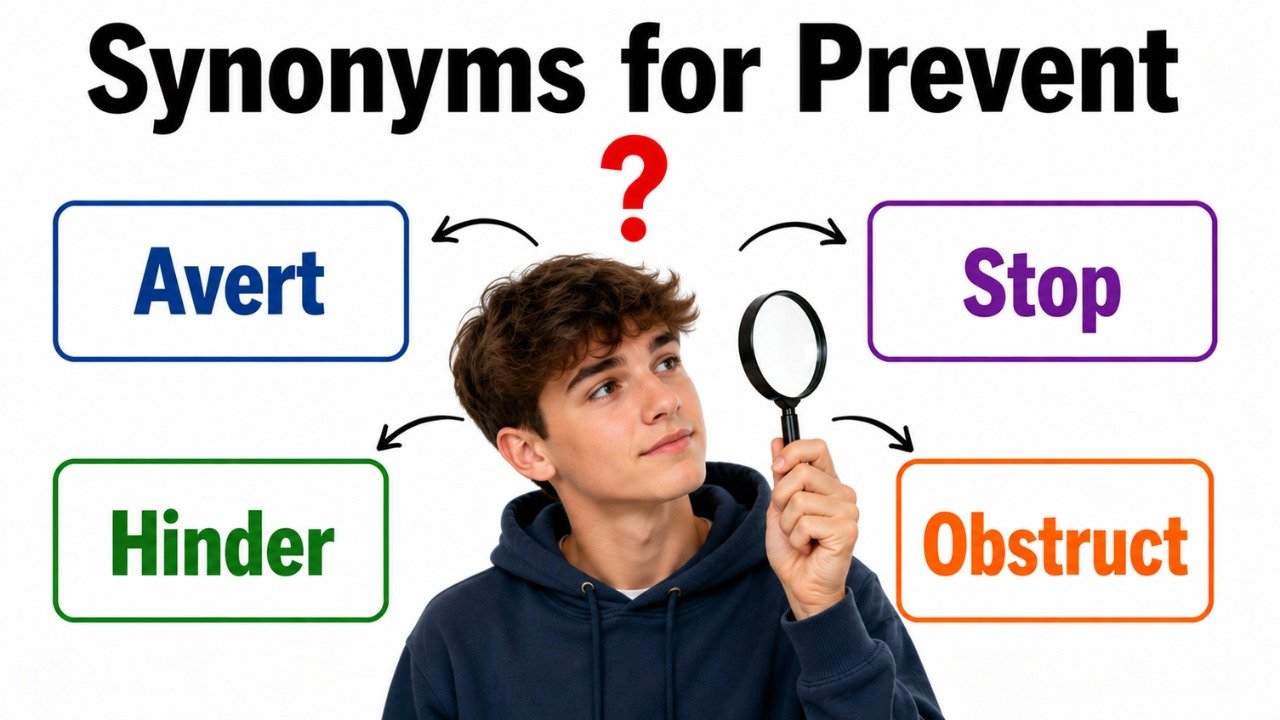
Quick Answer: The best synonyms for prevent include stop, avoid, avert, hinder, deter, block, prohibit, preclude, forestall, and thwart. Use stop for a direct and general replacement, avert for avoiding danger or an unwanted result, hinder for slowing progress, deter for discouraging behavior, prohibit for rules or laws, and preclude for formal writing when something becomes impossible. Forestall works when action is taken early, while thwart is best for defeating a plan or intention.
Pronunciation and Word Details
Word: Prevent.
Pronunciation: /prɪˈvent/.
Part of Speech: Verb.
Meaning: To stop something from happening or stop someone from doing something.
US Pronunciation:
UK Pronunciation:
What Does “Prevent” Mean?
Prevent means to stop an event, action, problem, or result from happening. It is a verb commonly used when a person, rule, object, or action creates a barrier against something unwanted.
The word can describe complete prevention, such as stopping unauthorized entry, or partial risk reduction, such as taking steps to prevent accidents. The exact meaning depends on the sentence and the result being discussed.
Prevent often appears before a noun.
Example: Regular maintenance can prevent equipment failure.
It can also appear in the structure “prevent someone from doing something.”
Example: The locked door prevented the children from entering the room.
In formal writing, prevent is common in discussions about safety, health, security, law, education, technology, and risk management. In everyday conversation, it is often replaced by simpler words such as stop, keep, or block.
Meaning, Tone, and Context of “Prevent”
Prevent has a neutral and practical tone. It is suitable for both formal and conversational English, although it appears especially often in professional, academic, technical, and instructional writing.
Formal Use: Prevent is appropriate in reports, policies, essays, research, safety instructions, and official communication.
Example: Stronger controls may prevent unauthorized access to confidential information.
Conversational Use: In everyday speech, prevent may sound slightly more formal than stop or keep from.
Example: Closing the window will prevent the rain from coming inside.
Technical Use: The word is frequently used when describing systems, procedures, safety measures, and protective actions.
Example: The filter prevents harmful particles from entering the machine.
Emotional Use: Prevent is usually neutral rather than emotional, but it can appear in serious statements about harm, loss, danger, or conflict.
Example: Immediate action could prevent a tragedy.
Legal and Regulatory Use: Prevent may describe the purpose of a law, rule, restriction, or official requirement.
Example: The regulation is intended to prevent unfair business practices.
Prevent is strongest when the writer clearly identifies what is being stopped, who is affected, and how the prevention occurs.
When and How to Use “Prevent”
For Stopping an Unwanted Event
Use prevent when an action stops an event, result, or problem from occurring.
Example: Early repairs can prevent serious structural damage.
For Reducing Risk
Use prevent when describing steps intended to lower the possibility of harm. Avoid suggesting complete certainty unless the action truly guarantees the result.
Example: Careful planning can help prevent costly mistakes.
For Blocking Access
Use prevent when a barrier, system, or rule stops a person from entering, reaching, or using something.
Example: A secure password prevents strangers from accessing the account.
For Discouraging Behavior
Use prevent when a rule, warning, consequence, or protective measure stops someone from taking an action.
Example: Clear penalties may prevent employees from ignoring safety procedures.
For Rules and Restrictions
Use prevent when policies, laws, or regulations stop certain actions.
Example: The policy prevents staff members from sharing private information.
For Physical Barriers
Use prevent when an object blocks movement, contact, entry, or escape.
Example: The fence prevents animals from entering the garden.
For Early Action
Use prevent when something is done before a problem develops.
Example: Regular inspections can prevent minor faults from becoming major failures.
For Protecting People or Property
Use prevent when a safety measure protects someone or something from harm.
Example: Proper storage can prevent damage to valuable documents.
Best Synonyms for Prevent
Stop
Synonym: To cause an action, event, or process to end or not begin.
Example: The barrier stopped the vehicle from entering the restricted area.
Avoid
Synonym: To stay away from something or make sure it does not affect you.
Example: Careful budgeting can help families avoid unnecessary debt.
Avert
Synonym: To prevent a dangerous, harmful, or unpleasant event.
Example: The quick response helped avert a major crisis.
Hinder
Synonym: To make progress or action more difficult.
Example: Poor communication can hinder the completion of a project.
Deter
Synonym: To discourage someone from doing something through fear, difficulty, or consequences.
Example: Visible security measures may deter thieves.
Block
Synonym: To create a physical or practical barrier that prevents movement, access, or progress.
Example: The fallen tree blocked traffic from entering the road.
Prohibit
Synonym: To officially forbid an action through a rule or law.
Example: The regulations prohibit visitors from entering the laboratory.
Preclude
Synonym: To make an action, possibility, or result impossible.
Example: His existing commitments preclude him from accepting another position.
Forestall
Synonym: To act early so that an expected problem does not happen.
Example: The company changed its procedures to forestall future complaints.
Thwart
Synonym: To successfully prevent a plan, effort, or intention from succeeding.
Example: Investigators thwarted the attempt to steal the records.
50 Synonyms for Prevent with Short Meanings
- Stop: To cause something not to happen or continue.
- Avoid: To stay away from an unwanted result or situation.
- Avert: To prevent something dangerous or unpleasant.
- Hinder: To make action or progress more difficult.
- Deter: To discourage someone from taking an action.
- Block: To prevent movement, access, or progress.
- Prohibit: To officially forbid an action.
- Preclude: To make something impossible.
- Forestall: To act early to stop an expected event.
- Thwart: To prevent a plan from succeeding.
- Foil: To defeat an attempt or harmful plan.
- Obstruct: To place a barrier in the way.
- Impede: To slow or interfere with progress.
- Inhibit: To limit or restrain an action or process.
- Restrain: To hold back or keep under control.
- Restrict: To place limits on an action or activity.
- Bar: To prevent entry, access, or participation.
- Ban: To officially declare something unacceptable or forbidden.
- Forbid: To order that something must not be done.
- Disallow: To refuse permission for something.
- Intercept: To stop something before it reaches its destination.
- Counter: To act against a force, effect, or action.
- Counteract: To reduce or cancel the effect of something.
- Neutralize: To make something ineffective or harmless.
- Suppress: To stop or limit an activity, reaction, or expression.
- Curb: To control or reduce something harmful.
- Check: To slow, control, or stop development.
- Contain: To keep a problem within limits.
- Control: To manage something so it does not become harmful.
- Limit: To reduce the amount, extent, or effect of something.
- Minimize: To reduce something to the smallest practical level.
- Reduce: To make an amount, risk, or effect smaller.
- Eliminate: To remove a cause, risk, or possibility completely.
- Halt: To bring an action or process to a stop.
- Arrest: To stop the development or progress of something.
- Head Off: To prevent a problem by acting before it develops.
- Ward Off: To keep danger, illness, or harm away.
- Fend Off: To defend against an attack, threat, or difficulty.
- Stave Off: To delay or prevent an unwanted event.
- Keep From: To stop someone or something from taking an action.
- Hold Back: To restrain movement, action, or progress.
- Shut Out: To prevent someone or something from entering.
- Rule Out: To remove a possibility from consideration.
- Make Impossible: To create conditions in which something cannot occur.
- Guard Against: To take protective action against a possible problem.
- Protect Against: To keep someone or something safe from harm.
- Safeguard Against: To establish protection against danger or loss.
- Discourage: To make someone less willing to act.
- Dissuade: To persuade someone not to do something.
- Deflect: To turn something away from its intended direction or target.
Read Also:
Synonyms for Know
Synonyms for Prevent by Context
When Prevent Means Stop an Event
Use these alternatives when an action keeps an unwanted event from occurring.
Avert: Best for danger, disaster, conflict, or crisis.
Example: Skilled negotiations helped avert a strike.
Forestall: Best when someone takes action before a problem develops.
Example: The manager acted quickly to forestall further complaints.
Head Off: A natural choice for stopping a problem at an early stage.
Example: The discussion helped head off a misunderstanding.
Stave Off: Best when preventing or delaying an unwanted outcome.
Example: The emergency funds helped stave off financial failure.
When Prevent Means Block Progress or Access
Use these words when something creates a barrier.
Block: Best for physical barriers, access, movement, or communication.
Example: A damaged vehicle blocked the entrance.
Obstruct: Best when something stands in the way of movement or action.
Example: Large boxes obstructed the emergency exit.
Impede: Best when progress is slowed rather than completely stopped.
Example: Lack of funding may impede the research.
Intercept: Best when something is stopped before reaching its destination.
Example: Security officers intercepted the package.
Bar: Best for preventing entry, participation, or access.
Example: The damaged pass barred him from entering the building.
When Prevent Means Discourage Behavior
Use these alternatives when the goal is to influence a person’s decision.
Deter: Best when consequences or difficulty discourage an action.
Example: Strong penalties may deter dishonest behavior.
Discourage: Best for making someone less willing to act.
Example: High fees can discourage small businesses from applying.
Dissuade: Best when words or advice persuade someone not to act.
Example: Her parents dissuaded her from making a rushed decision.
Restrain: Best when someone or something is actively held back.
Example: The officer restrained the crowd from moving forward.
When Prevent Means Forbid an Action
Use these words for rules, laws, policies, and official restrictions.
Prohibit: A formal word for officially forbidding something.
Example: The policy prohibits employees from accepting expensive gifts.
Ban: Best for a complete official restriction.
Example: The school banned smoking on its property.
Forbid: A direct word for ordering that something must not happen.
Example: The rules forbid visitors from touching the exhibits.
Disallow: Best when permission, a claim, or an action is refused.
Example: The judge disallowed the evidence.
When Prevent Means Reduce Harm
Use these alternatives when an action controls risk rather than guaranteeing complete prevention.
Curb: Best for controlling harmful growth or behavior.
Example: New measures may curb unnecessary spending.
Limit: Best when reducing the amount or effect of something.
Example: Protective clothing limits exposure to harmful substances.
Contain: Best for keeping a problem within a controlled area.
Example: Fire crews worked to contain the flames.
Minimize: Best for reducing risk, damage, or inconvenience.
Example: Clear instructions minimize confusion.
Control: Best when managing a continuing risk or process.
Example: The treatment helps control the symptoms.
When Prevent Means Defeat a Plan
Use these words when stopping an intention, attempt, or strategy.
Thwart: Best for stopping a plan from succeeding.
Example: Security officers thwarted the planned robbery.
Foil: Best for defeating a clever or harmful attempt.
Example: Investigators foiled the attempt to steal confidential files.
Counteract: Best for reducing or canceling an effect.
Example: The new procedure counteracts the weakness in the original system.
Neutralize: Best for making a threat or harmful force ineffective.
Example: The safety mechanism neutralized the threat.
Another Word for Prevent
The best general replacement for prevent is stop. It is clear, natural, and suitable for most everyday sentences. However, the strongest alternative depends on what is being prevented.
Use avert for danger, block for access, deter for behavior, prohibit for official rules, and reduce when the result cannot be guaranteed.
Original: Early treatment can prevent complications.
Better Option: Early treatment can avert complications.
Original: The gate prevents visitors from entering the private area.
Better Option: The gate blocks visitors from entering the private area.
Original: The policy prevents workers from sharing confidential files.
Better Option: The policy prohibits workers from sharing confidential files.
Original: Clear instructions prevent confusion.
Better Option: Clear instructions reduce confusion.
When Not to Use “Prevent”
Prevent is useful, but it is not always the most accurate choice. A more specific synonym can make the sentence clearer.
When Complete Prevention Is Not Guaranteed
Do not use prevent when an action only lowers risk unless you explain the limitation.
Weak: Exercise prevents every health problem.
Better: Regular exercise may reduce the risk of certain health problems.
When Describing an Official Rule
Use prohibit, forbid, ban, or disallow when a law or policy officially refuses permission.
Weak: The law prevents drivers from using this road.
Better: The law prohibits drivers from using this road.
When Something Only Slows Progress
Use hinder, impede, or obstruct when an action creates difficulty without completely stopping the result.
Weak: Limited funding prevented the project.
Better: Limited funding hindered the project’s progress.
When Describing Discouragement
Use deter or discourage when a person is still able to act but becomes less willing.
Weak: The warning prevented customers from making false claims.
Better: The warning deterred customers from making false claims.
When Prevent Becomes Repetitive
Repeated use of prevent can make a paragraph sound dull or mechanical.
Weak: The system prevents errors, prevents delays, and prevents confusion.
Better: The system reduces errors, avoids delays, and minimizes confusion.
When the Meaning Is Too General
Choose a word that explains how the action works.
Weak: The wall prevents the noise.
Better: The wall blocks the noise.
Words Commonly Confused With Prevent
Prevent vs Avoid: Prevent means causing something not to happen. Avoid means staying away from something or escaping its effects. A safety guard may prevent an accident, while a driver may avoid an accident by changing direction.
Prevent vs Stop: Stop is broader and more conversational. Prevent often refers to action taken before something happens, while stop can also refer to ending something already in progress.
Prevent vs Prohibit: Prevent describes the result of stopping something. Prohibit means officially forbidding something through a rule, policy, or law.
Prevent vs Deter: Prevent means an action does not happen. Deter means someone becomes less willing to act, although the action may still be possible.
Prevent vs Hinder: Prevent means stopping something completely. Hinder means making it slower or more difficult.
Prevent vs Avert: Avert is mainly used for unpleasant events such as danger, disaster, conflict, or failure. Prevent has a wider meaning.
Prevent vs Preclude: Preclude is more formal and means making something impossible. Prevent is more common and can describe both practical barriers and protective actions.
Which Synonym Should You Choose?
For General Writing: Choose stop when you need a simple and direct replacement.
For Formal Writing: Choose preclude when circumstances make something impossible.
For Dangerous Situations: Choose avert when discussing disasters, crises, accidents, or serious harm.
For Early Action: Choose forestall or head off when action is taken before a problem develops.
For Access and Movement: Choose block, bar, obstruct, or intercept when something creates a barrier.
For Rules and Policies: Choose prohibit, forbid, ban, or disallow when an action is officially restricted.
For Behavior: Choose deter, discourage, or dissuade when the goal is to influence someone’s decision.
For Slower Progress: Choose hinder or impede when something causes difficulty but does not completely stop progress.
For Plans and Attempts: Choose thwart or foil when someone successfully defeats an intention or strategy.
For Reports and Essays: Choose reduce, limit, minimize, or control when discussing risk reduction rather than guaranteed prevention.
For Technical Writing: Choose inhibit, suppress, neutralize, or counteract when describing processes, reactions, or effects.
For Casual Conversation: Choose stop, keep from, hold back, or block for natural everyday language.
Real Life Examples of “Prevent” in Sentences
Original: Wearing protective gloves can prevent injuries.
Better Option: Wearing protective gloves can reduce the risk of injuries.
Original: The security gate prevents unauthorized vehicles from entering.
Better Option: The security gate blocks unauthorized vehicles from entering.
Original: The new policy prevents employees from sharing private records.
Better Option: The new policy prohibits employees from sharing private records.
Original: Early communication prevented a serious disagreement.
Better Option: Early communication averted a serious disagreement.
Original: The warning signs prevent visitors from entering dangerous areas.
Better Option: The warning signs deter visitors from entering dangerous areas.
Original: Poor weather prevented the team from completing the work.
Better Option: Poor weather hindered the team’s progress.
Original: The emergency response prevented the fire from spreading.
Better Option: The emergency response contained the fire.
Original: Strong passwords prevent strangers from accessing private accounts.
Better Option: Strong passwords block strangers from accessing private accounts.
Original: The investigation prevented the plan from succeeding.
Better Option: The investigation thwarted the plan.
Original: Careful preparation prevented unnecessary delays.
Better Option: Careful preparation avoided unnecessary delays.
Synonym Groups and Usage Differences
Stopping Group
This group includes stop, halt, arrest, and check. These words describe bringing an action, process, or development to an end.
Stop is the most general choice. Halt sounds more deliberate or formal. Arrest is often used for development, decline, or disease. Check can mean controlling or slowing growth.
Example: Immediate repairs halted the leak.
Protection Group
This group includes avert, ward off, fend off, guard against, and safeguard against. These alternatives focus on protection from danger, damage, illness, or loss.
Avert is used for serious events. Ward off often refers to keeping something harmful away. Fend off suggests active resistance. Guard against and safeguard against describe preparation and protection.
Example: The new controls safeguard against unauthorized access.
Restriction Group
This group includes prohibit, forbid, ban, disallow, restrict, and bar. These words describe rules, limits, and denied permission.
Prohibit is formal. Forbid is direct. Ban usually refers to a complete official restriction. Disallow means refusing permission. Restrict limits an activity, while bar prevents access or participation.
Example: The agreement bars either party from sharing confidential information.
Obstruction Group
This group includes block, obstruct, impede, hinder, and inhibit. These words describe barriers or interference.
Block may indicate complete prevention. Obstruct suggests something stands in the way. Impede and hinder usually mean slowing progress. Inhibit often refers to processes, reactions, development, or behavior.
Example: Excessive rules can inhibit creativity.
Discouragement Group
This group includes deter, discourage, and dissuade. These words affect a person’s willingness to act.
Deter often involves consequences or fear. Discourage reduces confidence or interest. Dissuade involves persuading someone not to act.
Example: Clear penalties may deter repeated violations.
Control Group
This group includes curb, contain, limit, minimize, reduce, suppress, and control. These alternatives describe reducing an effect rather than guaranteeing that it never happens.
Curb means controlling harmful growth. Contain keeps a problem within boundaries. Minimize and reduce lower an amount or risk. Suppress limits activity or expression.
Example: Better procedures can minimize costly errors.
Defeat Group
This group includes thwart, foil, counter, counteract, and neutralize. These words describe opposing and defeating an effort, force, plan, or effect.
Thwart and foil are commonly used for plans. Counter means responding with opposing action. Counteract reduces an effect. Neutralize makes something ineffective.
Example: The updated security system foiled the attempted break in.
Antonyms of Prevent
The opposite of prevent depends on whether the main meaning involves permission, support, access, progress, or cause.
Allow: To let something happen.
Permit: To give official permission.
Enable: To make something possible.
Encourage: To make someone more willing to act.
Facilitate: To make an action or process easier.
Support: To help something continue or succeed.
Promote: To encourage growth, progress, or acceptance.
Advance: To help something move forward.
Admit: To allow someone to enter.
Open: To make access possible.
Cause: To make something happen.
Trigger: To start an event, process, or reaction.
Provoke: To cause a reaction or response.
Accelerate: To make progress or development faster.
Assist: To help someone complete an action.
Comparison: Prevent vs Related Words
Prevent vs Stop
Prevent usually refers to action taken before something happens. Stop can refer to preventing an event or ending one that has already begun.
Example With Prevent: The alarm may prevent unauthorized entry.
Example With Stop: The guard stopped the visitor at the entrance.
Prevent vs Avoid
Prevent focuses on causing an event not to happen. Avoid focuses on staying away from an event, person, place, or result.
Example With Prevent: Strong barriers prevent animals from entering the field.
Example With Avoid: The hikers avoided the flooded path.
Prevent vs Avert
Prevent is a broad word for stopping any action or event. Avert is mainly used for serious, harmful, or unpleasant situations.
Example With Prevent: The cover prevents dust from reaching the equipment.
Example With Avert: Emergency action averted a major disaster.
Prevent vs Deter
Prevent means an action does not occur. Deter means a person is discouraged from acting but may still have the ability to do so.
Example With Prevent: The locked gate prevented entry.
Example With Deter: The warning sign deterred visitors from entering.
Prevent vs Hinder
Prevent suggests complete stopping. Hinder means making progress more difficult or slower.
Example With Prevent: The road closure prevented the bus from reaching the village.
Example With Hinder: Heavy traffic hindered the bus driver’s progress.
Prevent vs Prohibit
Prevent describes a practical result. Prohibit describes an official rule or command.
Example With Prevent: The barrier prevents visitors from entering.
Example With Prohibit: The rules prohibit visitors from entering.
Prevent vs Preclude
Prevent is common in everyday and formal English. Preclude is more formal and emphasizes that something has become impossible.
Example With Prevent: The delay prevented us from attending the meeting.
Example With Preclude: The schedule precludes our attendance at the meeting.
Prevent vs Forestall
Prevent is general. Forestall specifically suggests acting early before an expected event occurs.
Example With Prevent: Better planning prevented further problems.
Example With Forestall: The early announcement forestalled public confusion.
Common Phrases and Expressions With “Prevent”
Prevent Accidents: To stop accidents from occurring.
Prevent Damage: To protect something from being harmed.
Prevent Disease: To stop or reduce the development or spread of disease.
Prevent Someone From Doing Something: To stop a person from taking a particular action.
Prevent Further Problems: To stop additional difficulties from developing.
Prevent Unauthorized Access: To block people who do not have permission.
Prevent Loss: To protect money, property, information, or opportunities.
Prevent Recurrence: To stop the same event or problem from happening again.
Prevent Harm: To protect a person, animal, object, or environment from injury or damage.
Prevent Confusion: To make information clear enough that misunderstanding does not develop.
Common Mistakes to Avoid
Using the Wrong Verb Pattern
Prevent is normally followed by a noun or by a person plus “from” and an action ending in “ing.”
Incorrect: The rule prevented employees to enter the room.
Correct: The rule prevented employees from entering the room.
Omitting “From” Before an Action
Use “from” when naming the person or thing that cannot perform an action.
Incorrect: The barrier prevented the water entering the building.
Correct: The barrier prevented the water from entering the building.
Using “Prevent Against”
Prevent does not normally require “against.”
Incorrect: These measures prevent against fraud.
Correct: These measures prevent fraud.
Correct Alternative: These measures guard against fraud.
Claiming Complete Certainty
Avoid saying that something prevents a result when it only reduces risk.
Weak: This habit prevents every mistake.
Better: This habit reduces the likelihood of mistakes.
Confusing Prevent and Avoid
The subject that causes prevention is different from the person who avoids something.
Incorrect: The driver prevented the damaged road.
Correct: The driver avoided the damaged road.
Correct Alternative: The barrier prevented drivers from using the damaged road.
Choosing a Weak Synonym
Do not replace prevent with a word that changes the meaning.
Weak: The rule discouraged access to the secure area.
Better: The rule prohibited access to the secure area.
Repeating Prevent Too Often
Use specific alternatives when several types of prevention appear in one paragraph.
Repetitive: The update prevents errors, prevents delays, and prevents security problems.
Improved: The update reduces errors, avoids delays, and blocks security threats.
Using a Vague Object
State clearly what is being prevented.
Vague: The new system prevents problems.
Clear: The new system prevents duplicate payments and unauthorized withdrawals.
Confusing Prevention With Delay
Stave off can mean delaying something rather than stopping it permanently.
Weak: The payment staved off the debt forever.
Better: The payment temporarily staved off further collection action.
Conclusion
The best synonyms for prevent depend on what is being stopped and how it is stopped. Use stop for general situations, avert for danger, block for access, deter for behavior, prohibit for official rules, hinder for slowed progress, and preclude for formal statements about impossibility. Forestall is useful for early action, while thwart and foil describe defeated plans. Choosing a precise alternative makes your writing clearer, more natural, and more informative. These synonyms for prevent can improve essays, reports, instructions, policies, and everyday communication.
FAQs About Synonyms for Prevent
What Is the Best Synonym for Prevent?
Stop is the best general synonym for prevent. More specific alternatives include avert, block, deter, prohibit, preclude, and hinder.
Is Avoid the Same as Prevent?
No. Prevent means causing something not to happen. Avoid means staying away from something or escaping its effects.
What Is a Formal Synonym for Prevent?
Preclude is a formal synonym that means making something impossible. Forestall and prohibit are also useful in formal contexts.
Can Stop Always Replace Prevent?
No. Stop may sound natural in general sentences, but prohibit, deter, avert, or hinder may communicate the meaning more accurately.
What Preposition Is Used After Prevent?
Use “from” when prevent is followed by a person or thing and an action.
Example: The rule prevented visitors from entering.
Is Prevent Followed by an Action Ending in “ing”?
Yes. The usual structure is prevent someone or something from doing something.
Example: The cover prevents dust from entering the machine.
What Is the Opposite of Prevent?
Common antonyms include allow, permit, enable, encourage, facilitate, and cause. The best opposite depends on the sentence.
