
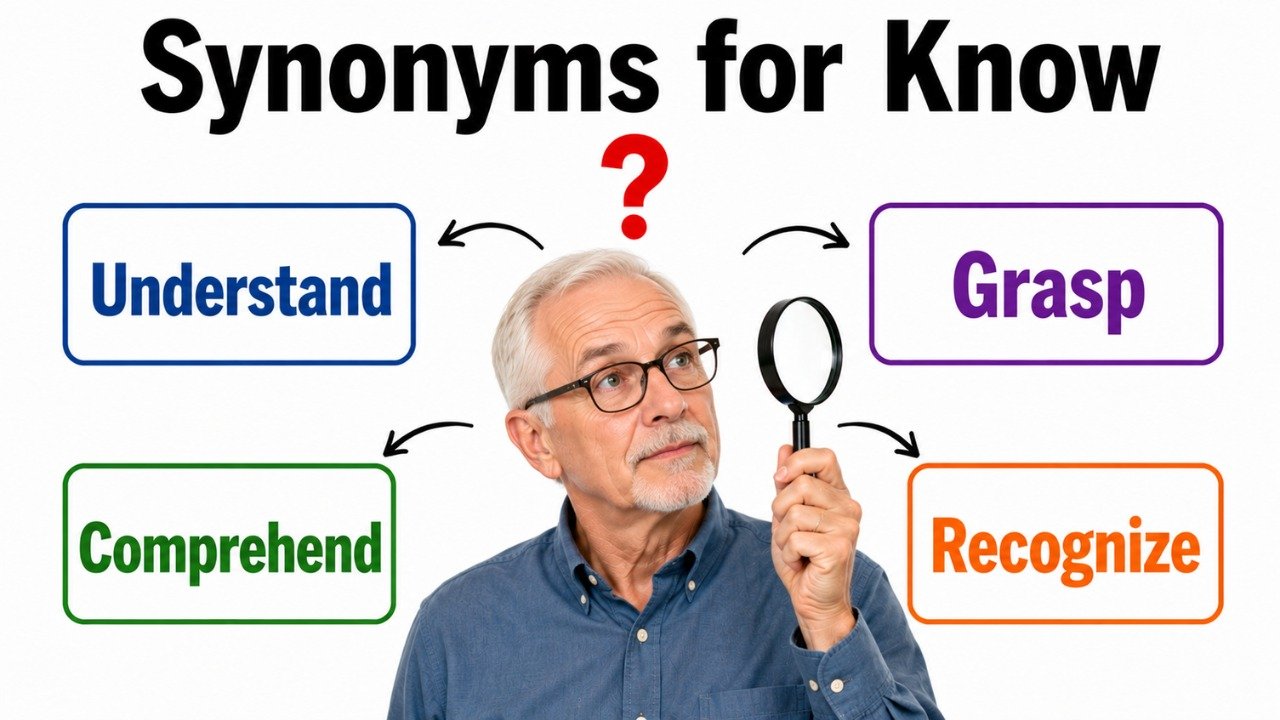
Quick Answer: The best synonyms for know are understand, realize, recognize, comprehend, grasp, identify, perceive, remember, acknowledge, and be aware of. Use understand when you clearly follow an idea, realize when you suddenly become conscious of a fact, and recognize when you identify someone or something familiar. Comprehend and grasp suit detailed understanding, while be aware of works well in formal writing. Identify is best for naming something correctly, and remember refers to information kept in the mind.
Pronunciation and Word Details
Word: Know.
Pronunciation: /noʊ/.
Part of Speech: Verb.
Meaning: To have information, understanding, awareness, familiarity, or certainty about someone or something.
US Pronunciation:
UK Pronunciation:
What Does “Know” Mean?
Know means to have information, understanding, awareness, or familiarity in your mind.
Know is mainly used as a verb. Its past tense is knew, and its past participle is known. The word can describe understanding a subject, recognizing a person, remembering a fact, being familiar with a place, or feeling certain that something is true.
The meaning changes according to the words that follow it.
Knowing a Fact: I know that the meeting begins at ten.
Understanding a Subject: She knows how the system works.
Recognizing a Person: Do you know the woman standing near the door?
Being Familiar With a Place: He knows the city very well.
Having a Skill: They know how to repair the machine.
Feeling Certain: I know this is the correct decision.
Experiencing Something: She knows what disappointment feels like.
Know can be followed by a noun, a question word, an infinitive phrase, or a clause beginning with that.
Noun Pattern: I know the answer.
Question Word Pattern: She knows where the documents are.
Skill Pattern: He knows how to cook.
Clause Pattern: We know that the information is correct.
Meaning, Tone, and Context of “Know”
Know is a neutral and highly common word. It appears naturally in casual conversation, academic writing, professional communication, instructions, reports, stories, and personal discussions.
In casual speech, know often refers to information, familiarity, or understanding.
Casual Example: I know what you mean.
In formal writing, more precise alternatives such as understand, recognize, acknowledge, establish, determine, or be aware of may improve clarity.
Formal Example: Researchers understand how the process affects memory.
Know can also sound strong and certain. Saying “I know” communicates greater confidence than saying “I think” or “I believe.”
Certain Tone: I know the figures are accurate.
Uncertain Tone: I think the figures are accurate.
The word may also sound emotional when it refers to shared experience, trust, loss, love, or hardship.
Emotional Example: She knows how difficult the experience can be.
Know is conversational rather than technical. In academic or scientific contexts, writers should choose a more exact verb when describing evidence, observation, analysis, or conclusions.
When and How to Use “Know”
For Having Information
Use know when someone possesses a fact or piece of information.
Example: I know the correct address.
For Understanding an Idea
Use know when someone understands a concept, explanation, rule, or process.
Example: She knows why the plan failed.
For Recognizing Someone
Use know when a person is familiar enough to recognize another person.
Example: Do you know the man in the blue coat?
For Being Familiar With a Place
Use know when someone has experience with a location, route, building, or environment.
Example: Our driver knows the area well.
For Having a Skill
Use know how followed by an infinitive when discussing an ability or learned skill.
Example: He knows how to create a clear presentation.
For Expressing Certainty
Use know when you are confident that something is true.
Example: We know the results are reliable.
For Remembering Information
Use know when information can be recalled without checking another source.
Example: She knows every line of the speech.
For Understanding a Person
Use know when someone understands another person’s habits, character, preferences, or behavior.
Example: I know my sister well enough to recognize when she is worried.
For Personal Experience
Use know when someone has directly experienced a feeling, condition, or situation.
Example: He knows what it feels like to begin again.
For Distinguishing Things
Use know when someone can tell the difference between two people, objects, ideas, or situations.
Example: She knows right from wrong.
Best Synonyms for Know
Understand
Synonym: To clearly grasp the meaning, reason, or nature of something.
Example: I understand why the schedule was changed.
Realize
Synonym: To become aware of a fact or situation.
Example: She realized that she had entered the wrong room.
Recognize
Synonym: To identify someone or something seen, heard, or experienced before.
Example: He recognized the voice immediately.
Comprehend
Synonym: To understand something fully, especially something complex.
Example: The students comprehended the main argument.
Grasp
Synonym: To understand an idea, meaning, or situation clearly.
Example: She quickly grasped the purpose of the exercise.
Identify
Synonym: To recognize and correctly name someone or something.
Example: The witness identified the correct vehicle.
Perceive
Synonym: To notice, understand, or become aware of something.
Example: He perceived a change in her attitude.
Remember
Synonym: To keep or bring information back into the mind.
Example: I remember where we placed the keys.
Acknowledge
Synonym: To accept or admit that something is true or exists.
Example: The manager acknowledged the problem.
Be Aware Of
Synonym: To have knowledge or consciousness of a fact or situation.
Example: Please be aware of the updated guidelines.
50 Synonyms for Know with Short Meanings
- Understand: To grasp the meaning of something.
- Realize: To become conscious of a fact.
- Recognize: To identify something familiar.
- Comprehend: To understand something fully.
- Grasp: To understand an idea clearly.
- Identify: To recognize and name correctly.
- Perceive: To notice or understand through awareness.
- Remember: To recall information from the mind.
- Acknowledge: To accept that something is true.
- Be Aware Of: To have knowledge of something.
- Appreciate: To understand the importance or meaning of something.
- Discern: To recognize something through careful thought or observation.
- Detect: To discover or notice something difficult to see.
- Notice: To become aware of something through attention.
- Observe: To see or notice something carefully.
- Learn: To gain knowledge or understanding.
- Discover: To find out something previously unknown.
- Find Out: To obtain information about something.
- Ascertain: To learn or determine something with certainty.
- Determine: To establish a fact through thought or investigation.
- Establish: To prove or confirm that something is true.
- Confirm: To verify that information is correct.
- Verify: To check and prove the truth of something.
- Gather: To understand or conclude from available information.
- Infer: To reach an understanding from evidence.
- Deduce: To form a conclusion through logical reasoning.
- Conclude: To decide something after considering the facts.
- Sense: To become aware of something without direct proof.
- Feel: To have an instinctive awareness or impression.
- Suspect: To believe something may be true.
- Believe: To accept something as true.
- Accept: To recognize something as valid or true.
- See: To understand an idea or situation.
- Follow: To understand an explanation or argument.
- Get: To understand something in informal speech.
- Catch On: To begin understanding something.
- Figure Out: To understand or solve something through thought.
- Make Out: To understand or identify something with difficulty.
- Tell: To recognize or distinguish between things.
- Distinguish: To recognize the difference between things.
- Differentiate: To identify differences clearly.
- Be Familiar With: To have knowledge or experience of something.
- Be Acquainted With: To have some familiarity with a person or subject.
- Be Informed About: To possess current information about something.
- Be Conscious Of: To be mentally aware of something.
- Have Knowledge Of: To possess information about a subject.
- Have Experience Of: To understand something through personal experience.
- Master: To gain complete knowledge or skill.
- Know By Heart: To remember something perfectly.
- Know Of: To be aware that someone or something exists.
Read Also:
Synonyms for Pathetic
Synonyms for Know by Context
When Know Means Understand
Understand, comprehend, grasp, appreciate, see, follow, get, and catch on can replace know when the sentence refers to understanding meaning.
Understand is the clearest general option. Comprehend sounds more formal, while get and catch on are conversational.
Example With Know: I know what the instructions mean.
Example With Understand: I understand what the instructions mean.
Example With Comprehend: The students comprehended the theory.
Example With Get: I get what you are saying.
When Know Means Be Aware
Be aware of, realize, perceive, notice, sense, and be conscious of describe awareness of a fact, condition, or change.
Realize often suggests a new or sudden understanding. Be aware of usually describes existing knowledge.
Example With Know: She knows that the deadline has changed.
Example With Be Aware Of: She is aware that the deadline has changed.
Example With Realize: She realized that the deadline had changed.
When Know Means Recognize
Recognize, identify, distinguish, tell, differentiate, and make out are useful when someone can identify a person, sound, object, or difference.
Example With Know: I know that voice.
Example With Recognize: I recognize that voice.
Example With Identify: The expert identified the unusual sound.
When Know Means Be Familiar With
Be familiar with, be acquainted with, know of, and have knowledge of describe familiarity.
Be familiar with suggests useful knowledge or experience. Be acquainted with often suggests limited familiarity.
Example With Know: She knows the local area.
Example With Be Familiar With: She is familiar with the local area.
Example With Be Acquainted With: He is acquainted with the basic procedure.
When Know Means Discover
Learn, discover, find out, ascertain, determine, and establish describe gaining or confirming knowledge.
Find out is common in everyday speech. Ascertain and determine are more formal.
Example With Know: We need to know what caused the error.
Example With Find Out: We need to find out what caused the error.
Example With Determine: We need to determine what caused the error.
When Know Means Feel Certain
Confirm, verify, establish, believe, accept, and acknowledge can relate to certainty, truth, or acceptance.
Know expresses strong confidence, while believe leaves more room for doubt.
Example With Know: I know the statement is correct.
Example With Confirm: I can confirm that the statement is correct.
Example With Believe: I believe the statement is correct.
When Know Means Remember
Remember, know by heart, recall, and have memorized relate to information stored in the mind.
Remember is suitable for general recall. Know by heart means something can be repeated from memory.
Example With Know: She knows the poem perfectly.
Example With Know By Heart: She knows the poem by heart.
Example With Remember: She remembers every line of the poem.
When Know Means Experience Personally
Have experience of, understand, appreciate, and be familiar with may describe knowledge gained through direct experience.
Example With Know: He knows the pressure of working under a strict deadline.
Example With Have Experience Of: He has experience of working under strict deadlines.
Example With Understand: He understands the pressure of working under a strict deadline.
Another Word for Know
Understand is often the best single replacement for know when the sentence refers to meaning, explanation, or awareness. However, the strongest alternative depends on context. Use recognize for familiar people or objects, realize for new awareness, remember for recalled information, and determine for facts discovered through investigation.
Original: I know what this sentence means.
Better Option: I understand what this sentence means.
Original: She knew that she had made a mistake.
Better Option: She realized that she had made a mistake.
Original: Do you know the person in this photograph?
Better Option: Do you recognize the person in this photograph?
Original: We need to know why the system stopped working.
Better Option: We need to determine why the system stopped working.
When Not to Use “Know”
Know may sound vague when a more precise verb can explain how the information was gained or what kind of knowledge is involved.
Weak: The researchers know that the treatment produced a change.
Better: The researchers confirmed that the treatment produced a change.
Avoid know when you mean that someone noticed something through observation.
Weak: She knew a slight difference in the sound.
Better: She noticed a slight difference in the sound.
Do not use know when recognize is more accurate.
Weak: I knew his face when he entered the room.
Better: I recognized his face when he entered the room.
Know may also sound repetitive when it appears several times in a short paragraph.
Weak: I know the rule, and I know why it exists, but I do not know how to apply it.
Better: I understand the rule and its purpose, but I am unsure how to apply it.
Avoid know when describing information gained through formal analysis.
Weak: The report helped us know the cause of the decline.
Better: The report helped us identify the cause of the decline.
Do not use a formal alternative when simple conversation calls for know.
Weak: I am acquainted with where the keys are.
Better: I know where the keys are.
Know can also sound too certain when the statement is only an opinion.
Weak: I know this plan will succeed.
Better: I believe this plan will succeed.
Words Commonly Confused With Know
Know vs Understand: Know means having information or familiarity. Understand means grasping the meaning, reason, or process behind something.
Know vs Realize: Know describes existing awareness. Realize often describes the moment someone becomes aware of something.
Know vs Recognize: Know can describe broad familiarity. Recognize means identifying someone or something encountered before.
Know vs Learn: Know describes having information. Learn describes gaining that information.
Know vs Remember: Know means possessing information. Remember means bringing stored information back into the mind.
Know vs Believe: Know expresses certainty. Believe expresses acceptance or confidence that may not be based on complete proof.
Know vs Notice: Know describes awareness or understanding. Notice describes becoming aware through attention or observation.
Know vs Identify: Know may describe familiarity. Identify means recognizing and naming someone or something correctly.
Know vs Discover: Know describes a state of knowledge. Discover describes the process of finding something previously unknown.
Know vs Acknowledge: Know means being aware of something. Acknowledge means openly accepting or admitting it.
Which Synonym Should You Choose?
Choose understand when discussing meaning, explanations, ideas, rules, instructions, or reasons.
Choose realize when someone becomes aware of a fact, mistake, consequence, or situation.
Choose recognize when identifying a familiar person, face, voice, place, pattern, or object.
Choose comprehend for academic writing about full or detailed understanding.
Choose grasp when describing a clear understanding of an idea, concept, problem, or situation.
Choose be aware of in formal emails, notices, instructions, policies, and professional communication.
Choose identify when naming a person, object, problem, cause, pattern, or feature.
Choose remember when discussing information that is stored and recalled.
Choose determine in reports, research, investigations, and formal analysis.
Choose ascertain when facts must be learned with certainty through careful checking.
Choose confirm when information has already been suggested and needs verification.
Choose acknowledge when someone accepts or admits a truth, fact, issue, or responsibility.
Choose be familiar with when referring to experience with a place, system, topic, or process.
Choose get in informal conversation when the intended meaning is understand.
Choose tell when discussing the ability to recognize a difference.
Choose know by heart when someone has memorized words, facts, or information perfectly.
Real Life Examples of “Know” in Sentences
Original: I know why the machine stopped.
Better Option: I understand why the machine stopped.
Original: She knew that the information was incomplete.
Better Option: She realized that the information was incomplete.
Original: Do you know this melody?
Better Option: Do you recognize this melody?
Original: The team needs to know what caused the delay.
Better Option: The team needs to determine what caused the delay.
Original: He knows the safety instructions.
Better Option: He is familiar with the safety instructions.
Original: I know that the figures are accurate.
Better Option: I can confirm that the figures are accurate.
Original: She knows every word of the song.
Better Option: She knows every word of the song by heart.
Original: We know about the recent changes.
Better Option: We are aware of the recent changes.
Original: The technician knew the source of the noise.
Better Option: The technician identified the source of the noise.
Original: I know how difficult this situation can be.
Better Option: I understand how difficult this situation can be.
Synonym Groups and Usage Differences
Understanding Group
Understand, comprehend, grasp, appreciate, see, follow, and get refer to understanding meaning or reasoning.
Understand is the most flexible choice. Comprehend sounds formal, while get is informal.
Example: She understood the explanation after seeing a practical example.
Awareness Group
Realize, be aware of, perceive, notice, sense, and be conscious of refer to awareness.
Realize often marks a moment of discovery. Notice usually involves observation.
Example: He realized that the document contained an error.
Recognition Group
Recognize, identify, tell, distinguish, differentiate, and make out refer to recognizing people, objects, sounds, or differences.
Recognize emphasizes familiarity. Identify emphasizes naming correctly.
Example: She recognized the speaker’s voice immediately.
Discovery Group
Learn, discover, find out, ascertain, determine, and establish refer to gaining knowledge.
Find out is conversational. Ascertain and determine are suitable for formal writing.
Example: The investigation determined the cause of the problem.
Familiarity Group
Be familiar with, be acquainted with, know of, and have knowledge of describe different levels of familiarity.
Be familiar with suggests useful experience. Know of suggests only awareness that something exists.
Example: Our guide is familiar with every route through the valley.
Certainty Group
Confirm, verify, establish, believe, accept, and acknowledge relate to truth and certainty.
Confirm and verify require supporting evidence. Believe does not express the same certainty as know.
Example: The final test confirmed that the device was working correctly.
Memory Group
Remember, know by heart, recall, and have memorized relate to information kept in the mind.
Know by heart suggests complete memorization.
Example: She knew the entire speech by heart.
Experience Group
Have experience of, understand, appreciate, and be familiar with may describe knowledge gained through direct experience.
Example: He understands the demands of caring for a young child.
Antonyms of Know
The opposite of know depends on whether the word means understand, recognize, remember, or possess information.
Ignore: To pay no attention to available information.
Misunderstand: To interpret something incorrectly.
Forget: To fail to remember something.
Overlook: To fail to notice an important detail.
Miss: To fail to notice, understand, or recognize something.
Misinterpret: To understand a statement or situation incorrectly.
Confuse: To mistake one person, thing, or idea for another.
Doubt: To feel uncertain about whether something is true.
Question: To express uncertainty about a statement or belief.
Be Unaware Of: To have no knowledge of something.
Be Unfamiliar With: To lack experience or knowledge of something.
Be Ignorant Of: To lack information or awareness about something.
Fail to Recognize: To be unable to identify someone or something familiar.
Forget About: To no longer remember a person, task, or fact.
Remain Uncertain: To lack confidence or clear knowledge.
Comparison: Know vs Related Words
Know vs Understand
Know means having information. Understand means grasping its meaning, cause, or purpose.
Example With Know: I know the rules of the game.
Example With Understand: I understand why those rules are necessary.
Know vs Realize
Know describes information already held in the mind. Realize describes becoming aware of something.
Example With Know: She knows the road is closed.
Example With Realize: She realized the road was closed when she saw the sign.
Know vs Recognize
Know can describe familiarity or personal acquaintance. Recognize means identifying something encountered before.
Example With Know: I know the new supervisor.
Example With Recognize: I recognized the new supervisor from the meeting.
Know vs Learn
Know describes possessing knowledge. Learn describes gaining knowledge.
Example With Know: He knows the answer.
Example With Learn: He learned the answer during the lesson.
Know vs Remember
Know means information exists in the mind. Remember means recalling that information when needed.
Example With Know: I know her telephone number.
Example With Remember: I remembered her telephone number after a few moments.
Know vs Believe
Know communicates certainty. Believe communicates an opinion or acceptance that may include uncertainty.
Example With Know: I know the office is closed because I checked the notice.
Example With Believe: I believe the office is closed, but I have not checked.
Know vs Identify
Know can mean familiarity. Identify means recognizing and naming something precisely.
Example With Know: She knows the plant.
Example With Identify: She identified the plant as a type of fern.
Know vs Be Aware Of
Know is common in both casual and formal language. Be aware of sounds more formal and often appears in instructions or notices.
Example With Know: We know about the new requirements.
Example With Be Aware Of: Please be aware of the new requirements.
Common Phrases and Expressions With “Know”
Know About: To have information concerning a subject.
Know Of: To be aware that someone or something exists.
Know How: To have the skill or understanding needed to do something.
Know Why: To understand the reason for something.
Know Better: To have enough experience or judgment to avoid a mistake.
Know by Heart: To remember something completely.
Know for Certain: To possess information without doubt.
Know Full Well: To be completely aware of a fact.
Know Someone Well: To understand a person’s character, habits, or preferences.
Know the Difference: To recognize how two or more things are unlike.
Common Mistakes to Avoid
Repeating Know Too Often
Repeating know in nearby sentences can make writing sound weak.
Weak: I know the rule, I know the reason, and I know how to use it.
Better: I understand the rule, recognize its purpose, and know how to apply it.
Using Know Instead of Understand
Knowing information does not always mean understanding it.
Incorrect: I know the explanation, but it still makes no sense.
Better: I have read the explanation, but I still do not understand it.
Using Knew for Present Knowledge
Knew is the past tense of know. Use know for present awareness.
Incorrect: I knew the answer right now.
Correct: I know the answer right now.
Confusing Know and No
Know is a verb related to knowledge. No expresses refusal or absence.
Incorrect: I no the correct answer.
Correct: I know the correct answer.
Confusing Knew and New
Knew is the past tense of know. New describes something recent or unused.
Incorrect: She new the road was closed.
Correct: She knew the road was closed.
Using Know With an Incorrect Verb Pattern
Use know how to followed by the base form of a verb.
Incorrect: She knows to operate the machine.
Correct: She knows how to operate the machine.
Choosing an Overly Formal Synonym
A formal synonym may sound unnatural in ordinary conversation.
Unnatural: I ascertained where my shoes were.
Natural: I found out where my shoes were.
Using Know When the Meaning Is Only Believe
Do not use know when there is no certainty or supporting evidence.
Too Certain: I know the weather will remain clear next week.
More Accurate: I believe the weather will remain clear next week.
Using a Weak General Verb in Formal Writing
Formal reports often need a verb that explains how knowledge was gained.
Weak: The analysis helped us know the main cause.
Better: The analysis helped us identify the main cause.
Using Know of and Know Interchangeably
Know someone usually suggests personal familiarity. Know of someone means only being aware that the person exists.
Example With Know: I know the teacher because she taught my class.
Example With Know Of: I know of the teacher, but we have never met.
Conclusion
Learning synonyms for know helps you express understanding, awareness, recognition, certainty, memory, and familiarity more precisely. Use understand for ideas, realize for new awareness, recognize for familiar people or objects, and remember for stored information. Choose identify or determine in reports and investigations, be aware of in formal communication, and get in casual conversation. The right alternative depends on whether someone understands information, discovers a fact, recognizes something, recalls knowledge, or has direct experience.
FAQs About Synonyms for Know
What Is the Best Synonym for Know?
Understand is the best general synonym when know refers to meaning or comprehension. Other choices depend on the sentence context.
What Is a Formal Synonym for Know?
Comprehend, ascertain, determine, recognize, acknowledge, and be aware of are useful formal alternatives.
Can Understand Replace Know?
Understand can replace know when the sentence concerns meaning, reasons, ideas, or processes. It cannot replace know naturally in every context.
What Is Another Word for Know a Person?
Be acquainted with, recognize, be familiar with, and understand may work. The best choice depends on whether you mean personal familiarity or simple recognition.
What Is Another Word for Know a Fact?
Be aware of, realize, confirm, establish, and understand can describe knowledge of a fact.
What Is the Difference Between Know and Realize?
Know describes existing awareness. Realize describes the moment when someone becomes aware of something.
What Is the Opposite of Know?
Common opposites include misunderstand, forget, overlook, doubt, be unaware of, and be unfamiliar with.
