
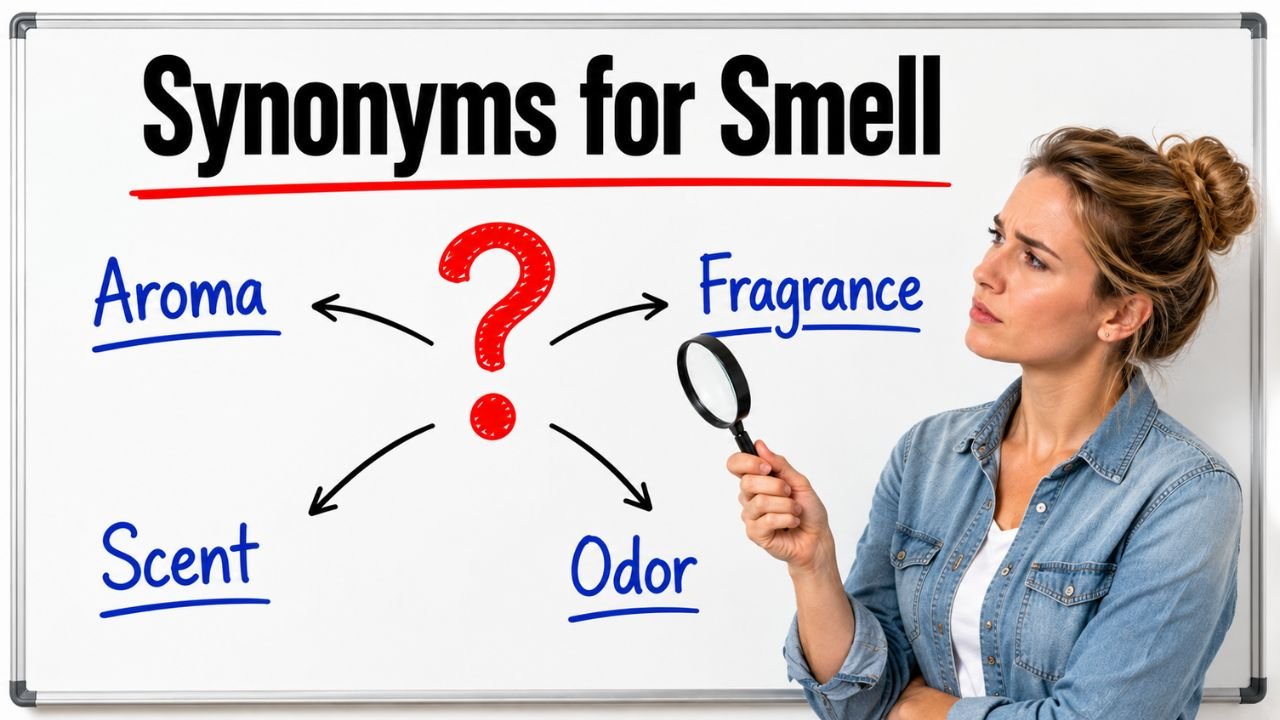
Quick Answer: Common synonyms for smell include scent, aroma, odor, fragrance, perfume, bouquet, whiff, stench, reek, and musk. Use scent for a noticeable or generally pleasant smell, aroma for food and drinks, odor for neutral or unpleasant smells, fragrance for attractive smells, bouquet for complex scents, and stench for a powerful unpleasant smell. In formal or technical writing, odor is often the clearest choice. In casual speech, scent, whiff, and stink sound more natural.
Pronunciation and Word Details
Word: Smell.
Pronunciation: /smel/.
Part of Speech: Noun and verb.
Meaning: Smell is an odor noticed through the nose or the act of detecting an odor.
US Pronunciation:
UK Pronunciation:
What Does “Smell” Mean?
Smell means an odor that a person or animal notices through the nose. As a noun, it refers to the quality or sensation produced by something in the air.
Noun Example: The smell of fresh bread filled the kitchen.
As a verb, smell means to notice an odor or to have a particular odor.
Detection Example: I can smell smoke outside.
Description Example: The flowers smell wonderful.
Smell can describe pleasant, unpleasant, strong, weak, familiar, natural, or unusual odors. Its meaning often depends on the adjective or surrounding context.
The word can also refer to the physical ability to detect odors.
Example: Her sense of smell became stronger after the cold disappeared.
In some contexts, smell can suggest suspicion or awareness rather than a physical odor.
Example: He could smell trouble before the argument began.
Meaning, Tone, and Context of “Smell”
Smell is a neutral and widely understood word. It is common in everyday conversation, descriptive writing, health discussions, food writing, scientific explanations, and sensory descriptions.
The word itself does not always indicate whether an odor is pleasant or unpleasant. Context usually provides that information.
Pleasant Context: The smell of warm cinnamon was comforting.
Unpleasant Context: A terrible smell came from the drain.
Neutral Context: The gas has a noticeable smell.
In casual conversation, smell is often used instead of more specific words such as aroma, fragrance, scent, odor, or stench. In descriptive writing, a precise synonym creates a clearer picture.
Aroma and fragrance usually carry positive associations. Odor is more neutral or formal, although it can sound negative in everyday speech. Stench, stink, reek, and fetor clearly describe offensive smells.
As a verb, smell is conversational and neutral. Detect and perceive sound more formal, while sniff describes the physical action of drawing air through the nose.
When and How to Use “Smell”
For Pleasant Odors
Use smell with a positive adjective when describing food, flowers, nature, perfume, or clean surroundings.
Example: The garden had a sweet smell after the rain.
For Unpleasant Odors
Use smell with adjectives such as bad, foul, strange, strong, or unpleasant.
Example: A foul smell was coming from the rubbish bin.
For Detecting an Odor
Use smell as a verb when someone notices something through the nose.
Example: We could smell coffee from the next room.
For Describing How Something Smells
Use smell as a linking verb followed by an adjective.
Example: The soup smells delicious.
For Food and Cooking
Smell helps describe the sensory quality of ingredients, meals, and drinks.
Example: The smell of roasted garlic made everyone hungry.
For Warning or Danger
Smell can alert someone to smoke, gas, chemicals, spoiled food, or other risks.
Example: She smelled gas and immediately opened the windows.
For Memory and Emotion
Smells often create associations with people, places, seasons, and past experiences.
Example: The smell of pine reminded him of winter holidays.
For Suspicion
In figurative language, smell can mean to sense that something is wrong.
Example: The reporter could smell a dishonest deal.
Best Synonyms for Smell
Scent
Synonym: Scent means a recognizable odor, often one that is pleasant or intentionally followed.
Example: The soft scent of lavender filled the room.
Aroma
Synonym: Aroma is a pleasant and noticeable smell, especially from food or drinks.
Example: The aroma of freshly prepared coffee reached the hallway.
Odor
Synonym: Odor is a formal or neutral word for a smell, although it may suggest something unpleasant.
Example: The technician investigated the unusual odor.
Fragrance
Synonym: Fragrance is a sweet, attractive, or carefully created smell.
Example: The fragrance of roses drifted through the garden.
Perfume
Synonym: Perfume is a pleasant scent produced naturally or created for personal use.
Example: Her perfume had a light floral quality.
Bouquet
Synonym: Bouquet is a combination of pleasant scents, especially in flowers, wine, or other drinks.
Example: The drink had a rich fruity bouquet.
Whiff
Synonym: Whiff is a brief or faint smell noticed for a short moment.
Example: He caught a whiff of smoke near the door.
Stench
Synonym: Stench is an extremely strong and unpleasant smell.
Example: The stench from the spoiled food was unbearable.
Reek
Synonym: Reek means a powerful and usually offensive smell.
Example: The reek of old smoke remained in the curtains.
Musk
Synonym: Musk is a deep, warm, earthy scent often associated with perfume, animals, or natural surroundings.
Example: The room carried a subtle musk.
50 Synonyms for Smell with Short Meanings
- Aroma: A pleasant and noticeable smell.
- Scent: A recognizable odor, often pleasant.
- Odor: A general or formal word for a smell.
- Fragrance: A sweet or attractive scent.
- Perfume: A pleasant natural or created scent.
- Bouquet: A complex mixture of pleasant smells.
- Whiff: A brief or faint smell.
- Hint: A very small amount of a smell.
- Trace: A barely noticeable remaining smell.
- Essence: The concentrated quality of a scent.
- Redolence: A noticeable and often pleasant fragrance.
- Musk: A deep, warm, and earthy scent.
- Tang: A sharp and distinctive smell.
- Note: One particular quality within a complex scent.
- Savor: A sensory quality connected with smell and taste.
- Air: A noticeable quality or smell surrounding a place.
- Atmosphere: The sensory quality created within an environment.
- Emanation: A smell or substance released from something.
- Effluvium: An unpleasant vapor or smell given off by matter.
- Exhalation: Air, vapor, or odor released from something.
- Fumes: Strong gases or vapors with a noticeable smell.
- Vapor: A substance in the air that may carry an odor.
- Stench: A very powerful and offensive smell.
- Stink: A strong and unpleasant smell.
- Reek: A heavy and offensive odor.
- Fetor: A highly unpleasant smell.
- Malodor: A bad or offensive odor.
- Mustiness: A stale smell caused by dampness or poor airflow.
- Pong: An informal word for a strong unpleasant smell.
- Funk: A heavy, stale, or earthy odor.
- Unpleasant Odor: A smell that causes discomfort.
- Foul Odor: A strongly offensive smell.
- Strong Odor: A smell that is easy to notice.
- Aromatic Note: A particular quality within a pleasant scent.
- Fragrance Note: One part of a layered fragrance.
- Sniff: The act of drawing air through the nose to smell something.
- Inhale: To breathe in air that may contain a smell.
- Breathe In: To take air and its odors into the nose or lungs.
- Nose: To examine or discover something through smell.
- Detect: To notice the presence of an odor.
- Sense: To become aware of a smell.
- Perceive: To recognize an odor through the senses.
- Notice: To become conscious of a particular smell.
- Identify: To determine what is producing a smell.
- Recognize: To know a familiar smell again.
- Catch: To notice a smell briefly.
- Pick Up: To become aware of a faint odor.
- Sniff Out: To locate or discover something by smell.
- Discern: To detect a subtle difference between smells.
- Distinguish: To tell one smell apart from another.
Read Also:
Synonyms for God

Synonyms for Smell by Context
When Smell Means a Pleasant Scent
Aroma, fragrance, perfume, bouquet, redolence, and scent are useful for pleasant odors.
Aroma works especially well for food, coffee, spices, and baked goods.
Example: The aroma of warm bread spread through the house.
Fragrance is suitable for flowers, soaps, plants, and personal scents.
Example: The fragrance of jasmine became stronger in the evening.
Bouquet describes a layered combination of scents.
Example: The tea had a delicate floral bouquet.
When Smell Means a Neutral Odor
Odor, scent, note, trace, hint, and emanation can describe a smell without strongly judging it.
Odor is common in reports, instructions, product descriptions, and technical explanations.
Example: Investigators noticed an unusual odor near the equipment.
Note is useful when discussing one quality within a complex scent.
Example: The candle contained a light citrus note.
When Smell Means an Unpleasant Odor
Stench, stink, reek, fetor, malodor, mustiness, and pong describe unpleasant smells.
Stench suggests an extremely powerful offensive smell.
Example: A terrible stench rose from the blocked drain.
Mustiness specifically describes a stale odor caused by dampness, age, or poor ventilation.
Example: The basement had a noticeable mustiness.
When Smell Means a Brief Sensation
Whiff, hint, trace, and note describe faint or short lasting smells.
Whiff suggests that the smell was noticed only briefly.
Example: She caught a whiff of perfume as the door opened.
Trace suggests that only a small amount remains.
Example: There was still a trace of smoke in the room.
When Smell Means to Detect
Detect, sense, perceive, notice, identify, recognize, catch, and pick up can replace smell as a verb.
Detect is suitable for formal, scientific, or safety related contexts.
Example: The device can detect dangerous gases.
Recognize works when the odor is familiar.
Example: He recognized the scent of his favorite tea.
When Smell Means to Examine With the Nose
Sniff, inhale, nose, and sniff out describe a deliberate action.
Sniff is the most natural word for physically drawing air through the nose.
Example: She sniffed the milk before using it.
Sniff out can describe finding something through smell or uncovering hidden information.
Example: The dog sniffed out the missing bag.
Another Word for Smell
The best general replacement for smell is scent. It is natural, widely understood, and suitable for many neutral or pleasant contexts. However, the best alternative depends on whether the smell is pleasant, unpleasant, strong, faint, formal, or connected with a specific action.
Original: The smell of flowers entered the room.
Better Option: The scent of flowers entered the room.
Original: The smell of coffee made him feel awake.
Better Option: The aroma of coffee made him feel awake.
Original: A bad smell came from the old container.
Better Option: A foul odor came from the old container.
Original: She noticed the smell of smoke.
Better Option: She detected the odor of smoke.
When Not to Use “Smell”
Smell is useful, but it may sound vague when the exact quality of an odor matters. A more specific synonym can show whether the odor is pleasant, unpleasant, faint, powerful, natural, chemical, or complex.
When Describing a Pleasant Food Scent
Aroma is often more vivid than smell when discussing food or drinks.
Weak: The smell of the soup was inviting.
Better: The aroma of the soup was inviting.
When Describing a Powerful Bad Odor
Stench or reek creates a stronger and clearer image.
Weak: There was a bad smell in the alley.
Better: A terrible stench filled the alley.
When Writing a Formal Report
Odor or detect may sound more precise than smell.
Weak: Workers smelled something strange near the machine.
Better: Workers detected an unusual odor near the machine.
When the Smell Is Very Faint
Whiff, hint, or trace can show how little was noticed.
Weak: I noticed a small smell of smoke.
Better: I caught a faint whiff of smoke.
When Repetition Weakens the Description
Avoid repeating smell several times in one paragraph.
Weak: The room had a sweet smell, and the smell became stronger near the flowers.
Better: The room had a sweet fragrance that became stronger near the flowers.
Words Commonly Confused With Smell
Smell vs Scent: Smell is a broad word for any odor. Scent often suggests a recognizable, pleasant, or intentionally followed odor.
Smell vs Aroma: Smell can be pleasant or unpleasant. Aroma usually describes a pleasant smell from food, drinks, spices, or natural materials.
Smell vs Odor: Smell is common in conversation. Odor is more formal and often appears in scientific, technical, medical, or safety related writing.
Smell vs Fragrance: Smell is neutral. Fragrance refers to a pleasant, sweet, or carefully created scent.
Smell vs Perfume: Smell is any odor. Perfume is usually a pleasant scent created for the body, clothing, or surroundings.
Smell vs Stench: Smell has no fixed positive or negative meaning. Stench always indicates an extremely unpleasant odor.
Smell vs Taste: Smell is detected through the nose, while taste is experienced mainly through the mouth. The two senses work together but are not identical.
Smell vs Sniff: Smell means to detect an odor or possess an odor. Sniff describes the physical action of drawing air through the nose.
Which Synonym Should You Choose?
Choose scent for a pleasant or recognizable smell in everyday speech.
Choose aroma when describing food, coffee, tea, spices, or cooking.
Choose odor for formal reports, technical writing, safety information, or neutral descriptions.
Choose fragrance when describing flowers, personal scents, soaps, candles, or other attractive smells.
Choose bouquet when discussing a complex combination of scents in flowers, drinks, or carefully blended products.
Choose whiff when the smell is faint, brief, or noticed suddenly.
Choose hint when only a small quality of a smell is present.
Choose stench when the smell is extremely strong and offensive.
Choose mustiness when describing a stale smell caused by dampness, age, or limited airflow.
Choose detect when writing about the formal or deliberate recognition of an odor.
Choose sniff when describing the physical action of smelling something closely.
Choose recognize when someone knows a familiar scent from memory.
Choose musk when describing a deep, warm, earthy, or animal like scent.
Real Life Examples of “Smell” in Sentences
Original: The smell of fresh bread filled the bakery.
Better Option: The aroma of fresh bread filled the bakery.
Original: A pleasant smell came from the garden.
Better Option: A pleasant fragrance came from the garden.
Original: I could smell smoke near the window.
Better Option: I could detect smoke near the window.
Original: The smell from the bin was terrible.
Better Option: The stench from the bin was terrible.
Original: She noticed the smell of lavender on the pillow.
Better Option: She noticed the scent of lavender on the pillow.
Original: There was a slight smell of lemon in the drink.
Better Option: There was a hint of lemon in the drink.
Original: He smelled the shirt before putting it on.
Better Option: He sniffed the shirt before putting it on.
Original: The old cupboard had a damp smell.
Better Option: The old cupboard had a noticeable mustiness.
Original: The drink had a rich smell.
Better Option: The drink had a rich bouquet.
Original: She could smell her favorite perfume in the hallway.
Better Option: She recognized her favorite perfume in the hallway.
Synonym Groups and Usage Differences
Pleasant Scent Group
Aroma, scent, fragrance, perfume, bouquet, redolence, and musk describe attractive or interesting smells. Aroma is strongly connected with food, while fragrance is common for flowers and created scents.
Example: The fragrance of the blossoms mixed with the aroma of warm tea.
Neutral Odor Group
Odor, smell, emanation, note, air, and atmosphere can describe a sensory quality without clearly calling it pleasant or unpleasant.
Example: A chemical odor was present near the storage area.
Unpleasant Odor Group
Stench, stink, reek, fetor, malodor, mustiness, pong, and funk describe disagreeable smells. They differ mainly in strength, formality, and cause.
Example: The stench from the spoiled vegetables spread through the kitchen.
Faint Smell Group
Whiff, hint, trace, and note refer to smells that are weak, brief, or difficult to notice.
Example: A faint trace of smoke remained on the jacket.
Detection Group
Detect, sense, perceive, notice, catch, and pick up describe becoming aware of an odor. Detect and perceive are more formal than catch or pick up.
Example: She detected a faint gas odor near the cooker.
Recognition Group
Identify, recognize, discern, and distinguish describe understanding what a smell is or separating it from other odors.
Example: The expert could distinguish each spice by its scent.
Physical Action Group
Sniff, inhale, breathe in, nose, and sniff out describe actively using the nose to examine or locate something.
Example: The dog sniffed the ground and followed the trail.
Antonyms of Smell
The opposite of smell depends on whether the word refers to an odor, the ability to detect an odor, or the action of noticing one.
Odorlessness: The complete absence of smell.
Scentlessness: The quality of having no noticeable scent.
Freshness: A clean quality without stale or offensive odors.
Purity: A clean state without unwanted smells or substances.
Deodorization: The process of removing an unpleasant smell.
Neutrality: The absence of a strong or distinctive odor.
Miss: To fail to notice a smell.
Overlook: To remain unaware of an odor or sensory clue.
Ignore: To notice a smell but give it no attention.
Fail to Detect: To be unable to sense the presence of an odor.
Comparison: Smell vs Related Words
Smell vs Scent
Smell is the broadest everyday term and can be positive, negative, or neutral. Scent often suggests something pleasant, recognizable, or intentionally followed.
Example With Smell: A strange smell came from the cupboard.
Example With Scent: The scent of roses filled the garden.
Smell vs Odor
Smell sounds natural in conversation. Odor sounds more formal and is common in technical, scientific, medical, and safety contexts.
Example With Smell: I noticed a smell in the kitchen.
Example With Odor: The inspector detected an unusual odor near the pipe.
Smell vs Aroma
Smell can refer to any odor. Aroma usually describes a pleasant smell, especially one produced by food or drinks.
Example With Smell: The room had a strong smell.
Example With Aroma: The aroma of baked apples filled the room.
Smell vs Fragrance
Smell is neutral and general. Fragrance suggests sweetness, beauty, or an intentionally attractive scent.
Example With Smell: The soap has a noticeable smell.
Example With Fragrance: The soap has a delicate floral fragrance.
Smell vs Stink
Smell can be pleasant or unpleasant. Stink is informal and always refers to a strong bad odor.
Example With Smell: The room had a familiar smell.
Example With Stink: The rubbish began to stink in the heat.
Smell vs Stench
Smell is general, while stench describes an intense and offensive odor.
Example With Smell: A smell came from the drain.
Example With Stench: A powerful stench came from the blocked drain.
Smell vs Sniff
Smell refers to noticing an odor or having a particular odor. Sniff refers to the deliberate physical action used to examine an odor.
Example With Smell: She could smell the flowers.
Example With Sniff: She sniffed the flowers carefully.
Common Phrases and Expressions With “Smell”
Smell Good: To have a pleasant scent.
Smell Bad: To have an unpleasant odor.
Smell Like: To have an odor similar to something else.
Smell Of: To carry the noticeable odor of something.
Sense of Smell: The physical ability to detect odors.
Strong Smell: An odor that is easy to notice.
Sweet Smell: A pleasant odor similar to flowers, fruit, or sugar.
Foul Smell: A powerful and offensive odor.
Familiar Smell: An odor recognized from a previous experience.
Smell Something Burning: To detect smoke or an odor produced by heat or fire.
Common Mistakes to Avoid
Assuming Smell Is Always Negative
Smell is neutral unless the sentence gives it a positive or negative quality.
Incorrect Assumption: The word smell always means an offensive odor.
Better Understanding: A smell can be pleasant, unpleasant, or neutral.
Using Aroma for an Unpleasant Smell
Aroma normally suggests a pleasant smell, especially from food or drinks.
Unnatural: The aroma of rotten food filled the room.
Better: The stench of rotten food filled the room.
Using Stench for a Mild Odor
Stench is too strong for a faint or slightly unpleasant smell.
Unnatural: There was a tiny stench of perfume.
Better: There was a faint whiff of perfume.
Confusing Smell and Sniff
Smell describes detection or odor. Sniff describes a deliberate physical action.
Incorrect: She smelled loudly through her nose.
Better: She sniffed loudly through her nose.
Using an Adverb After a Linking Verb
When smell describes the condition of something, it is commonly followed by an adjective.
Incorrect: The meal smells deliciously.
Better: The meal smells delicious.
The first sentence would suggest that the meal is actively performing the action of smelling. The second correctly describes the meal.
Repeating Smell Too Often
Frequent repetition makes sensory descriptions flat.
Repetitive: The smell of coffee mixed with the smell of bread and the smell of cinnamon.
Improved: The aroma of coffee mixed with the scent of bread and a hint of cinnamon.
Choosing a Synonym Without Considering Tone
Odor may sound formal, while stink can sound casual or rude. Fragrance sounds positive, while stench is strongly negative. Match the synonym to the situation and audience.
Writing Vague Descriptions
A phrase such as strange smell gives little useful information. Add details about strength, source, character, or effect.
Vague: There was a strange smell.
Clearer: A sharp chemical odor came from the open container.
Conclusion
The best synonyms for smell depend on the type, strength, and effect of the odor. Use scent or fragrance for pleasant smells, aroma for food and drinks, odor for formal or neutral writing, whiff for a brief sensation, and stench or reek for powerful unpleasant odors. As a verb, smell can often be replaced by detect, sense, notice, sniff, or recognize. Choosing a precise alternative makes descriptions clearer, more vivid, and better suited to the intended context.
FAQs About Synonyms for Smell
What Is the Best Synonym for Smell?
Scent is the best general synonym for a neutral or pleasant smell. Odor is better for formal contexts, while aroma works well for food.
What Is a Synonym for a Pleasant Smell?
Aroma, fragrance, perfume, bouquet, and scent are common words for a pleasant smell.
What Is a Synonym for a Bad Smell?
Stench, stink, reek, fetor, malodor, and foul odor describe bad smells. Stench is one of the strongest choices.
What Is a Formal Word for Smell?
Odor is the most common formal replacement. Detect or perceive can replace smell when it is used as a verb.
What Word Describes a Faint Smell?
Whiff, hint, trace, and note describe a faint or brief smell.
Are Smell and Scent the Same?
They are similar, but smell can be pleasant or unpleasant. Scent more often describes a pleasant, recognizable, or intentionally followed odor.
Can Smell Be Used as Both a Noun and a Verb?
Yes. As a noun, it names an odor. As a verb, it means to detect an odor or to have a particular scent.
