
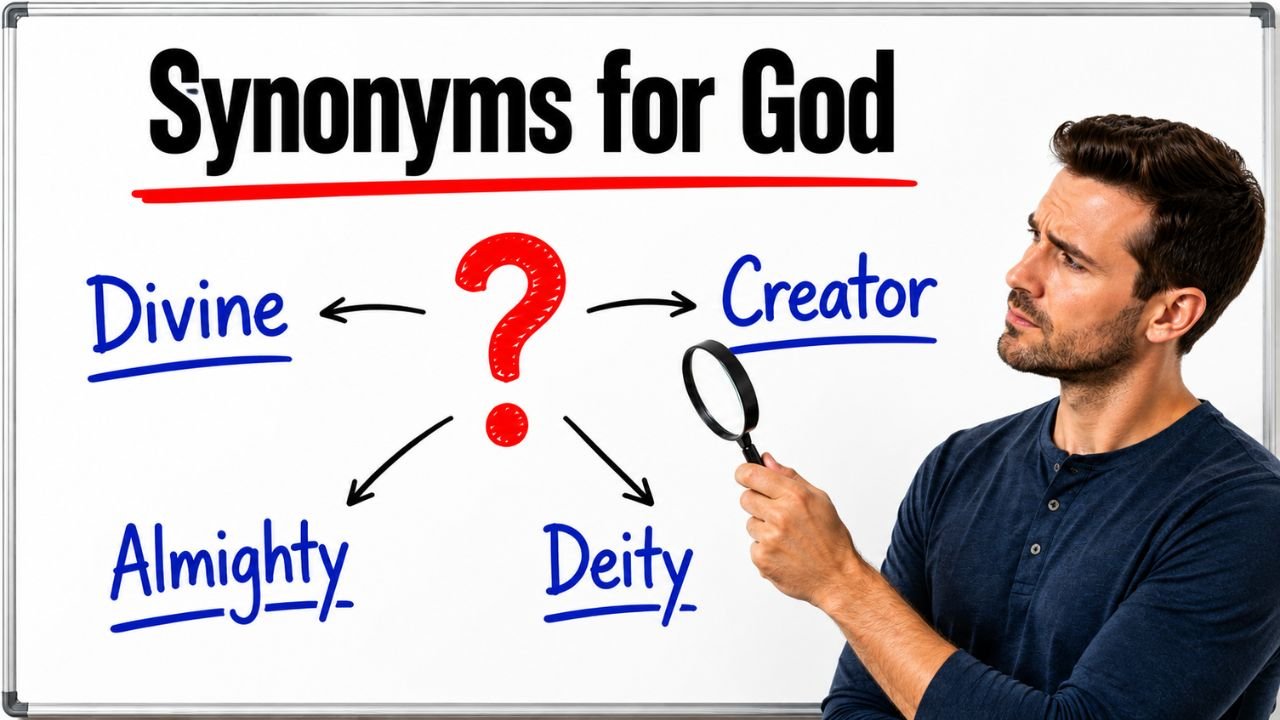
Quick Answer: The best synonyms for God include deity, Supreme Being, Creator, Lord, Almighty, Maker, Divine Being, Higher Power, Providence, and Divinity. Use deity as a neutral term in academic or comparative writing, Creator when emphasizing the origin of life or the universe, and Lord when expressing worship or authority. Almighty highlights unlimited power, while Higher Power is broader and less specific. In monotheistic contexts, God is normally capitalized because it functions as a proper name.
Pronunciation and Word Details
Word: God.
Pronunciation: /ɡɒd/ in British English and /ɡɑːd/ in American English.
Part of Speech: Noun.
Meaning: A supreme divine being or a supernatural being believed to possess power over life, nature, or the universe.
US Pronunciation:
UK Pronunciation:
What Does “God” Mean?
God means a supreme divine being worshipped as the creator, ruler, or source of the universe.
The word is a noun. When capitalized as God, it usually refers to the one supreme being in a monotheistic belief system. When written as god with a lowercase letter, it can refer to one of several divine beings in a polytheistic religion, mythology, or traditional story.
As a Proper Noun: Many believers pray to God for wisdom and guidance.
As a Common Noun: The ancient story describes a god associated with the sea.
God may also be used figuratively for someone who is greatly admired, unusually powerful, or exceptionally successful in a particular field. This use is informal and may sound exaggerated.
Figurative Use: Admirers described the famous athlete as a god of the sport.
The exact meaning depends on belief, culture, capitalization, and sentence context. In religious writing, God often expresses holiness, authority, creation, mercy, judgment, protection, or divine presence. In mythology, a god may control a particular part of nature, life, knowledge, or human activity.
Meaning, Tone, and Context of “God”
God has a serious, powerful, and often sacred tone. Its meaning is strongly connected with religion, spirituality, worship, philosophy, mythology, literature, and personal belief.
When capitalized, God is generally treated as a proper name for the supreme being. This form is common in prayer, devotional writing, religious discussion, and statements of faith.
When written in lowercase, god is a general category word. It may refer to a deity in mythology, a traditional belief system, or a fictional world.
Sacred Context: She thanked God for the strength to continue.
Academic Context: The essay compares different ideas about a supreme deity.
Mythological Context: The story presents a god who controls thunder.
Philosophical Context: The argument considers whether a First Cause is necessary.
Literary Context: The poet describes a divine presence within nature.
Figurative Context: The musician was treated like a god by devoted admirers.
The word should be used respectfully when referring to sincere religious beliefs. In neutral or academic writing, deity, Supreme Being, divine being, or object of worship may provide greater precision.
When and How to Use “God”
For the Supreme Being
Use God with a capital letter when referring to the one supreme being in a monotheistic context.
Example: They believed that God guided them through the difficult period.
For a Divine Being in Mythology
Use god with a lowercase letter when referring to one divine being among several.
Example: The legend describes a god who protected travelers.
For Creation
Use God when emphasizing belief in a divine creator of life, humanity, or the universe.
Example: Many people believe that God created the world.
For Worship and Prayer
Use God in sentences about prayer, gratitude, faith, devotion, guidance, or religious worship.
Example: She prayed to God for courage and patience.
For Divine Authority
Use God when referring to the highest spiritual authority or ruler.
Example: The speaker described God as the final source of justice.
For Protection and Comfort
Use God when expressing belief in divine care, mercy, or protection.
Example: He trusted that God would give him strength.
For Academic Discussion
Use a neutral alternative such as deity or Supreme Being when comparing religious concepts without expressing personal belief.
Example: The paper examines how different cultures understand a supreme deity.
For Mythological Categories
Use god with a descriptive phrase when identifying the area connected with a particular deity.
Example: The character was worshipped as a god of agriculture.
For Figurative Praise
Use god carefully when describing someone as exceptionally skilled or admired. This use is informal and may sound exaggerated or insensitive in certain settings.
Example: His supporters called him a god of modern comedy.
Best Synonyms for God
Deity: A god or goddess worshipped as a divine being.
Example: The temple was dedicated to a local deity.
Supreme Being: The highest divine being believed to rule or create the universe.
Example: The philosopher argued for the existence of a Supreme Being.
Creator: A divine being believed to have brought the universe or life into existence.
Example: The prayer praises the Creator of all living things.
Lord: A respectful title expressing divine authority, rule, or worship.
Example: The worshippers asked the Lord for guidance.
Almighty: A title for God that emphasizes unlimited power.
Example: They placed their trust in the Almighty.
Maker: A divine creator, especially in literary or devotional language.
Example: The poem describes humanity returning to its Maker.
Divine Being: A supernatural being possessing sacred or godlike qualities.
Example: The story centers on a divine being who protects the city.
Higher Power: A spiritual power greater than human beings.
Example: She believed that a Higher Power gave meaning to her life.
Providence: Divine guidance, protection, or control over events.
Example: They viewed their safe arrival as an act of Providence.
Divinity: A god, divine nature, or the quality of being sacred.
Example: The ancient community worshipped a divinity associated with the sun.
50 Synonyms for God with Short Meanings
- Deity: A god or goddess worshipped as divine.
- Supreme Being: The highest divine ruler or creator.
- Creator: The divine source believed to have made the universe.
- Lord: A sacred title expressing divine authority.
- Almighty: A title emphasizing unlimited divine power.
- Maker: The being believed to have created life or existence.
- Divine Being: A supernatural being with sacred power.
- Higher Power: A spiritual force greater than humanity.
- Providence: Divine guidance, care, or control over events.
- Divinity: A divine being or sacred nature.
- Godhead: The nature, essence, or identity of God.
- Holy One: A title emphasizing perfect holiness.
- Divine One: A respectful term for a sacred being.
- Eternal One: A divine being believed to exist forever.
- Everlasting One: A sacred being without an end.
- Infinite One: A divine being without limits.
- Most High: A title expressing supreme divine rank.
- Supreme Deity: A god holding the highest divine position.
- Sovereign Lord: A divine ruler with complete authority.
- Universal Creator: The being believed to have created everything.
- Heavenly Father: A title expressing divine care and authority.
- King of Heaven: A title for the supreme ruler of heaven.
- Ruler of Heaven: A divine being believed to govern heaven.
- Heavenly Ruler: A sacred ruler of the spiritual realm.
- Divine Ruler: A god who possesses sacred authority.
- Supreme Power: The greatest spiritual force or authority.
- Divine Power: Sacred power believed to influence existence.
- Sacred Being: A being regarded as holy and worthy of worship.
- Celestial Being: A supernatural being associated with heaven.
- Supernatural Being: A being believed to exist beyond natural laws.
- Immortal Being: A being believed to live forever.
- Divine Presence: The experienced or believed nearness of God.
- Sacred Presence: A holy presence felt or recognized by believers.
- Omnipotent One: A divine being believed to possess unlimited power.
- Omniscient One: A divine being believed to know everything.
- First Cause: The original cause believed to have begun existence.
- Prime Mover: The first source believed to have set existence in motion.
- Great Spirit: A title for a supreme spiritual presence in some traditions.
- Supreme Spirit: The highest spiritual being or power.
- Creator Deity: A god believed to have created the world.
- Patron Deity: A god believed to protect a person, place, or activity.
- Guardian Deity: A divine being believed to provide protection.
- Nature Deity: A god associated with the natural world.
- Sky Deity: A god connected with the sky or heavens.
- Household Deity: A god believed to protect a home or family.
- Cosmic Ruler: A divine ruler of the universe.
- Divine Authority: The highest sacred source of rule or command.
- Object of Worship: A being or power that receives religious devotion.
- Spirit: A supernatural or divine presence in certain contexts.
- Immortal: A divine being believed to be free from death.
Read Also:
Synonyms for Water
Synonyms for God by Context
When God Means the Supreme Being
Supreme Being, Most High, Almighty, Eternal One, Infinite One, and Sovereign Lord refer to the highest divine being. These terms are common in formal, spiritual, philosophical, and devotional contexts.
Example: The philosopher believed that a Supreme Being was the source of moral order.
Example: The worshippers praised the Most High for mercy and protection.
When God Means the Creator
Creator, Maker, Universal Creator, Creator Deity, First Cause, and Prime Mover focus on the origin of life or the universe.
Creator and Maker are understandable in religious and literary writing. First Cause and Prime Mover are more philosophical.
Example: The poem addresses the Creator of the heavens and the earth.
Example: The argument describes a First Cause behind all existence.
When God Means a Divine Ruler
Lord, Sovereign Lord, King of Heaven, Ruler of Heaven, Heavenly Ruler, and Cosmic Ruler emphasize command, authority, and control.
Example: The prayer asks the Lord to guide the community.
Example: The ancient hymn praises a heavenly ruler who maintains order.
When God Means a General Deity
Deity, divine being, sacred being, supernatural being, celestial being, and immortal being work well when discussing gods in general.
Deity is usually the strongest neutral choice in academic and comparative writing.
Example: The sculpture represents a deity associated with wisdom.
Example: The hero receives advice from a divine being.
When God Means Divine Power
Higher Power, Supreme Power, Divine Power, Supreme Spirit, Great Spirit, and Providence focus on spiritual force, guidance, or control rather than a clearly described personlike being.
Example: He believed that a Higher Power helped him overcome despair.
Example: The travelers credited Providence for their safe return.
When God Means a Protective Deity
Patron Deity, Guardian Deity, Household Deity, and Heavenly Father emphasize protection, care, belonging, or guidance.
Example: The community honored a patron deity connected with the city.
Example: The family prayed to their Heavenly Father for comfort.
When God Means a Deity Connected With Nature
Nature Deity, Sky Deity, Creator Deity, and Cosmic Ruler are useful in mythology, traditional narratives, and comparative studies.
Example: The villagers worshipped a nature deity associated with rain.
Example: The story describes a sky deity who commands storms.
When God Refers to Divine Presence
Divine Presence, Sacred Presence, Providence, and Spirit focus on the experience or influence of the divine.
Example: The quiet gathering created a strong sense of divine presence.
Example: She felt a sacred presence during the prayer.
When God Is Used Figuratively
Master, legend, icon, champion, genius, and superstar may replace the figurative use of god when describing a highly admired person. These are not religious synonyms, but they may communicate the intended praise more naturally.
Example: His fans considered him a legend of the sport.
Example: She became an icon of classical performance.
Another Word for God
Deity is usually the best neutral replacement for god because it can describe a divine being without assuming a particular religious belief. However, it does not always carry the personal, sacred, or devotional meaning expressed by the capitalized word God.
The best alternative depends on whether the sentence emphasizes creation, power, worship, authority, mythology, or spiritual guidance.
Original: The culture worshipped a god connected with the sea.
Better Option: The culture worshipped a deity connected with the sea.
Original: They believed that God created all life.
Better Option: They believed that the Creator made all life.
Original: She trusted God during the difficult period.
Better Option: She trusted in a Higher Power during the difficult period.
Original: The poem praises God as the ruler of heaven.
Better Option: The poem praises the Sovereign Lord as the ruler of heaven.
When Not to Use “God”
Do not use God with a capital letter when referring generally to one of several gods. Capitalization changes the meaning.
Weak: The ancient people worshipped a God of the sea.
Better: The ancient people worshipped a god of the sea.
Do not use god when deity is more neutral and precise in academic writing.
Weak: The report compares gods from several belief systems.
Better: The report compares deities from several belief systems.
Avoid replacing God with a synonym when the original sentence refers to a specific sacred name or title. A replacement may change the theological or emotional meaning.
Weak: The prayer directly addresses a supernatural being.
Better: The prayer directly addresses God.
Do not use Almighty for an ordinary mythological deity unless the story clearly presents that deity as all powerful.
Weak: The story describes every minor god as the Almighty.
Better: The story describes each figure as a divine being.
Avoid using god figuratively when it may sound disrespectful, exaggerated, or unclear.
Weak: The office manager is a god of filing documents.
Better: The office manager is exceptionally skilled at organizing documents.
Do not use Providence as a direct replacement when the sentence refers to God as a personal being. Providence usually means divine guidance or care.
Weak: The worshippers spoke directly to Providence in every prayer.
Better: The worshippers spoke directly to God in every prayer.
Avoid repeating God unnecessarily when a pronoun or suitable title can maintain clarity.
Weak: They believed God heard them because God understood their pain and God cared for them.
Better: They believed God heard them because the Lord understood their pain and cared for them.
Words Commonly Confused With God
God vs Deity: God with a capital letter usually refers to one supreme being. Deity is a general term for any god or goddess.
God vs Lord: God identifies a divine being, while Lord is a title emphasizing authority, rule, respect, or worship.
God vs Divinity: God refers to a divine being. Divinity can refer to a god, divine nature, sacred status, or the study of religious ideas.
God vs Creator: God has a broad religious meaning. Creator specifically emphasizes the act of bringing life or the universe into existence.
God vs Providence: God refers to the divine being. Providence refers to divine care, guidance, or control over events.
God vs Spirit: God may be understood as a supreme divine being. Spirit is broader and can refer to a nonphysical being, inner character, or supernatural presence.
God vs Idol: A god is a divine being believed to possess sacred power. An idol is an image or object that represents or receives worship.
God vs Demigod: A god is fully divine within a mythological system. A demigod is usually partly divine or possesses a lower divine status.
God vs Angel: God is regarded as divine and supreme in monotheistic belief. An angel is generally understood as a created spiritual messenger or servant.
God vs Goddess: God can be a general word for a male or unspecified deity. Goddess specifically refers to a female deity.
Which Synonym Should You Choose?
Choose deity for neutral, formal, academic, or comparative writing about divine beings.
Choose Supreme Being when discussing the highest divine power in philosophy, theology, or formal essays.
Choose Creator when the sentence focuses on the origin of life, humanity, nature, or the universe.
Choose Lord when expressing worship, obedience, sacred authority, or personal devotion.
Choose Almighty when emphasizing unlimited power.
Choose Maker in literary, poetic, or devotional writing about creation.
Choose Divine Being when describing a supernatural sacred figure without naming a particular religion.
Choose Higher Power in broad spiritual discussions or personal conversations where the speaker does not identify a specific divine being.
Choose Providence when referring to divine guidance, care, protection, or control over events.
Choose Divinity when discussing divine nature, sacred qualities, or a god in formal writing.
Choose First Cause when writing a philosophical essay about the origin of existence.
Choose Prime Mover when discussing the first source of motion, change, or causation in philosophical language.
Choose Patron Deity when a god protects a particular city, occupation, person, or activity.
Choose Guardian Deity when protection is the main idea.
Choose Nature Deity or Sky Deity when describing a god associated with natural forces.
Choose Heavenly Father when emphasizing divine care, personal relationship, and authority in a devotional context.
Choose god with a lowercase letter when referring to one deity among several.
Choose God with a capital letter when using the word as the proper name of the supreme being in a monotheistic context.
Real Life Examples of “God” in Sentences
Original: Many people believe that God created the universe.
Better Option: Many people believe that a Supreme Being created the universe.
Original: The poem praises God for creating life.
Better Option: The poem praises the Creator for bringing life into existence.
Original: The family asked God for protection.
Better Option: The family asked the Lord for protection.
Original: She believed that God had guided her decision.
Better Option: She believed that Providence had guided her decision.
Original: The ancient community worshipped a god of agriculture.
Better Option: The ancient community worshipped an agricultural deity.
Original: The philosopher described God as the first source of existence.
Better Option: The philosopher described the First Cause as the source of existence.
Original: He placed his trust in God during recovery.
Better Option: He placed his trust in a Higher Power during recovery.
Original: The story introduces a god who protects the city.
Better Option: The story introduces a guardian deity who protects the city.
Original: The hymn describes God as having unlimited power.
Better Option: The hymn describes the Almighty as possessing unlimited power.
Original: The people believed their god ruled the sky.
Better Option: The people believed their sky deity ruled the heavens.
Synonym Groups and Usage Differences
Supreme Being Group
Supreme Being, Most High, Eternal One, Infinite One, Almighty, and Supreme Deity describe the highest possible divine rank.
Supreme Being is neutral and formal. Most High and Almighty have a stronger devotional tone. Infinite One and Eternal One emphasize qualities rather than a specific action.
Example: The speaker described the Most High as the source of mercy and justice.
Creation Group
Creator, Maker, Universal Creator, Creator Deity, First Cause, and Prime Mover focus on beginnings and origins.
Creator and Maker are suitable for common religious writing. First Cause and Prime Mover are more philosophical and analytical.
Example: The essay considers whether the universe requires a First Cause.
Authority Group
Lord, Sovereign Lord, King of Heaven, Ruler of Heaven, Heavenly Ruler, and Cosmic Ruler emphasize command and authority.
Lord is personal and devotional. Cosmic Ruler sounds more literary or mythological.
Example: The worshippers praised the Sovereign Lord as the ruler of all creation.
General Deity Group
Deity, Divine Being, Sacred Being, Celestial Being, Supernatural Being, and Immortal describe divine or supernatural beings broadly.
Deity is the clearest general term. Celestial Being may also include heavenly figures that are not gods, so context matters.
Example: The legend tells of a deity who protected sailors.
Power Group
Higher Power, Supreme Power, Divine Power, Omnipotent One, and Almighty emphasize spiritual strength and authority.
Higher Power is broad and may be used without describing a specific religious belief. Almighty is a stronger sacred title.
Example: She believed that a Higher Power gave her courage.
Knowledge and Eternity Group
Omniscient One, Eternal One, Everlasting One, Infinite One, and Immortal Being describe divine qualities.
Omniscient One emphasizes complete knowledge. Eternal One and Everlasting One emphasize existence without end.
Example: The prayer addresses the Eternal One as the source of wisdom.
Protection Group
Heavenly Father, Patron Deity, Guardian Deity, Providence, and Sacred Presence emphasize care, guidance, or protection.
Providence describes divine care rather than the divine being directly.
Example: The travelers believed Providence had protected them.
Mythology Group
Nature Deity, Sky Deity, Household Deity, Patron Deity, and Creator Deity are useful when describing the role of a god within a mythological or traditional system.
Example: Families placed offerings before a household deity believed to protect the home.
Presence Group
Divine Presence, Sacred Presence, Spirit, and Divinity describe the experienced, symbolic, or spiritual nearness of the divine.
Example: The quiet ceremony gave participants a sense of sacred presence.
Antonyms of God
God has no exact antonym because the word names a divine being rather than a quality with a simple opposite. However, several words can provide conceptual contrasts depending on the sentence.
Mortal: A living being that will eventually die.
Human: A member of humanity rather than a divine being.
Creature: A living being understood as created rather than the creator.
Created Being: A being believed to have been brought into existence.
Finite Being: A being with limits in power, knowledge, or existence.
Earthly Being: A being connected with the physical world rather than heaven.
Natural Being: A being existing within the ordinary laws of nature.
Powerless Being: A being lacking authority or strength.
Secular Authority: A nonreligious source of leadership or control.
Profane: Not sacred or religious.
Ungodly: Not showing reverence, goodness, or religious character.
Atheistic: Rejecting or lacking belief in a god.
These are contrasts rather than perfect antonyms. Devil, demon, and evil are not universal opposites of God because their meanings depend on the belief system and context.
Comparison: God vs Related Words
God vs Deity
God with a capital letter usually names the supreme being in a monotheistic context. Deity is a neutral category word for a god or goddess.
Example With God: She thanked God for giving her strength.
Example With Deity: The statue represents a deity associated with healing.
God vs Supreme Being
God is direct and commonly used in worship and belief. Supreme Being is more formal, neutral, and philosophical.
Example With God: They prayed to God for guidance.
Example With Supreme Being: The argument assumes the existence of a Supreme Being.
God vs Creator
God can express many ideas, including authority, mercy, judgment, and worship. Creator specifically focuses on bringing existence into being.
Example With God: He believed that God heard every prayer.
Example With Creator: The hymn praises the Creator of the natural world.
God vs Lord
God identifies the divine being. Lord functions mainly as a title of authority, respect, or worship.
Example With God: They believed that God remained close to them.
Example With Lord: They asked the Lord to guide their choices.
God vs Almighty
God is the broader word. Almighty is a title emphasizing complete power.
Example With God: She placed her hope in God.
Example With Almighty: She placed her hope in the Almighty.
God vs Higher Power
God usually refers to a specific supreme being. Higher Power is broader and may describe an undefined spiritual force or authority.
Example With God: He prayed to God for forgiveness.
Example With Higher Power: He believed a Higher Power had helped him change.
God vs Providence
God refers to the divine being. Providence describes divine guidance, care, or control.
Example With God: They trusted God during the journey.
Example With Providence: They trusted Providence to guide their journey.
God vs Divinity
God refers to a particular divine being. Divinity may mean a deity, divine nature, sacred quality, or religious study.
Example With God: The prayer is addressed directly to God.
Example With Divinity: The poem explores the relationship between humanity and divinity.
God vs Spirit
God is commonly understood as a supreme divine being. Spirit is broader and can refer to a supernatural presence, inner character, or nonphysical essence.
Example With God: The believers worshipped God together.
Example With Spirit: The story describes a spirit living near the river.
God vs Idol
A god is believed to be a divine being. An idol is a physical image or object that represents or receives worship.
Example With God: The community believed the god controlled the harvest.
Example With Idol: A carved idol stood near the entrance of the shrine.
Common Phrases and Expressions With “God”
Thank God: An expression of relief, gratitude, or praise.
God Willing: Used to express hope that something will happen with divine permission.
By the Grace of God: Through divine kindness, favor, or support.
Act of God: An uncontrollable natural event that cannot reasonably be prevented.
Word of God: A sacred teaching, message, or scripture believed to come from God.
House of God: A place used for religious worship.
Child of God: A person understood as belonging to or being loved by God.
Man of God: A religious or deeply faithful man.
Fear of God: Deep reverence, awe, or fear connected with divine authority.
In the Eyes of God: According to divine judgment or understanding.
Common Mistakes to Avoid
Using Incorrect Capitalization
Capitalize God when it functions as the proper name of the supreme being. Use lowercase god when discussing a general deity or one god among several.
Incorrect: Many believers pray to god.
Correct: Many believers pray to God.
Incorrect: The story describes the God of the river.
Correct: The story describes the god of the river.
Treating Every Alternative as Exact
Creator, Lord, Almighty, Providence, and Higher Power do not have identical meanings. Each highlights a different aspect of the divine.
Unclear: Providence created the universe.
Better: The Creator brought the universe into existence.
Confusing God With Deity
Deity is a category term. It may refer to any god or goddess, while God often refers to one supreme being.
Incorrect: The academic paper uses God for every divine figure.
Better: The academic paper uses deity as the general category.
Using Providence as a Personal Name
Providence usually refers to divine guidance or care, not necessarily to a personal divine being.
Unnatural: Providence spoke directly to the prophet.
Better: God spoke directly to the prophet.
Using Higher Power in a Specific Sacred Context
Higher Power may sound too vague when the sentence refers to a clearly identified object of worship.
Vague: The worshippers offered their prayer to a Higher Power named in the text.
Better: The worshippers offered their prayer to God.
Confusing a God With an Idol
A god is the divine being worshipped. An idol is an image or object connected with worship.
Incorrect: The stone god was carried into the building.
Clearer: The stone idol representing the god was carried into the building.
Using Exaggerated Figurative Language
Calling a talented person a god can sound disrespectful, excessive, or unnatural.
Weak: She is the god of office organization.
Better: She is exceptionally skilled at office organization.
Ignoring the Reader’s Beliefs
Religious vocabulary can carry deep personal meaning. Use neutral words such as deity or divine being in comparative or academic writing, and preserve sacred titles in devotional contexts.
Repeating the Same Sacred Title
Repetition may make a paragraph sound heavy. Use pronouns or appropriate titles carefully without changing the intended meaning.
Repetitive: God created the world, and God cares for it because God values creation.
Improved: God created the world and cares for it because the Creator values all creation.
Conclusion
Synonyms for God vary according to belief, tone, and context. Deity is the best neutral alternative, while Supreme Being suits philosophical writing. Creator and Maker emphasize the origin of existence, Lord expresses sacred authority, and Almighty highlights unlimited power. Higher Power works in broader spiritual discussion, while Providence refers to divine care or guidance. Always consider capitalization and meaning before replacing God, because many alternatives express only one aspect of the original word rather than serving as exact substitutes.
FAQs About Synonyms for God
What Is the Best Synonym for God?
Deity is the best general alternative. However, Creator, Lord, Supreme Being, or Almighty may be better in specific religious or philosophical contexts.
Is Deity the Same as God?
Deity is a general term for a god or goddess. God with a capital letter usually refers to one supreme divine being.
Should God Always Be Capitalized?
Capitalize God when it functions as a proper name. Use lowercase god when referring to one deity among several or to gods in general.
What Is a Formal Synonym for God?
Supreme Being, deity, divinity, First Cause, and Prime Mover are useful formal alternatives.
What Is a Spiritual Alternative to God?
Higher Power, Divine Presence, Supreme Spirit, and Providence can work in broad spiritual contexts, though their meanings are not identical.
Can Creator Replace God?
Creator can replace God when the sentence emphasizes the origin of life or the universe. It may not fit sentences focused on prayer, judgment, or divine authority.
Does God Have a True Antonym?
No. God does not have a single exact antonym. Mortal, human, finite being, and profane are conceptual contrasts rather than direct opposites.
