
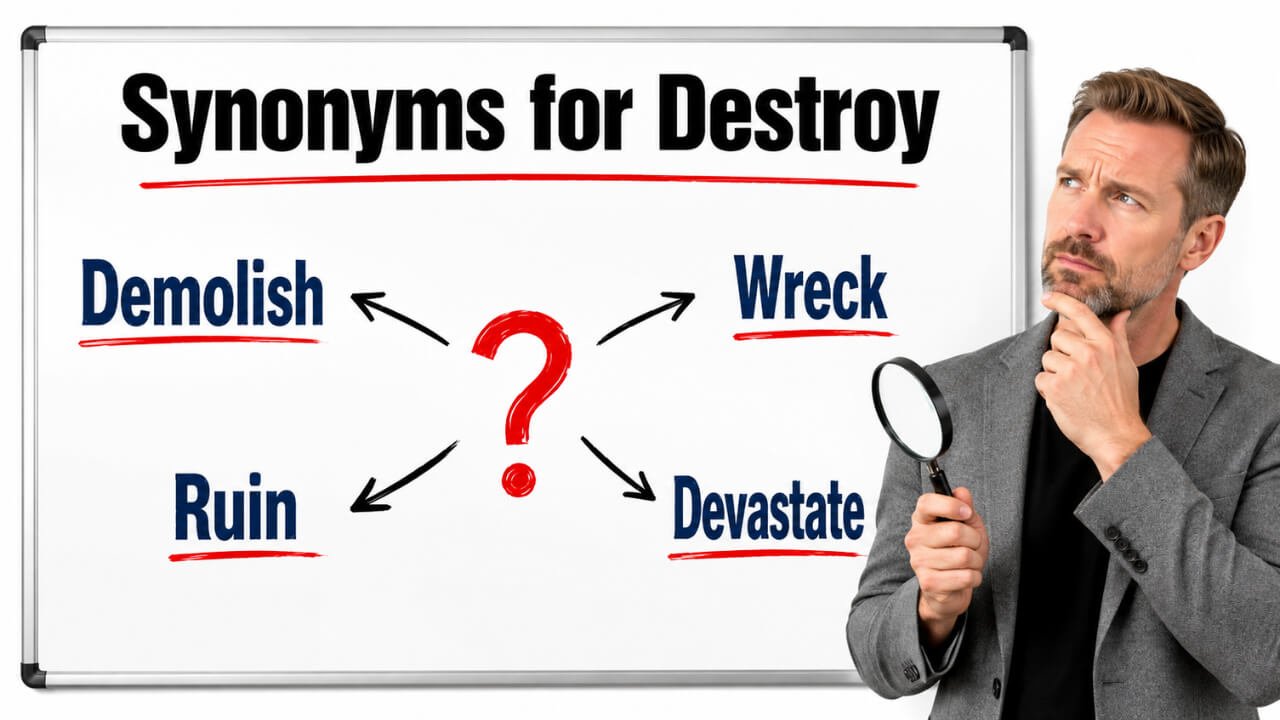
Quick Answer: The best synonyms for destroy are demolish, ruin, wreck, devastate, annihilate, obliterate, eradicate, dismantle, crush, and shatter. The keyword synonyms for destroy covers physical damage, complete removal, emotional harm, failure, and loss. Use demolish for buildings, ruin for plans or experiences, devastate for severe physical or emotional harm, eradicate for diseases or problems, dismantle for systems, annihilate for complete defeat, and shatter for objects, hopes, or confidence.
Pronunciation and Word Details
Word: Destroy
Pronunciation: /dɪˈstrɔɪ/
Part of Speech: Verb
Meaning: To damage something so severely that it no longer exists, works, or remains useful.
US Pronunciation:
UK Pronunciation:
What Does “Destroy” Mean?
Destroy means to damage, eliminate, or ruin something so completely that it cannot continue in its original condition. It is mainly used as a verb and can describe both physical and nonphysical harm.
A storm can destroy a house, fire can destroy important documents, and a serious mistake can destroy trust. The word can also describe emotional effects, such as destroying someone’s confidence or hope.
Destroy is usually followed by a direct object. The object identifies the person, place, object, system, feeling, or idea that is seriously damaged.
Physical Context: The earthquake destroyed several buildings.
Emotional Context: The harsh criticism destroyed his confidence.
Abstract Context: Dishonesty can destroy trust within a team.
Technical Context: The harmful program destroyed the stored data.
The word often suggests a final or extremely serious result. However, the exact meaning depends on what is being destroyed and whether the damage is physical, emotional, social, or functional.
Meaning, Tone, and Context of “Destroy”
Destroy is a strong and generally neutral verb. It is neither especially formal nor especially casual, so it appears naturally in conversation, essays, reports, stories, instructions, and news style writing.
Its tone becomes emotional when it refers to personal loss, confidence, relationships, dreams, or communities. For example, saying that an event destroyed a family’s home creates a serious and emotional image.
In formal or technical writing, destroy may describe the complete removal of data, organisms, materials, or harmful substances. More precise synonyms such as eradicate, eliminate, dismantle, or incinerate may be better when the method or result matters.
In casual speech, destroy can be exaggerated. Someone may say that a difficult test destroyed them even though no literal destruction occurred. In this use, the word means that something caused exhaustion, defeat, embarrassment, or emotional stress.
Neutral Use: The machine destroyed the defective materials.
Emotional Use: The unexpected loss destroyed her sense of security.
Formal Use: The treatment is designed to destroy harmful cells.
Figurative Use: One careless statement destroyed his reputation.
Exaggerated Use: That long workout destroyed me.
When and How to Use “Destroy”
Use destroy when something experiences severe damage, complete loss, permanent failure, or total removal. The word can be used literally or figuratively.
For Physical Damage: Use destroy when an object, building, vehicle, or natural area is damaged beyond repair.
Example: The powerful storm destroyed several coastal homes.
For Complete Removal: Use destroy when something is eliminated so thoroughly that it no longer remains.
Example: The process destroys harmful bacteria in the water.
For Emotional Harm: Use destroy when an experience severely affects confidence, hope, trust, or emotional stability.
Example: Repeated rejection nearly destroyed his confidence.
For Plans and Opportunities: Use destroy when an action or event causes a plan, goal, or opportunity to fail completely.
Example: The unexpected delay destroyed their travel plans.
For Systems and Organizations: Use destroy when a system, structure, or organization becomes unable to function.
Example: Years of poor management destroyed the organization.
For Reputation: Use destroy when someone loses respect, credibility, or public trust.
Example: The false statement could destroy her professional reputation.
For Competition: Use destroy informally when one person or team defeats another by a large amount.
Example: Their strongest player destroyed the competition.
For Data and Records: Use destroy when information is erased, corrupted, burned, shredded, or made permanently unavailable.
Example: The damaged device destroyed several important files.
Best Synonyms for Destroy
Demolish
Synonym: To completely tear down a building or physical structure.
Example: The workers will demolish the abandoned factory next month.
Ruin
Synonym: To damage something so badly that its value, quality, success, or enjoyment is lost.
Example: Heavy rain ruined the outdoor celebration.
Wreck
Synonym: To severely damage an object, vehicle, plan, or situation.
Example: The collision wrecked the front of the car.
Devastate
Synonym: To cause extreme physical destruction or emotional suffering.
Example: The flood devastated the entire farming community.
Annihilate
Synonym: To destroy something completely or defeat it with overwhelming force.
Example: The powerful attack annihilated the enemy’s defenses.
Obliterate
Synonym: To remove or destroy every visible trace of something.
Example: The explosion obliterated the small storage building.
Eradicate
Synonym: To completely remove a disease, problem, habit, or harmful condition.
Example: The program aims to eradicate the infection from the region.
Dismantle
Synonym: To take something apart or gradually remove its structure and power.
Example: Investigators worked to dismantle the illegal network.
Crush
Synonym: To press, defeat, or damage something with great force.
Example: The falling rocks crushed the empty vehicle.
Shatter
Synonym: To break something into many pieces or seriously damage hope, confidence, or peace.
Example: The disappointing result shattered her hopes of qualifying.
50 Synonyms for Destroy with Short Meanings
- Demolish: To tear down a building or structure completely.
- Ruin: To damage the value, quality, success, or enjoyment of something.
- Wreck: To cause severe physical or practical damage.
- Devastate: To cause extreme destruction or emotional pain.
- Annihilate: To destroy or defeat something completely.
- Obliterate: To remove every trace of something.
- Eliminate: To completely remove something unwanted.
- Eradicate: To remove a problem, disease, or harmful condition completely.
- Crush: To damage, press, or defeat with great force.
- Shatter: To break into pieces or destroy confidence and hope.
- Smash: To break something violently into smaller parts.
- Break: To damage something so that it no longer works properly.
- Dismantle: To take apart or remove the structure of something.
- Raze: To completely destroy a building or area.
- Level: To knock a structure down to the ground.
- Flatten: To press or knock something into a flat condition.
- Tear Down: To pull apart or completely remove a structure.
- Wipe Out: To completely destroy, eliminate, or defeat.
- Extinguish: To put out a fire or bring something to an end.
- Exterminate: To kill or remove an entire group of harmful organisms.
- Decimate: To destroy or severely reduce a large part of something.
- Ravage: To cause widespread and violent damage.
- Spoil: To reduce the quality, success, or enjoyment of something.
- Damage: To harm something physically or functionally.
- Impair: To weaken the quality, ability, or function of something.
- Cripple: To seriously weaken or limit the operation of something.
- Undermine: To gradually weaken support, strength, authority, or confidence.
- Sabotage: To deliberately damage a plan, system, or effort.
- Disrupt: To interrupt normal activity or prevent smooth operation.
- Dissolve: To break apart, end, or cause something to disappear.
- Disintegrate: To break into small parts or lose structural unity.
- Decompose: To break down naturally into simpler materials.
- Consume: To use up or destroy something completely.
- Burn: To damage or destroy something with fire.
- Incinerate: To burn something until little or nothing remains.
- Vaporize: To turn something into vapor through intense heat or force.
- Blast: To damage or break apart with an explosion or powerful force.
- Explode: To burst violently and cause serious destruction.
- Sink: To cause a boat or floating object to go below the water.
- Scuttle: To deliberately sink a ship or cause a plan to fail.
- Kill: To end the life, activity, success, or effectiveness of something.
- Defeat: To overcome an opponent or cause an effort to fail.
- Overpower: To defeat someone or something using greater strength.
- Subdue: To bring someone or something under control by force.
- Nullify: To make an action, agreement, or result legally ineffective.
- Cancel: To stop a planned event, arrangement, or process.
- Invalidate: To make an argument, document, or result no longer valid.
- Erase: To remove writing, information, memory, or evidence.
- Remove: To take something away from its place or position.
- Abolish: To officially end a law, practice, or system.
Read Also:
Synonyms for Showing

Synonyms for Destroy by Context
When Destroy Means Damage a Physical Object
Demolish, smash, wreck, shatter, break, crush, flatten, and raze are useful when describing physical objects or structures.
Demolish and raze are especially appropriate for buildings. Smash and shatter suggest sudden force. Wreck often describes vehicles, machines, or objects that become unusable.
Example: The construction crew demolished the unsafe building.
Example: The heavy object smashed the glass table.
Example: The crash wrecked the delivery truck.
When Destroy Means Cause Widespread Damage
Devastate, ravage, decimate, ruin, and cripple describe serious damage affecting large areas, communities, industries, or systems.
Devastate can describe both physical and emotional effects. Ravage suggests violent or uncontrolled destruction. Cripple means that something still exists but cannot function effectively.
Example: The drought devastated farms across the region.
Example: The disease ravaged several rural communities.
Example: The shortage crippled local production.
When Destroy Means Remove Completely
Annihilate, obliterate, eradicate, eliminate, exterminate, wipe out, and extinguish suggest complete or nearly complete removal.
Eradicate is common for diseases, harmful practices, and social problems. Exterminate usually refers to pests or dangerous organisms. Obliterate emphasizes that no visible trace remains.
Example: The treatment helped eradicate the infection.
Example: The fire obliterated the paper records.
Example: The new controls eliminated unnecessary delays.
When Destroy Means Ruin Plans or Success
Ruin, sabotage, spoil, disrupt, defeat, cancel, and scuttle work well for plans, events, goals, opportunities, and organized efforts.
Sabotage suggests deliberate interference. Spoil means that something loses its quality or enjoyment. Scuttle often means deliberately causing a plan to fail.
Example: Poor preparation ruined their chances of success.
Example: Someone tried to sabotage the negotiations.
Example: The sudden resignation scuttled the agreement.
When Destroy Means Harm Confidence or Trust
Shatter, crush, undermine, ruin, devastate, and damage are useful for emotions, trust, hope, confidence, and reputation.
Shatter suggests sudden emotional loss. Undermine describes gradual weakening. Crush often communicates intense disappointment.
Example: The accusation shattered the trust between them.
Example: Constant criticism undermined his confidence.
Example: The final rejection crushed her hopes.
When Destroy Means End a System or Rule
Dismantle, abolish, dissolve, eliminate, invalidate, and nullify are useful for systems, organizations, laws, agreements, and formal arrangements.
Dismantle suggests removing separate parts of a system. Abolish means officially ending a law or practice. Nullify means making something legally ineffective.
Example: The reforms dismantled the outdated system.
Example: The new law abolished the restrictive practice.
Example: The court decision nullified the agreement.
Another Word for Destroy
Ruin is one of the most flexible replacements for destroy. It works naturally when talking about plans, experiences, opportunities, relationships, reputations, and physical objects. However, the best alternative depends on the exact context and the degree of damage.
Use demolish for buildings, shatter for glass or confidence, eradicate for diseases and problems, and dismantle for systems or organizations.
Original: The storm destroyed their weekend plans.
Better Option: The storm ruined their weekend plans.
Original: Workers destroyed the unsafe bridge.
Better Option: Workers demolished the unsafe bridge.
Original: The announcement destroyed her confidence.
Better Option: The announcement shattered her confidence.
Original: Officials are trying to destroy the harmful disease.
Better Option: Officials are trying to eradicate the harmful disease.
When Not to Use “Destroy”
Do not use destroy when the damage is minor, temporary, or easily repaired. The word often suggests complete or severe damage, so it can sound exaggerated when only a small problem occurred.
Weak: A small mark destroyed the desk.
Better: A small mark damaged the desk.
Avoid destroy when a more precise verb can explain exactly what happened.
Weak: The workers destroyed the old building.
Better: The workers demolished the old building.
Do not use destroy repeatedly within the same paragraph. Repetition can make the writing sound flat and reduce the emotional effect of the word.
Weak: The fire destroyed the house, destroyed the furniture, and destroyed the documents.
Better: The fire devastated the house, ruined the furniture, and burned the documents.
Avoid destroy when discussing a gradual reduction rather than complete loss.
Weak: Poor communication destroyed employee confidence over several years.
Better: Poor communication gradually undermined employee confidence.
Do not use an extremely strong synonym when the situation is ordinary or limited.
Weak: The delayed bus annihilated our schedule.
Better: The delayed bus disrupted our schedule.
Words Commonly Confused With Destroy
Destroy vs Damage: Destroy usually suggests complete or severe harm. Damage means harm has occurred, but the object may still exist or function.
Destroy vs Demolish: Destroy is broad and works in many contexts. Demolish usually refers to intentionally tearing down a building or structure.
Destroy vs Ruin: Destroy suggests severe damage or complete loss. Ruin often means making an experience, plan, appearance, or opportunity unsuccessful or unpleasant.
Destroy vs Devastate: Destroy focuses on the result of damage. Devastate emphasizes extreme destruction or deep emotional pain.
Destroy vs Annihilate: Destroy can describe different levels of serious damage. Annihilate suggests complete destruction or overwhelming defeat.
Destroy vs Eradicate: Destroy can refer to objects, plans, feelings, or systems. Eradicate is mainly used for completely removing diseases, pests, harmful practices, or serious problems.
Destroy vs Dismantle: Destroy means causing something to stop existing or working. Dismantle means taking something apart physically or removing its structure gradually.
Destroy vs Shatter: Destroy is a general term. Shatter specifically means breaking into pieces or suddenly damaging confidence, hope, trust, or peace.
Which Synonym Should You Choose?
Choose demolish when writing about buildings, walls, bridges, or physical structures that are intentionally torn down.
Choose ruin when describing spoiled plans, failed experiences, damaged reputations, lost opportunities, or reduced quality.
Choose wreck when talking about vehicles, machines, relationships, plans, or situations that are badly damaged.
Choose devastate when the destruction is widespread or when someone experiences deep emotional pain.
Choose annihilate when something is completely destroyed or an opponent is defeated by an overwhelming amount.
Choose obliterate when every visible trace of an object, mark, structure, or memory is removed.
Choose eradicate in formal, academic, medical, or social writing about removing a disease, harmful habit, pest, or serious problem.
Choose dismantle when describing the removal of a system, organization, machine, network, or power structure.
Choose shatter when glass breaks into pieces or when hope, trust, peace, or confidence is suddenly lost.
Choose undermine when strength, authority, trust, or confidence weakens gradually.
Choose sabotage when a person deliberately damages a plan, project, system, or effort.
Choose disrupt when an event interrupts normal activity without completely ending it.
Choose damage when the harm is limited and the object may still be repaired.
Choose abolish when a government, institution, or authority officially ends a law, rule, custom, or practice.
Choose nullify or invalidate in reports, legal writing, agreements, policies, and formal discussions about making something ineffective or invalid.
Real Life Examples of “Destroy” in Sentences
Original: The fire destroyed the old warehouse.
Better Option: The fire incinerated the old warehouse.
Original: Heavy rain destroyed our picnic plans.
Better Option: Heavy rain ruined our picnic plans.
Original: The workers destroyed the damaged building.
Better Option: The workers demolished the damaged building.
Original: The false accusation destroyed his reputation.
Better Option: The false accusation ruined his reputation.
Original: The earthquake destroyed several villages.
Better Option: The earthquake devastated several villages.
Original: The final decision destroyed her confidence.
Better Option: The final decision shattered her confidence.
Original: The treatment destroys harmful bacteria.
Better Option: The treatment eliminates harmful bacteria.
Original: Investigators destroyed the criminal network.
Better Option: Investigators dismantled the criminal network.
Original: Poor planning destroyed the entire project.
Better Option: Poor planning sabotaged the entire project.
Original: The powerful team destroyed its opponent.
Better Option: The powerful team annihilated its opponent.
Synonym Groups and Usage Differences
Physical Destruction Group
Demolish, raze, flatten, smash, crush, shatter, wreck, and break describe physical damage. The best choice depends on the object and the type of force involved.
Demolish and raze suit buildings. Shatter suits glass and fragile materials. Crush suggests pressure, while smash suggests a violent impact.
Example: The impact shattered the window and crushed the metal frame.
Complete Removal Group
Annihilate, obliterate, eradicate, eliminate, exterminate, and wipe out describe complete or nearly complete removal.
Annihilate and obliterate are extremely strong. Eradicate and eliminate are more suitable for formal writing about diseases, problems, risks, or harmful conditions.
Example: The health campaign aims to eradicate the disease.
Severe Damage Group
Devastate, ravage, decimate, cripple, ruin, and wreck suggest extensive damage without always meaning that everything has disappeared.
Devastate often carries emotional weight. Ravage describes uncontrolled widespread harm. Cripple means that normal operation becomes extremely difficult.
Example: The long drought crippled agriculture and devastated local communities.
Emotional Harm Group
Shatter, crush, devastate, undermine, damage, and ruin describe harm to confidence, hope, trust, peace, or emotional strength.
Shatter and crush suggest a powerful immediate effect. Undermine usually describes slow and repeated weakening.
Example: Repeated criticism gradually undermined her confidence.
Plans and Success Group
Ruin, sabotage, spoil, disrupt, scuttle, cancel, and defeat describe failed plans, goals, opportunities, events, and efforts.
Sabotage suggests intention. Disrupt usually means interruption rather than complete failure. Ruin and scuttle suggest that success is no longer possible.
Example: A lack of funding scuttled the expansion plan.
Systems and Authority Group
Dismantle, abolish, dissolve, eliminate, nullify, and invalidate relate to systems, organizations, laws, agreements, and official structures.
Dismantle means removing connected parts. Abolish means officially ending a practice. Nullify and invalidate mean removing legal or formal effectiveness.
Example: The reform was created to dismantle the outdated system.
Fire and Heat Group
Burn, incinerate, consume, and vaporize describe destruction caused by fire, heat, or intense energy.
Burn is the broadest word. Incinerate means burning something almost completely. Vaporize suggests such intense heat or force that a substance becomes vapor.
Example: The intense fire consumed the wooden structure.
Antonyms of Destroy
The opposite of destroy depends on whether the context involves building, protecting, repairing, improving, saving, or maintaining something.
Create: To bring something new into existence.
Build: To make a structure by joining materials or parts.
Construct: To form a building, system, argument, or object carefully.
Repair: To fix something that is damaged or broken.
Restore: To return something to an earlier or better condition.
Rebuild: To build something again after severe damage.
Preserve: To protect something from harm, loss, or decay.
Protect: To keep someone or something safe from damage.
Save: To prevent loss, destruction, failure, or danger.
Maintain: To keep something in good working condition.
Strengthen: To make something more powerful, stable, or effective.
Improve: To make something better in quality, condition, or performance.
Develop: To help something grow, progress, or become more advanced.
Support: To help something remain stable, successful, or effective.
Revive: To bring something back to activity, strength, or popularity.
Comparison: Destroy vs Related Words
Destroy vs Demolish
Destroy is a broad verb that can apply to buildings, objects, hopes, plans, trust, systems, and reputations. Demolish usually refers to intentionally tearing down a physical structure.
Example With Destroy: The storm destroyed homes throughout the valley.
Example With Demolish: The city will demolish the unsafe apartment building.
Destroy vs Ruin
Destroy suggests complete or severe damage. Ruin often describes loss of value, quality, enjoyment, beauty, success, or opportunity.
Example With Destroy: The fire destroyed the paper records.
Example With Ruin: The spilled paint ruined the carpet.
Destroy vs Damage
Destroy describes very serious or complete harm. Damage describes partial harm that may be repaired.
Example With Destroy: The explosion destroyed the vehicle.
Example With Damage: The falling branch damaged the vehicle’s roof.
Destroy vs Devastate
Destroy focuses on severe physical or functional loss. Devastate adds a sense of extreme scale, suffering, or emotional pain.
Example With Destroy: The fire destroyed several houses.
Example With Devastate: The fire devastated the small community.
Destroy vs Annihilate
Destroy can describe serious damage without always meaning total disappearance. Annihilate strongly suggests complete destruction or overwhelming defeat.
Example With Destroy: The attack destroyed several defensive positions.
Example With Annihilate: The final assault annihilated the remaining defenses.
Destroy vs Obliterate
Destroy means causing something to stop existing or functioning. Obliterate means removing every visible trace or memory of it.
Example With Destroy: The blast destroyed the storage room.
Example With Obliterate: The blast obliterated every trace of the storage room.
Destroy vs Eradicate
Destroy has a broad range of physical and figurative uses. Eradicate refers to completely removing a disease, pest, problem, belief, or harmful practice.
Example With Destroy: Heat can destroy harmful organisms.
Example With Eradicate: The treatment may eradicate the infection.
Destroy vs Dismantle
Destroy suggests a complete and often forceful result. Dismantle means taking something apart or removing its structure piece by piece.
Example With Destroy: The conflict destroyed the organization.
Example With Dismantle: Investigators helped dismantle the organization’s network.
Common Phrases and Expressions With “Destroy”
Destroy Completely: To cause total damage or removal.
Destroy Evidence: To remove or damage proof so that it cannot be examined.
Destroy a Building: To damage a structure beyond repair.
Destroy a Reputation: To cause someone to lose respect, trust, or credibility.
Destroy Confidence: To make someone lose belief in their abilities.
Destroy Hope: To remove a person’s expectation of a positive result.
Destroy Trust: To seriously damage belief in someone’s honesty or reliability.
Destroy a Relationship: To cause a personal or professional connection to fail.
Destroy the Environment: To cause severe harm to land, water, wildlife, or natural systems.
Destroy a Plan: To make an intended action impossible or unsuccessful.
Common Mistakes to Avoid
One common mistake is using destroy for minor damage. If something is scratched, weakened, or partly broken, damage may be more accurate.
Another mistake is choosing a synonym that does not match the object. Buildings are demolished, diseases are eradicated, glass is shattered, systems are dismantled, and plans are ruined or sabotaged.
Avoid repeating destroy several times in a short passage. Use precise alternatives to make the writing clearer and more natural.
Do not assume that strong synonyms are always interchangeable. Annihilate and obliterate are much more forceful than damage or disrupt. Using them for small problems can make a sentence sound exaggerated.
Be careful with figurative language. Destroy confidence is natural, but demolish confidence usually sounds unnatural. Shatter, crush, damage, or undermine are better choices.
Decimate is sometimes used to mean almost completely destroy, but it usually suggests a large reduction rather than total elimination. Use annihilate or wipe out when complete destruction is intended.
Use the correct verb form after helping verbs and infinitive markers.
Incorrect: The fire will destroyed the structure.
Correct: The fire will destroy the structure.
Use destroyed for completed actions in the past.
Incorrect: The storm destroy several homes yesterday.
Correct: The storm destroyed several homes yesterday.
Conclusion
Understanding synonyms for destroy helps writers describe different kinds and degrees of damage more accurately. Use demolish for structures, ruin for plans and experiences, devastate for widespread or emotional harm, and shatter for glass, confidence, or hope. Eradicate fits diseases and serious problems, while dismantle works for systems and organizations. Stronger choices such as annihilate and obliterate suggest complete destruction. Choosing a word that matches the object, method, and result will make every sentence clearer and more effective.
FAQs About Synonyms for Destroy
What Is the Best Synonym for Destroy?
Ruin is a flexible general synonym, but the best replacement depends on context. Demolish suits buildings, eradicate suits diseases, and shatter suits glass or confidence.
What Is a Stronger Word Than Destroy?
Annihilate and obliterate are stronger than destroy because they suggest complete removal, overwhelming defeat, or the absence of any remaining trace.
What Is a Formal Synonym for Destroy?
Eliminate, eradicate, dismantle, invalidate, and abolish are formal alternatives. The correct choice depends on whether the sentence refers to a problem, system, agreement, or practice.
What Is Another Word for Destroying a Building?
Demolish and raze are the most accurate choices. Demolish is common for planned construction work, while raze emphasizes complete destruction down to the ground.
What Is Another Word for Destroying Confidence?
Shatter, crush, damage, and undermine can describe harm to confidence. Shatter and crush suggest sudden harm, while undermine suggests gradual weakening.
What Is the Difference Between Destroy and Damage?
Destroy means causing severe or complete harm. Damage means causing partial harm, and the affected object may still work or be repaired.
Can Destroy Be Used Figuratively?
Yes. Destroy can describe serious harm to trust, confidence, relationships, plans, reputations, opportunities, and emotional well being.
